What Is Narrative Writing?
Taught in US schools
Key Takeaways
- Narrative writing tells a story - it has characters, a setting, a problem, and a solution.
- Personal narratives are true stories from the writer's own life; fiction is invented.
- Strong narratives use specific details, dialogue, and sensory language - not just plot summary.
- Show, don't tell: 'Her hands shook' is more powerful than 'She was nervous.'
What Is Narrative Writing?
Narrative writing tells a story. It can be:
-
Personal narrative: A true story from the writer's own life, told in first person
-
Fiction: An invented story with imagined characters and events
Both types use the same story structure and craft techniques. Narrative writing is the most natural starting point for young writers - everyone has stories to tell.
Elements of a Strong Narrative
Characters: Who is in the story? What do they want, fear, and feel?
Setting: Where and when does the story happen? Vivid settings use sensory details.
Problem/Conflict: What challenge does the character face? Without a problem, there's no story.
Plot: The sequence of events. What happens, and in what order?
Resolution: How is the problem solved? How does the character change?
Voice: The writer's distinct personality coming through word choices and perspective.
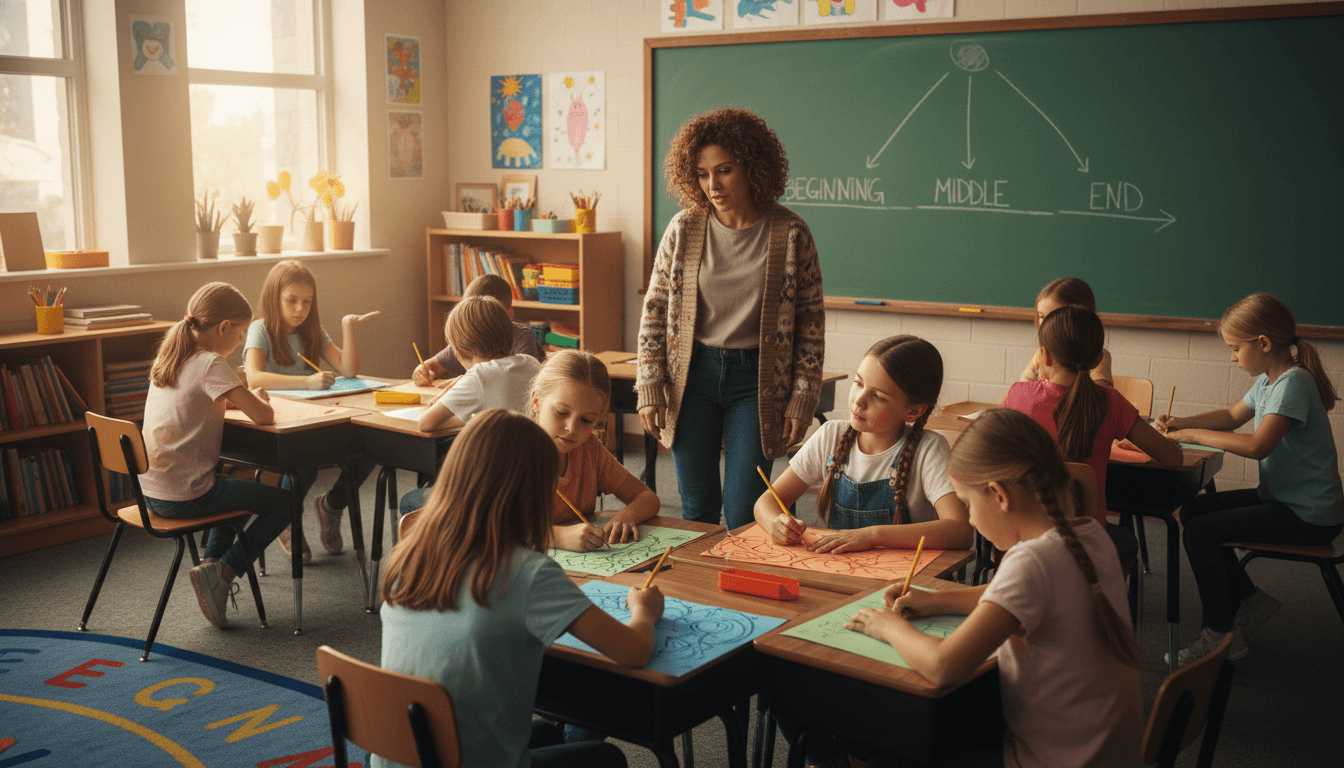
Story Structure
Beginning: Introduce characters, setting, and the problem
Middle:    Events that build tension as the character tries to solve the problem
End:       The resolution  -  how the problem is solved and what the character learns
Show, Don't Tell
The most important craft principle in narrative writing:
Telling: "She was nervous." Showing: "Her pencil tapped against the desk. She read the first question three times without moving."
Showing lets readers experience the emotion rather than just being told about it. It requires writers to think: what does this look and sound like from the outside?
Narrative Craft Techniques
Dialogue: Let characters speak - it reveals personality and advances plot.
"I can't do this," Marcus whispered, staring at the starting block.
Sensory details: Engage all five senses - sight, sound, smell, touch, taste.
The gym smelled of floor wax and sweat. The crowd noise became white noise in her ears.
Pacing: Slow down important moments (zoom in); speed through transitions (zoom out).
Strong leads: Hook the reader in the first sentence.
"The day I almost drowned started like any other summer day."
Endings that resonate: Reflect on what the experience meant - don't just stop at "and then I went home."
What Grade Do Kids Write Narratives?
K-1: Draw and write to tell about a real or imagined experience in sequence (W.K.3, W.1.3).
2nd Grade: Recount events in sequence with details and a sense of closure (W.2.3).
3rd Grade: Establish a situation, use dialogue and description, organize a logical sequence, provide a conclusion (W.3.3).
4th Grade: Use narrative techniques (dialogue, pacing, description); choose words and sensory language carefully (W.4.3).
5th Grade: Write with orientation and exposition; use all narrative techniques; provide a conclusion that follows from and reflects on the narrated experience (W.5.3).
Common Misconceptions
"More events = better narrative." Long summary narratives ("and then this happened, and then this happened") are weaker than one well-developed scene. Focus on fewer moments with more depth.
"Narrative writing is just about what happened." Craft matters as much as content. Two students can write about the same event - vivid detail, dialogue, and voice make one soar and one fall flat.
"The ending has to be happy." A reflective, honest ending ("I didn't win, but I learned that trying was enough") is often more powerful and authentic than a forced happy ending.
Practice Activities
-
Small moment writing: Zoom in on one specific, brief experience - not "my vacation" but "the first time I tried to waterski."
-
Show-don't-tell transformations: Give telling sentences ("He was excited"); students rewrite as showing.
-
Story mapping: Complete a graphic organizer (characters, setting, problem, events, resolution) before writing.
-
Dialogue practice: Take an existing narrative and add one exchange of dialogue that reveals character.
-
Strong leads workshop: Write three different opening sentences for the same story; share and vote on the most powerful hook.

Frequently Asked Questions
What is the difference between a personal narrative and fiction?
A personal narrative is a true story written from the author's own experience, told in first person (I). The events are real, the people are real, and the writer reflects on what the experience meant to them. Fiction is invented - the events, characters, and settings are made up, even if they're inspired by real life. Both use narrative structure (problem/solution, beginning/middle/end) and literary techniques (dialogue, description, pacing). Common Core writing standards address both types under W.K-5.3.
What are the key elements of narrative writing?
Characters: who is in the story, with specific traits and motivations. Setting: when and where the story takes place. Problem/Conflict: what challenge does the main character face? Plot: the sequence of events that leads to resolving the conflict. Resolution: how the problem is solved. Narrator's voice: the distinctive perspective and personality coming through the writing. Dialogue: what characters say - reveals personality and moves the plot. Sensory details: sights, sounds, smells, textures, tastes that make the reader feel present.
What does 'show, don't tell' mean?
Telling gives the reader a label: 'She was scared.' Showing gives evidence that creates the emotion in the reader's imagination: 'Her knees wouldn't stop shaking. She kept checking the door, then the window, then the door again.' Showing is more vivid, more engaging, and more believable. It requires the writer to think about what the emotion looks like from the outside - body language, actions, dialogue, thoughts - rather than simply naming the feeling. 'Show, don't tell' is the single most important craft principle in narrative writing.
How does narrative writing progress from kindergarten to 5th grade?
Kindergarten: Use drawing, dictating, or writing to narrate a single event with a reaction. 1st grade: Write a narrative about two or more events in sequence with details and an ending. 2nd grade: Recount events using transition words (first, then, next, finally); include details and a conclusion. 3rd grade: Establish a situation, introduce a narrator/characters, use dialogue and description, organize events logically, provide a conclusion. 4th grade: Use narrative techniques (dialogue, description, pacing); use concrete words and sensory language. 5th grade: Use techniques of professional writers; orient the reader well; reflect on what was learned.
What is a 'small moment' narrative?
A 'small moment' narrative focuses on one specific, brief event rather than a broad summary. Instead of 'Write about your summer vacation,' a small moment prompt would be 'Write about one specific thing that happened on your vacation.' Small moment writing produces more vivid, detailed narratives because the writer has room to slow down and develop a single scene. This approach, popularized by Lucy Calkins' Writer's Workshop, is widely used in elementary schools and directly teaches the craft of zooming in on detail.
Free Narrative Writing Worksheets
Curriculum-aligned printable worksheets for Kindergarten – 5th Grade. Download free.