What Is a Paragraph?
Taught in US schools
Key Takeaways
- A paragraph groups sentences about ONE main idea - never mix topics in one paragraph.
- Structure: topic sentence → supporting details → concluding or transition sentence.
- Indent or skip a line to signal a new paragraph - visual format matters.
- Paragraphs are the building blocks of all organized writing: essays, reports, opinion pieces.
What Is a Paragraph?
A paragraph is a group of related sentences that develop one main idea.
Paragraphs are the building blocks of all organized writing. Understanding how to construct a strong paragraph is the foundation for essays, reports, and any multi-paragraph writing.
Basic paragraph structure:
- Topic sentence - states the main idea
- Supporting details - facts, examples, reasons, evidence
- Concluding/transition sentence - wraps up or connects to the next paragraph
The Topic Sentence
The topic sentence announces the paragraph's main idea. It should be:
- Specific enough to control the paragraph's content
- Broad enough to allow for 2-3 supporting details
Weak: "Dogs are good pets." Strong: "Golden Retrievers make excellent family dogs because they are gentle, patient, and easy to train."
Every other sentence in the paragraph should support the topic sentence.
Supporting Details
Supporting sentences develop the main idea with:
-
Facts and statistics: "Studies show that Golden Retrievers rank among the top 3 most popular dog breeds in the US."
-
Examples: "Their patience makes them excellent with young children - even toddlers."
-
Reasons: "Because they're eager to please, they respond quickly to training commands."
-
Explanations: "This combination of traits makes them ideal for families of all sizes."
Details should be relevant - anything that doesn't relate to the topic sentence belongs in a different paragraph.
Concluding/Transition Sentence
Concluding: Restates the main idea or summarizes.
"For all these reasons, Golden Retrievers are one of the most beloved family dog breeds."
Transitional: Connects this paragraph to the next.
"While Golden Retrievers are valued for their gentle nature, Labrador Retrievers offer their own unique advantages."
Paragraph Formatting
-
Indent the first line of each new paragraph (about 5 spaces or one tab), OR
-
Skip a line between paragraphs (block format)
Both formats are correct. Consistency matters more than which format is used.
What Grade Do Kids Learn Paragraph Writing?
2nd Grade: Write opinion and informative pieces with a topic sentence and reasons/facts (W.2.1, W.2.2).
3rd Grade: Write paragraphs with a topic sentence, supporting details, and a concluding sentence; group related information (W.3.1, W.3.2).
4th Grade: Multi-paragraph essays with an introduction, body paragraphs, and conclusion; use precise language and linking words (W.4.1, W.4.2).
5th Grade: Multi-paragraph writing with clear organization; logically ordered reasons; effective paragraph transitions (W.5.1, W.5.2).
Common Misconceptions
"A paragraph must be 5 sentences." There's no magic number. A paragraph needs as many sentences as its main idea requires - no more, no less. In elementary school, 3-5 sentences is a practical guide, not a rule.
"Any group of sentences is a paragraph." Unity is the key - every sentence must relate to the paragraph's ONE main idea. A paragraph that shifts topics is really two paragraphs.
"The topic sentence must always be first." While the first-sentence position is most common in elementary school, topic sentences can appear at the end (for buildup) or be implied. Explicit first-sentence placement is taught first for clarity.
Practice Activities
-
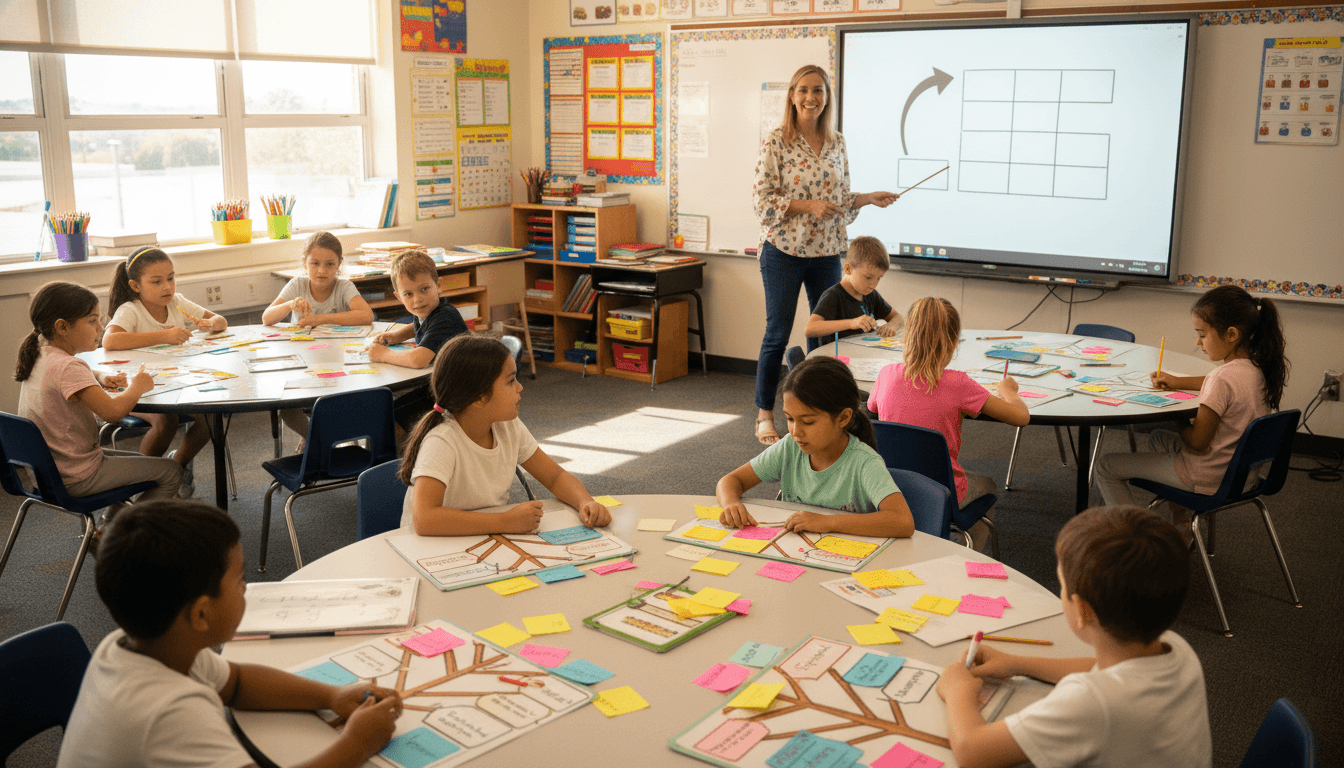
Hamburger graphic organizer: Top bun = topic sentence; meat/veggies = 2-3 supporting details; bottom bun = concluding sentence.
-
Broken paragraph sort: Jumbled sentences; students put them in logical order with the topic sentence first.
-
Off-topic sentence: Give a paragraph with one sentence that doesn't belong; students identify and remove it.
-
Expand a topic sentence: Give a topic sentence; students write 2-3 supporting details for it.
-
Paragraph from outline: Give a 3-point outline; students write the paragraph.

Frequently Asked Questions
What is a topic sentence?
A topic sentence states the main idea of the paragraph - it tells the reader what the paragraph will be about. It usually appears at the beginning of the paragraph and should be specific enough to control the content. A weak topic sentence: 'Dogs are interesting.' A strong topic sentence: 'Labrador Retrievers are popular family dogs because of their gentle temperament and trainability.' Every other sentence in the paragraph should support, explain, or give evidence for the topic sentence.
How many sentences should a paragraph have?
There is no fixed rule - a paragraph has as many sentences as needed to fully develop its main idea, and no more. In elementary school, a 3-5 sentence paragraph is a practical target. The structure: topic sentence + 2-3 supporting detail sentences + concluding or transition sentence. In advanced writing, paragraphs vary greatly in length. The key principle is unity: every sentence should relate to the paragraph's main idea. A one-sentence paragraph can be effective for emphasis; a ten-sentence paragraph is fine if all sentences belong.
What is the difference between a concluding sentence and a transition sentence?
A concluding sentence wraps up the paragraph's idea, often restating the topic sentence in different words or summarizing the key point. ('Clearly, Labrador Retrievers make excellent family companions.') A transition sentence ends the paragraph while connecting to the next one. ('Just as Labs are prized for their calm nature, Golden Retrievers share many of the same appealing qualities.') In multi-paragraph essays, transition sentences help paragraphs flow together. Both types are taught in 3rd-5th grade.
How do you organize a paragraph?
Several organizational patterns work: (1) General-to-specific: start with the main idea, then provide details and examples. (2) Specific-to-general: start with a striking example or detail, then state the main point. (3) Chronological: order details by time sequence (for narrative or process writing). (4) Order of importance: start with the most important point (or build up to it). The most common pattern in elementary school is general-to-specific (topic sentence first). More complex organizational patterns are introduced in 4th-5th grade.
How does paragraph writing connect to essay structure?
A five-paragraph essay is essentially a paragraph about paragraphs: introduction (topic sentence for the whole essay), body paragraphs (each with their own topic sentence supporting the essay's thesis), conclusion (wrapping up). Teaching paragraph structure in isolation first - in 2nd-3rd grade - gives students the building blocks. In 4th-5th grade, they combine these blocks into multi-paragraph essays. The micro-structure of a paragraph (topic sentence + details + conclusion) mirrors the macro-structure of an essay (introduction + body + conclusion).
Free Paragraph Worksheets
Curriculum-aligned printable worksheets for 2nd – 5th Grade. Download free.