What Is Capitalization?
Taught in US schools
Key Takeaways
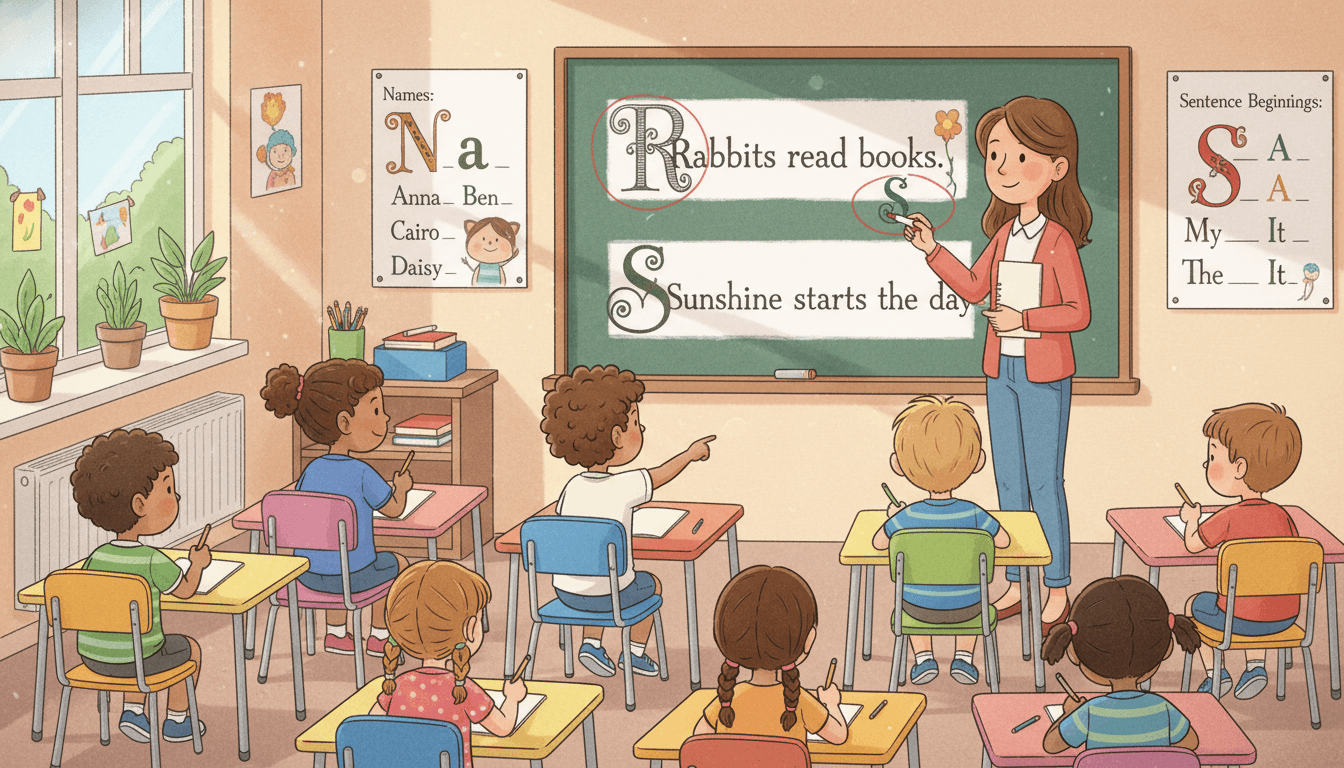
- Always capitalize: the first word of a sentence, the pronoun I, and proper nouns.
- Proper nouns are specific names: people, places, organizations, days, months, holidays.
- Common nouns are general and lowercase (city, school, month); proper nouns are specific and uppercase (Chicago, Lincoln Elementary, January).
- Titles of people are capitalized when used as a name (President Lincoln) but not when used generically (the president).
What Is Capitalization?
Capitalization means using uppercase (capital) letters at specific points in writing.
Capitalization signals:
- A new sentence is beginning
- A specific, unique name is being used (proper noun)
- The speaker is using the first-person pronoun I
It's one of the earliest conventions of print children learn - and one they continue refining through 4th grade.
What Is Always Capitalized?
1. First word of every sentence
The dog barked. She ran fast.
2. The pronoun I - always, anywhere in a sentence
"Jake and I went to the store."
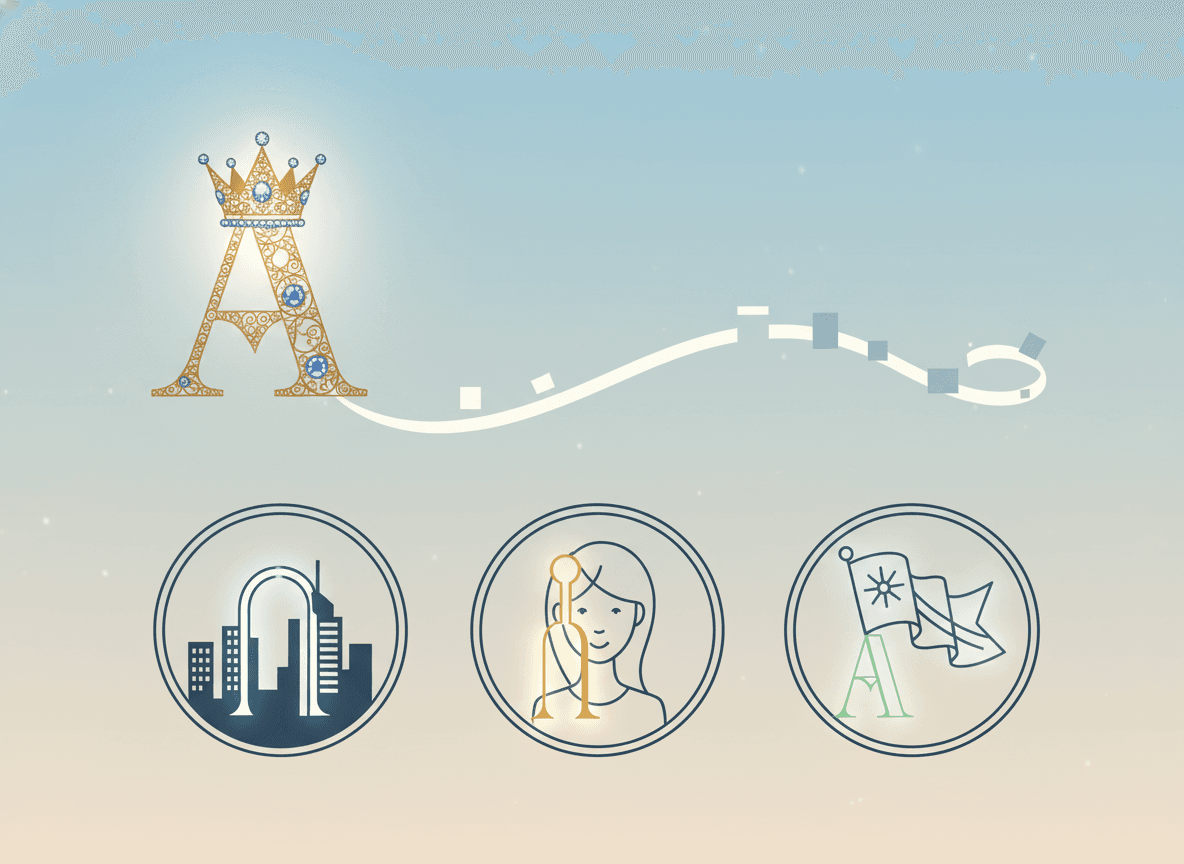
3. Proper nouns - specific names
- People: Emma, Dr. Chen, Uncle Marcus
- Places: Chicago, Lake Erie, Fifth Avenue
- Organizations: NASA, the United Nations
- Days and months: Monday, January (but NOT seasons: spring, fall)
- Holidays: Thanksgiving, Memorial Day
- Historical events: the American Revolution
- Languages and nationalities: Spanish, French, Australian
Proper Nouns vs. Common Nouns
city: Chicago
river: the Mississippi River
school: Lincoln Elementary
teacher: Mrs. Johnson
holiday: Thanksgiving
month: January Same word, different status: "My aunt is funny" vs. "I love Aunt Rosa."
Titles of People
Capitalize when used directly before a name or as a substitute for it:
President Lincoln, Dr. Kim, Grandma, Captain Torres
Don't capitalize when used generically:
"Abraham Lincoln was a president." / "My mom called." / "Ask the doctor."
Titles of Works
Capitalize the first and last words plus all major words (nouns, verbs, adjectives, adverbs). Do NOT capitalize short prepositions, articles, or conjunctions unless first or last.
Charlotte's Web / The Lion, the Witch and the Wardrobe / "Twinkle, Twinkle, Little Star"
What Grade Do Kids Learn Capitalization?
Kindergarten: Capitalize the first word in a sentence and the pronoun I (L.K.2a).
1st Grade: Capitalize dates and names of people (L.1.2a).
2nd Grade: Capitalize holidays, product names, and geographic names (L.2.2a).
3rd Grade: Capitalize appropriate words in titles (L.3.2a).
4th Grade: Use correct capitalization; know when to capitalize titles of people (L.4.2a).
Common Misconceptions
"Important words should be capitalized." Only proper nouns and the specific cases above are capitalized - not nouns that seem important.
"Seasons are capitalized." Seasons (spring, fall, winter, summer) are common nouns and are NOT capitalized unless they begin a sentence.
"My grandma" vs. "Grandma": When a family title replaces the person's name, it's capitalized ("I'll ask Grandma"). When used with a possessive, it's lowercase ("My grandma is here").
Practice Activities
-
Capitalization sort: Cards with words; students sort into "always capitalize" / "capitalize as proper noun" / "never capitalize."
-
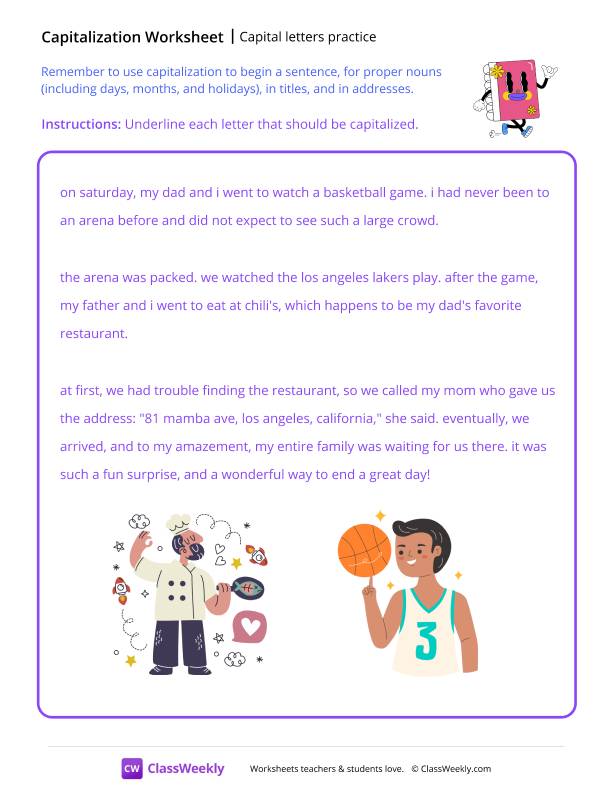
Proper noun hunt: In a paragraph, circle all words that should be capitalized and explain why.
-
Fix the capitalization: Passages with missing or extra capitals; students correct them.
-
Personal sentence revision: Students review their own writing for capitalization errors during editing.
-
Proper/common pairs: Give a common noun; students supply a proper noun example (city → Seattle; month → March).
Frequently Asked Questions
What is always capitalized in English?
Always capitalized: (1) The first word of every sentence. (2) The pronoun I (always, wherever it appears). (3) Proper nouns - specific names of people (Emma), places (Paris, Lake Michigan), organizations (NASA, Red Cross), days of the week (Monday), months (January), holidays (Thanksgiving), historical events (the American Revolution), languages (Spanish), nationalities (French), and brand names. (4) The first word of a direct quotation. (5) Titles of works (books, movies, songs) - typically all major words are capitalized.
What is the difference between proper and common nouns for capitalization?
Common nouns name general categories: city, river, school, teacher, president, holiday. They are NOT capitalized (unless beginning a sentence). Proper nouns name specific things: Chicago, the Mississippi River, Lincoln Elementary School, Ms. Johnson, President Lincoln, Thanksgiving. They ARE always capitalized. The same word can be common or proper depending on use: 'My uncle is kind' (uncle = common noun) vs. 'I visited Uncle Tom' (Uncle Tom = proper noun used as a name).
When are titles of people capitalized?
Capitalize a title when it is used directly before a name (as part of the name) or as a substitute for the name: President Lincoln, Dr. Smith, Grandma, Captain Rivera. Do NOT capitalize when the title is used generically after a name or with an article: 'Abraham Lincoln was a president,' 'my mom,' 'the doctor said.' This distinction - formal title before name vs. generic reference - is addressed in 4th grade and is a common source of errors.
How are titles of books, movies, and songs capitalized?
The standard rule for title capitalization: capitalize the first and last words, and all major words (nouns, verbs, adjectives, adverbs). Do NOT capitalize short conjunctions (and, but, or), prepositions (of, in, at), or articles (a, an, the) - UNLESS they're the first or last word. Examples: Charlotte's Web, The Lion, the Witch and the Wardrobe, Of Mice and Men. Note: song and poem titles get quotation marks; book and movie titles get italics or underlining.
What capitalization errors do elementary students commonly make?
Most common errors: (1) Capitalizing random nouns (treating all nouns as proper). (2) Not capitalizing proper nouns (months, days, names of specific places). (3) Inconsistently capitalizing I. (4) Mid-sentence capitals for emphasis (I want a Really Big ice cream). (5) Over-capitalizing titles (not knowing which words in a title are 'major'). Proofreading for capitalization as a separate step - going line by line looking only at capital letters - helps students catch these errors during editing.
Free Capitalization Worksheets
Curriculum-aligned printable worksheets for Kindergarten – 4th Grade. Download free.