What Is a Noun?
Taught in US schools
Key Takeaways
- A noun names a person, place, thing, or idea.
- Common nouns are general (dog, city, teacher). Proper nouns are specific names (Fido, Chicago, Ms. Johnson) and are always capitalized.
- Nouns can be singular (one) or plural (more than one). Most plurals add -s or -es.
- Abstract nouns name ideas you can't see or touch (love, freedom, courage).
Nouns are the building blocks of language. Before kids can write a complete sentence, they need nouns. Before they can understand pronouns, adjectives, or subject-verb agreement, they need a solid grasp of what nouns are. Fortunately, nouns are one of the most accessible grammar concepts for young learners - "naming words" is a description kids get immediately.
What Is a Noun?
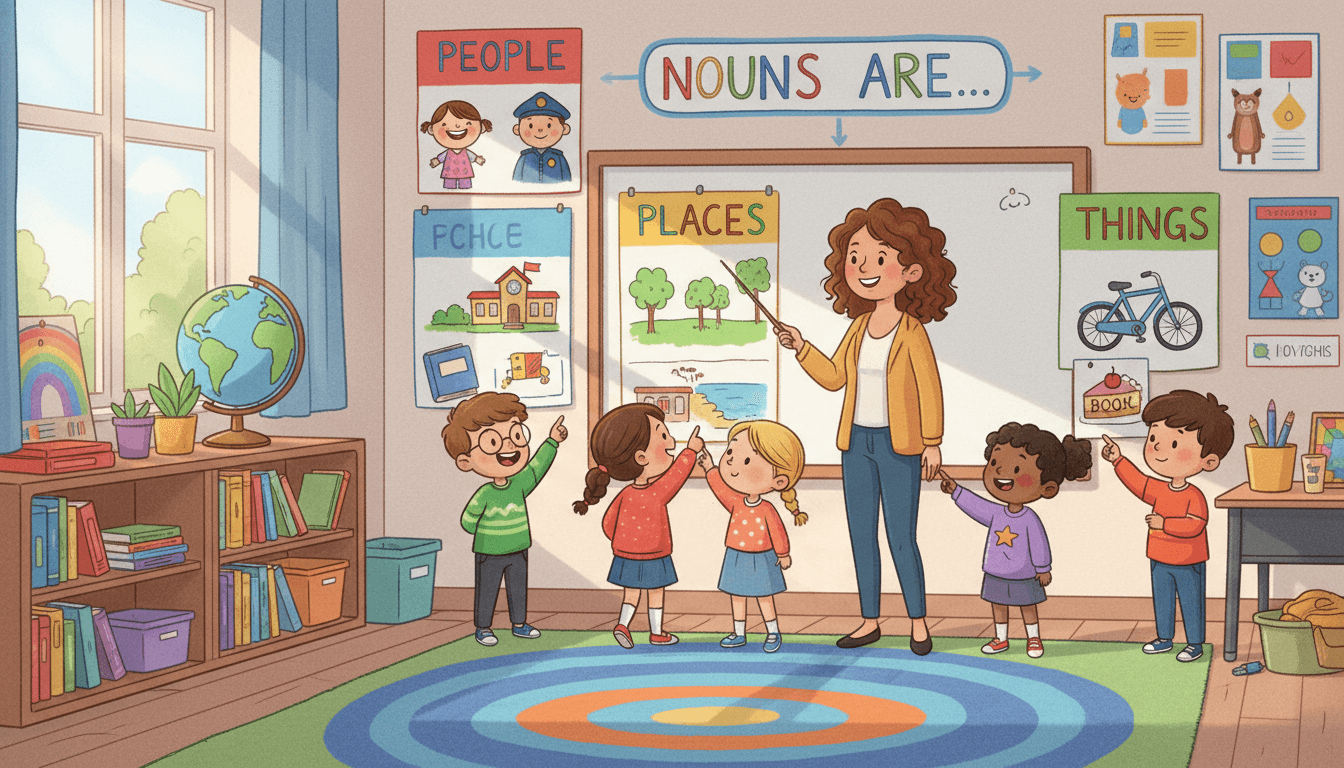
A noun is a word that names a person, place, thing, or idea.
-
Person: teacher, mother, scientist, Maria, Dr. Chen
-
Place: school, park, kitchen, Texas, the Moon
-
Thing: pencil, dog, tree, thunder, pizza
-
Idea: happiness, freedom, courage, love, justice
If you can put "a," "an," or "the" in front of a word and it makes sense, it's almost certainly a noun. (A dog, the park, an idea - all nouns. A quickly? Not a noun.)
Types of Nouns
Common nouns name general categories: dog, city, teacher, park. They are not capitalized unless they start a sentence.
Proper nouns name specific, one-of-a-kind things: Spot, Chicago, Ms. Johnson, the Eiffel Tower. Proper nouns are always capitalized.
Concrete nouns name things you can physically experience with your senses: apple, thunder, perfume, carpet. You can see, hear, smell, taste, or touch them.
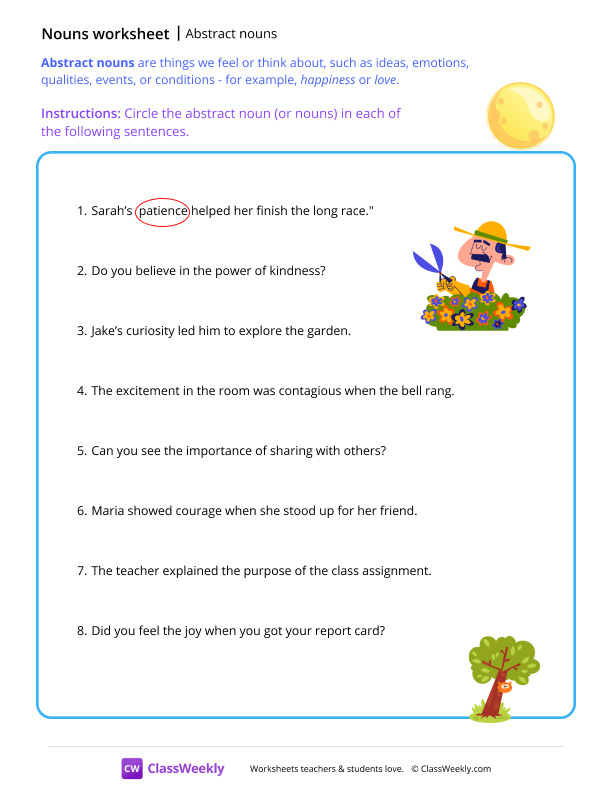
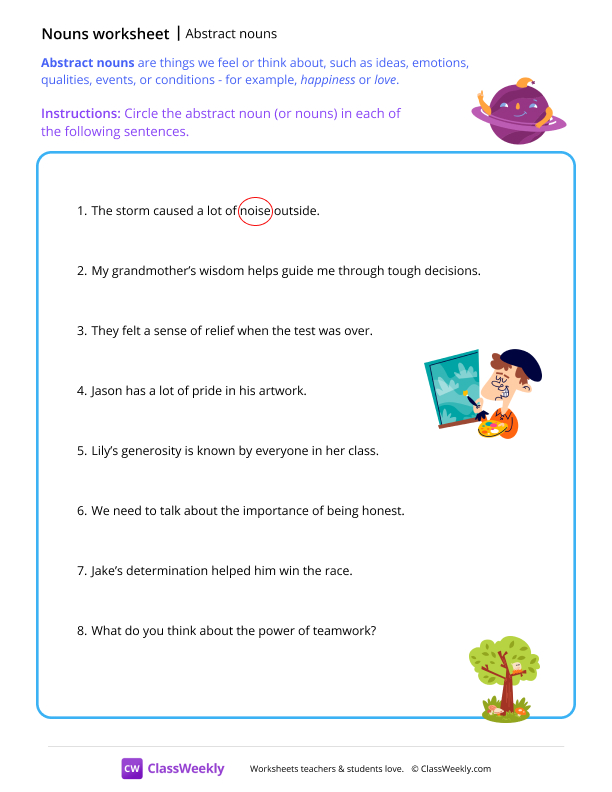
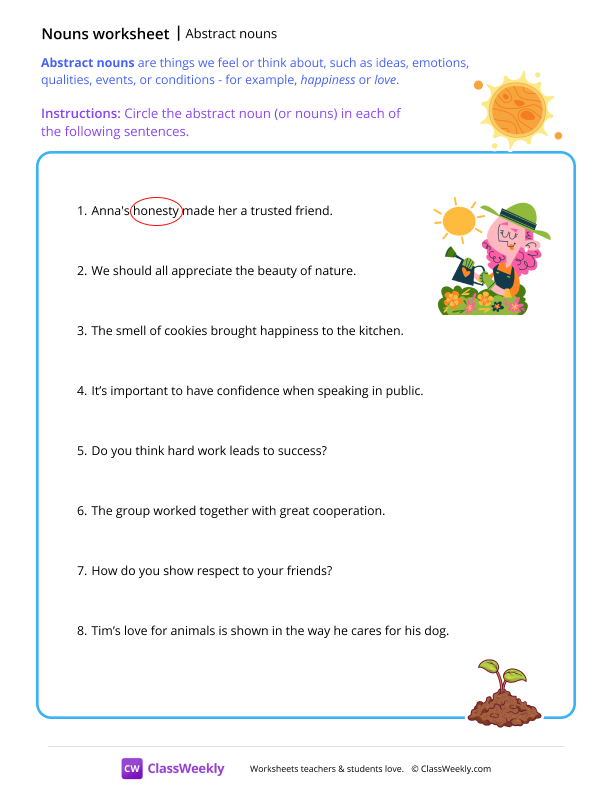
Abstract nouns name ideas, feelings, and concepts you can't physically sense: love, bravery, democracy, time, anger. These are harder for young kids to categorize and are introduced more gradually in 2nd-3rd grade.
Collective nouns name a group as a single unit: a team of players, a flock of birds, a class of students, a pack of wolves.
Compound nouns are two or more words that function as one noun: toothbrush, birthday, swimming pool, mother-in-law.
What Grade Do Kids Learn About Nouns?
Kindergarten: Understanding that nouns are naming words. Sorting words into "names things" vs. "tells what things do." Beginning to identify nouns in simple sentences.
1st Grade: Distinguishing between common and proper nouns. Learning capitalization rules for proper nouns. Forming regular plural nouns (dog → dogs, bush → bushes).
2nd Grade: Collective nouns, irregular plural nouns (mouse → mice, foot → feet). Understanding that nouns can serve different functions in a sentence (subject, object).
3rd Grade: Abstract nouns. Expanding knowledge of irregular plurals. Using nouns in more complex sentence structures.
Why Nouns Matter
Nouns anchor sentences. Every sentence needs a subject - something that performs the action or is being described - and that subject is almost always a noun or pronoun. Without nouns, sentences can't exist.
For writing, a strong noun vocabulary means more precise, vivid writing. Compare "The thing walked into the place" vs. "The golden retriever bounded into the sunlit meadow." Both have a noun as subject. One is vague, one is specific. Expanding noun vocabulary directly improves writing quality.
Common Misconceptions
"Any word that names something is a noun." Verbs used as subjects can look like nouns (Running is fun - here "running" is acting as a noun), but this is a gerund, not a typical noun. This is a 5th grade+ concept; for K-3, keep the definition clear and concrete.
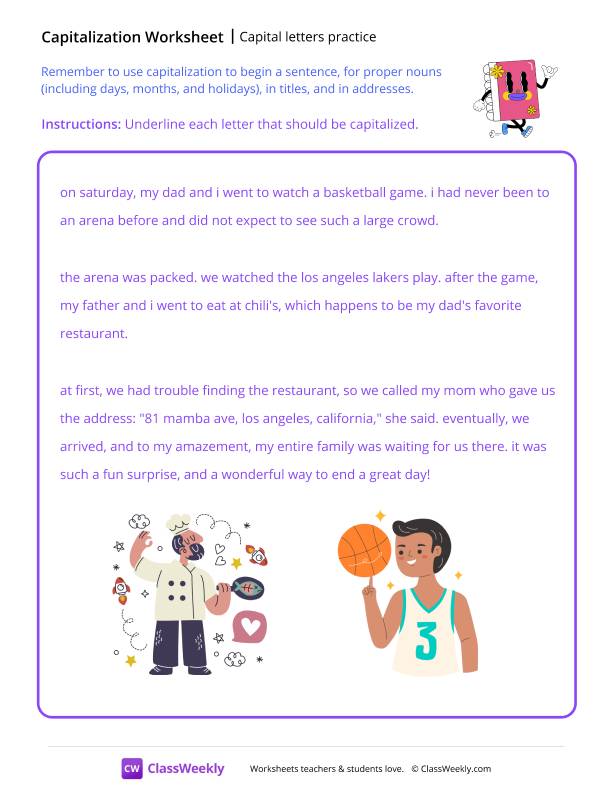
"Proper nouns are just names of people." Kids learn early that people's names are capitalized, but proper nouns extend to places, months, days of the week, holidays, book and movie titles, organizations, and brand names. These need ongoing examples.
"Plural always means adding -s." Irregular plurals (child/children, tooth/teeth, goose/geese, person/people) trip kids up constantly. These require explicit instruction and repeated exposure, not pattern application.
"Abstract nouns aren't real nouns." Young kids sometimes resist classifying love or fear as nouns because they can't point to them. Helping kids see that we can say "a fear" or "the love" - that the noun test still works - makes abstract nouns more accessible.
How to Teach Nouns
Start with concrete examples, always. Begin with objects in the classroom. Everything has a noun name. Sit on it, pick it up, point at it. Concrete nouns are the foundation.
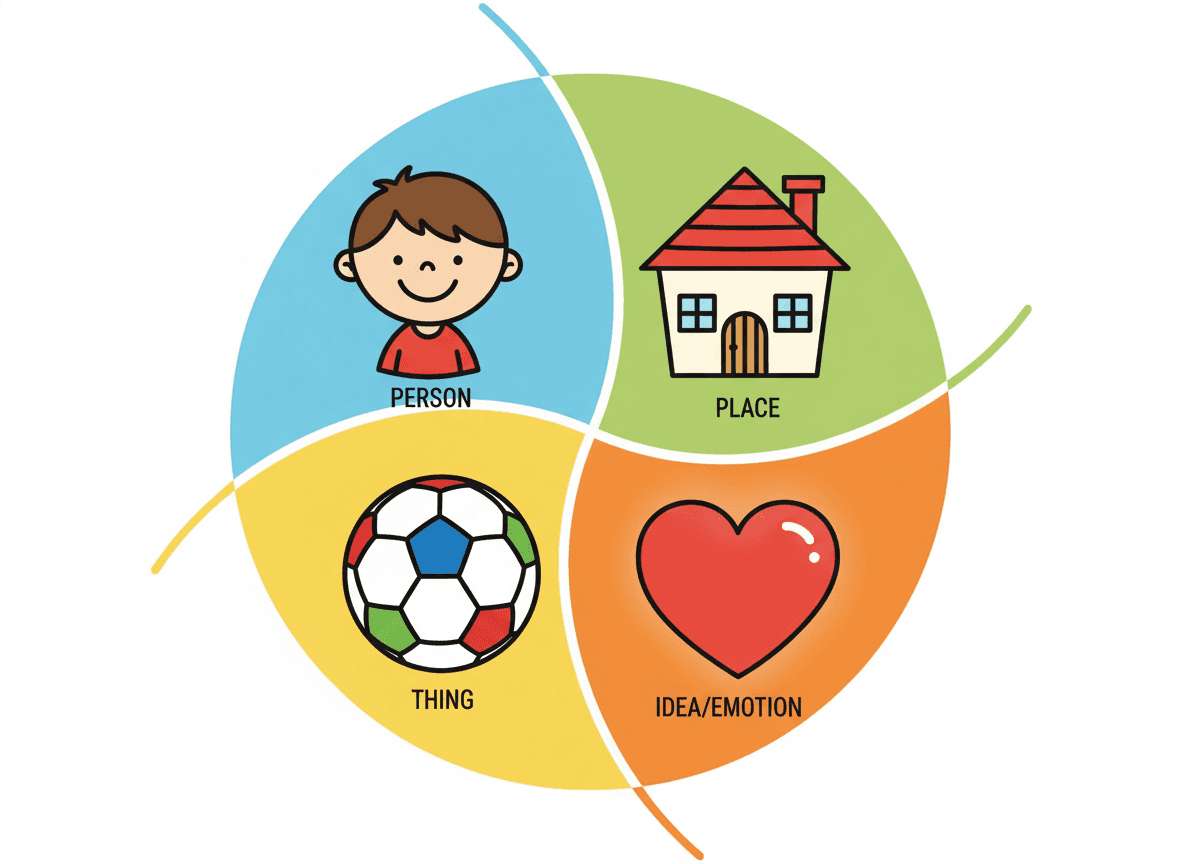
Sort into the four categories. Person, place, thing, idea - use a four-column chart and have kids sort words or cut pictures. The sorting process builds the concept.
Introduce proper nouns with the capitalization rule. The rule and the concept together, from the start. "Proper nouns are special names, and we show they're special by capitalizing them."
Use noun hunts. Read a short passage and highlight every noun. Young kids love this, and it embeds the concept in authentic text.
Build to irregular plurals gradually. Introduce irregular plurals a few at a time with lots of practice before adding more. Group related ones together (foot/feet, tooth/teeth, goose/geese - all vowel-change plurals).
Practice Activities
-
Classroom noun walk: Walk around the room pointing at and naming objects. Every name is a noun. Write a class list of 20+ classroom nouns.
-
Person-Place-Thing-Idea sort: Word cards sorted into four columns. Promotes flexible categorical thinking.
-
Proper noun spotlight: Each day, find 3 proper nouns in a shared text. Practice capitalizing them in writing.
-
Plural practice: A deck of picture cards - students name the singular noun, then the plural. Irregular plurals highlighted with a "tricky" sticker.
-
Noun replace-it: Read a sentence with a generic noun ("The animal slept in the building"). Replace the nouns with more specific ones. Compare the results.
Frequently Asked Questions
What are the different types of nouns?
Common nouns name general things (book, city, person). Proper nouns name specific people, places, or things and are always capitalized (Harry Potter, New York, Monday). Concrete nouns name things you can see or touch (apple, car). Abstract nouns name ideas, feelings, or concepts you can't physically sense (happiness, courage, democracy). Collective nouns name groups (team, flock, family). Compound nouns are two words joined together (notebook, sunflower, toothbrush).
How do you make a noun plural?
Most nouns become plural by adding -s (cat → cats, book → books). Nouns ending in -s, -sh, -ch, -x, or -z add -es (bus → buses, dish → dishes, church → churches). Nouns ending in consonant+y change the y to i and add -es (berry → berries, city → cities). Irregular plurals have their own forms (mouse → mice, child → children, tooth → teeth, sheep → sheep). English has many irregular plurals that kids simply need to memorize.
What is a proper noun, and when do you capitalize it?
Proper nouns are specific names for particular people, places, organizations, days, months, or titles. They are always capitalized: Maria, France, Monday, January, Disneyland, the Amazon River. The capitalization rule is one of the earliest grammar conventions kids learn in 1st grade. Common nouns are not capitalized unless they start a sentence.
What is a collective noun?
A collective noun names a group of people, animals, or things as a single unit. Examples: a flock of birds, a team of players, a herd of cattle, a class of students. In American English, collective nouns usually take singular verbs (the team is playing), though this is one area where usage varies.
How do you explain nouns to kids?
Start with the simplest version: a noun is a naming word. It names things we can see, like dog and table. Then add people (teacher, friend), places (school, park), and gradually introduce abstract nouns (love, fear) as vocabulary develops. A classic activity is the 'noun walk' - going around the classroom and naming everything you see. Everything nameable is a noun.
Free Noun Worksheets
Curriculum-aligned printable worksheets for Kindergarten – 3rd Grade. Download free.