What Is an Adjective?
Taught in US schools
Key Takeaways
- An adjective describes or modifies a noun (or pronoun).
- Adjectives answer the questions: What kind? How many? Which one? How much?
- Adjectives can come before a noun ('the red apple') or after a linking verb ('the apple is red').
- Comparative adjectives compare two things (bigger, faster). Superlative adjectives compare three or more (biggest, fastest).
Walk into any elementary classroom and you'll find adjective posters on the walls - and for good reason. Adjectives are the vocabulary expanders of grammar. They transform "the dog" into "the enormous, shaggy, exuberant dog." They're the difference between writing that's technically correct and writing that actually paints a picture.
What Is an Adjective?
An adjective is a word that describes or modifies a noun or pronoun. It tells you more about the noun by answering questions like: What kind? How many? Which one?
Examples:
-
The red balloon (what kind of balloon?)
-
Three kittens (how many kittens?)
-
This book (which book?)
-
A tall building (what kind of building?)
-
The soup is delicious (what is the soup like?)
Without adjectives, language is accurate but flat. Adjectives add the color.
Where Adjectives Sit in a Sentence
Adjectives have two positions:
Attributive position (before the noun): the big dog, a happy child, the wooden table
Predicative position (after a linking verb): The dog is big. The child seems happy. The table looks wooden.
Both positions are grammatically correct. The meaning is essentially the same - only the sentence structure differs.
Types of Adjectives
Descriptive adjectives describe qualities: tall, red, beautiful, rough, ancient, cheerful.
Quantitative adjectives indicate amount: many, few, some, several, enough, half, all.
Numeral adjectives indicate specific numbers: two, first, third, double.
Demonstrative adjectives point to specific nouns: this, that, these, those. (When they replace nouns entirely, they're demonstrative pronouns, but when they modify a noun, they're adjectives.)
Possessive adjectives show ownership: my, your, his, her, its, our, their.
Comparative adjectives compare two things: bigger, faster, more interesting.
Superlative adjectives identify the extreme among three or more: biggest, fastest, most interesting.
What Grade Do Kids Learn About Adjectives?
1st Grade: Identifying adjectives as describing words. Using adjectives to describe characters, settings, and objects in speaking and simple writing.
2nd Grade: Using adjectives in writing to add detail and specificity. Expanding sentences with adjectives. Understanding that adjectives can follow linking verbs.
3rd Grade: Comparative and superlative forms (-er, -est, more/most). Using adjectives to create strong imagery in narrative writing.
4th Grade: More sophisticated adjective use in writing. Understanding adjective order when using multiple adjectives. Recognizing adjective phrases.
Why Adjectives Matter for Writing
The difference between a beginning writer and a developing writer often comes down to adjective use. Beginning writers write: "The house was old." Developing writers write: "The narrow, crumbling house huddled at the end of the overgrown lane."
Adjectives matter for:
-
Precision: "A mammal" vs. "a small, brown, nocturnal mammal"
-
Imagery: painting a picture readers can see
-
Voice: word choice (including adjectives) is where a writer's personality shows
-
Reading comprehension: adjectives carry key descriptive information that readers need to visualize text
Common Misconceptions
"All describing words are adjectives." Adverbs describe verbs, adjectives, or other adverbs - not nouns. "She runs quickly" - quickly describes the verb runs, not any noun. It's an adverb, not an adjective. The distinction: adjectives modify nouns; adverbs modify verbs, adjectives, and other adverbs.
"Adjectives always come before nouns." Predicate adjectives come after linking verbs, not directly before nouns. "The water is cold" - cold is still an adjective even though it's not immediately before water.
"More adjectives = better writing." A common junior-writer mistake is piling up adjectives. Three adjectives before a noun usually weakens the writing. The goal is precise, carefully chosen adjectives, not many adjectives.
"Comparative means 'better.'" Comparative means "more [quality] than something else." Bigger isn't necessarily better than smaller. More expensive isn't necessarily better than less expensive. The comparison itself is neutral.
How to Teach Adjectives
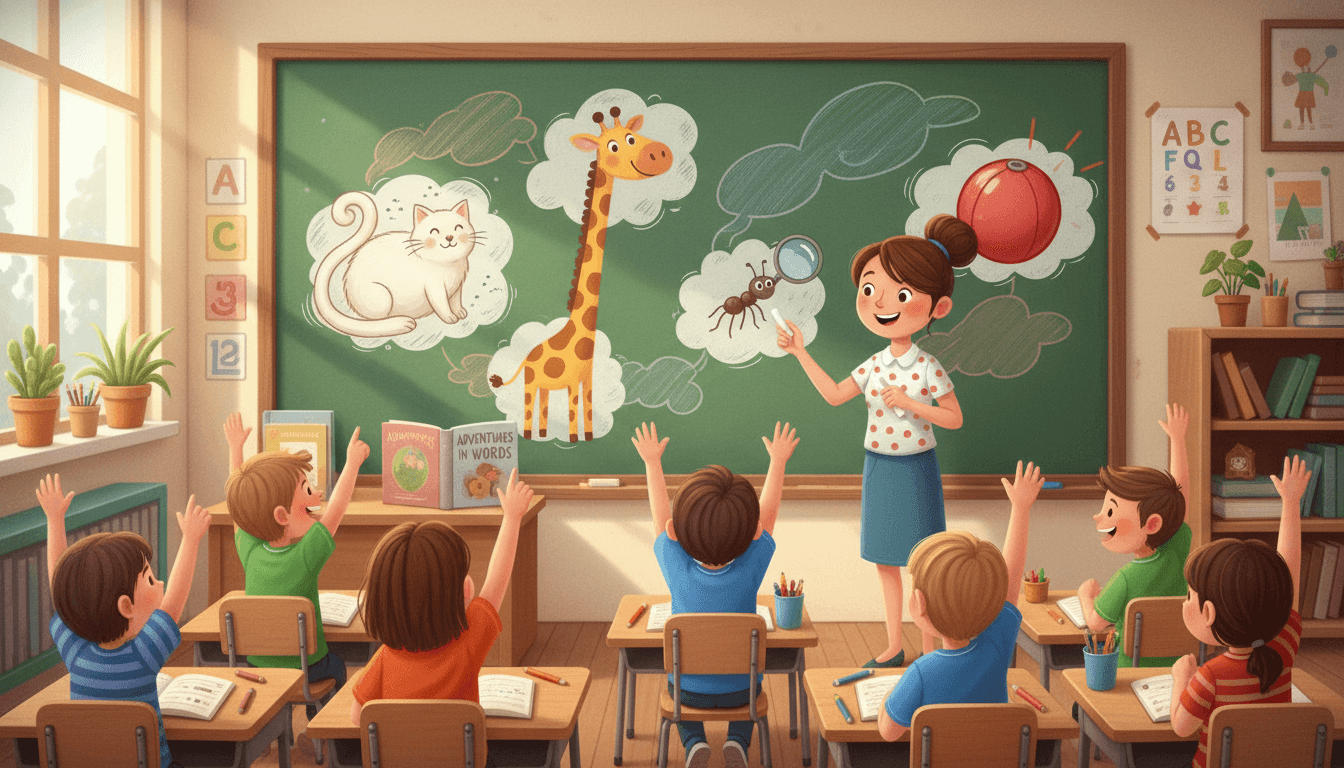
Start with sensory adjectives. What does it look like? Sound like? Feel like? Taste like? Smell like? Sensory adjectives are the most concrete and accessible for young learners.
Use noun-adjective pairs. Give kids a noun and challenge them to list as many adjectives as possible. "Puppy" → small, fluffy, energetic, playful, brown, spotted, loud. This builds vocabulary and the habit of thinking in modifiers.
Compare and upgrade. Show a sentence with a generic adjective ("The big dog") and ask students to find more precise alternatives (enormous, massive, towering, hulking). Precision is more valuable than volume.
Address comparative/superlative with familiar examples. tall/taller/tallest using kids in the classroom. hot/hotter/hottest. good/better/best. Make the pattern visible.
Connect to reading. Find adjectives in shared texts. Discuss what they add. What would the sentence mean without them?
Practice Activities
-
Five senses chart: Pick an object and fill in one adjective for each sense. Builds descriptive vocabulary.
-
Adjective escalator: Start with a plain sentence. Add one adjective. Then add another. Compare each version. "The dog barked." "The big dog barked." "The big, shaggy dog barked." "The enormous, shaggy, trembling dog barked."
-
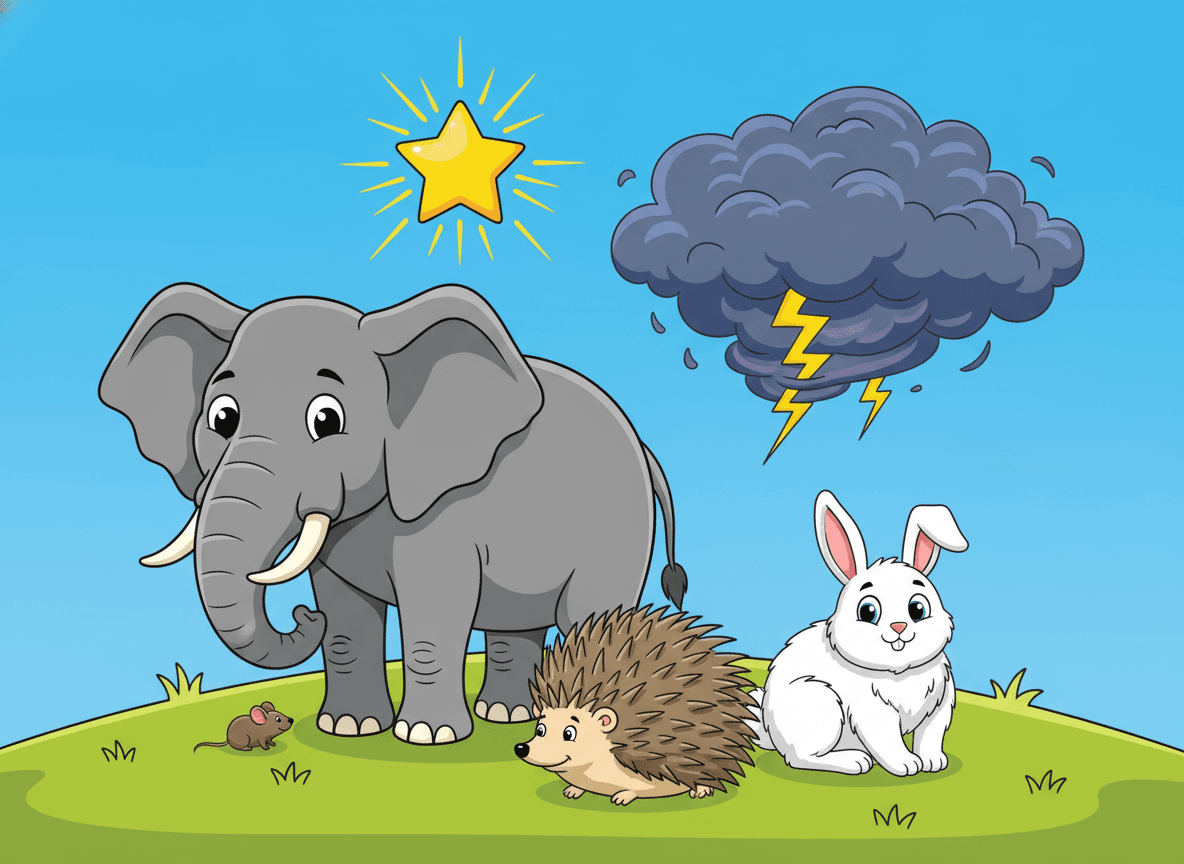
Comparative/superlative mats: Picture cards with objects of different sizes, speeds, colors. Students write comparative and superlative sentences.
-
Adjective word hunt: Highlight every adjective in a paragraph of a read-aloud book. Count them, categorize them, replace some with alternatives.
-
Mystery bag: Kids reach into a bag, feel an object without looking, and describe it using only adjectives. Classmates guess what it is.
Frequently Asked Questions
What questions do adjectives answer?
Adjectives modify nouns by answering one of four questions: What kind? (the blue door, the tiny ant, a wooden table). How many? (three apples, several students, many options). Which one? (this book, that dog, the last piece). How much? (more time, enough space, less sugar). Teaching kids to ask these questions when looking for adjectives is more reliable than memorizing a definition.
What is a predicate adjective?
A predicate adjective comes after a linking verb and describes the subject, rather than appearing right before a noun. In 'The sky is blue,' blue is a predicate adjective - it follows the linking verb 'is' and describes the subject 'sky.' Compare to attributive position: 'the blue sky.' Both 'blue' uses are adjectives; they just sit in different spots. Predicate adjectives are introduced in 2nd-3rd grade.
What are comparative and superlative adjectives?
Comparative adjectives compare two things and usually end in -er or use 'more': bigger, faster, more beautiful, more expensive. Superlative adjectives identify the extreme among three or more and usually end in -est or use 'most': biggest, fastest, most beautiful, most expensive. One-syllable adjectives usually take -er/-est (fast/faster/fastest). Multi-syllable adjectives usually use more/most (creative/more creative/most creative). Irregular forms: good/better/best, bad/worse/worst.
Can a word be both an adjective and another part of speech?
Yes, frequently. Many words serve multiple roles depending on context. 'Fast' is an adjective in 'a fast car' but an adverb in 'she runs fast.' 'Light' is an adjective in 'a light bag' but a noun in 'turn on the light.' In grammar, part of speech is determined by how a word functions in a specific sentence, not by the word itself. This is why context matters in grammar instruction.
What is the order of adjectives in English?
When multiple adjectives describe a noun, English speakers follow an instinctive order: opinion, size, age, shape, color, origin, material, purpose, then noun. 'A lovely little old rectangular green French silver whittling knife' sounds right; reversing the order sounds wrong. Kids don't need to memorize this sequence - they absorb it from extensive reading and conversation - but teachers can address it when kids write awkward adjective sequences.
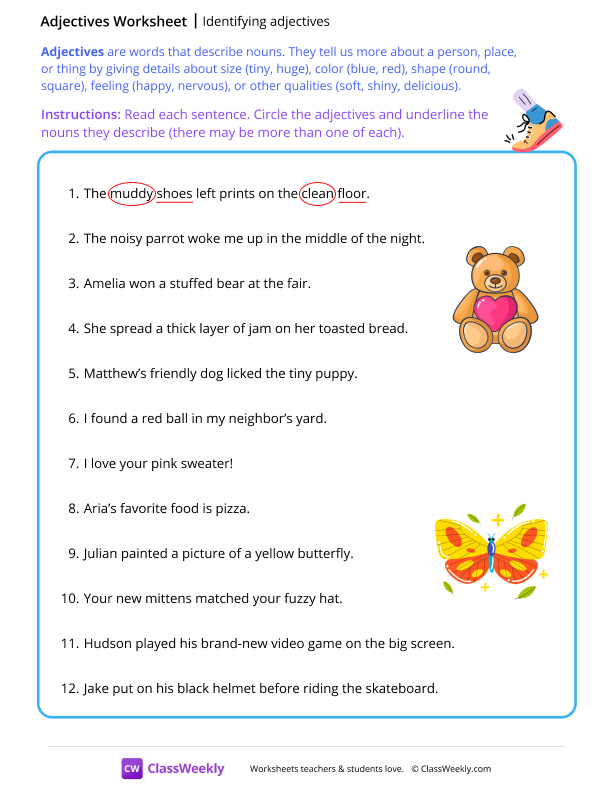
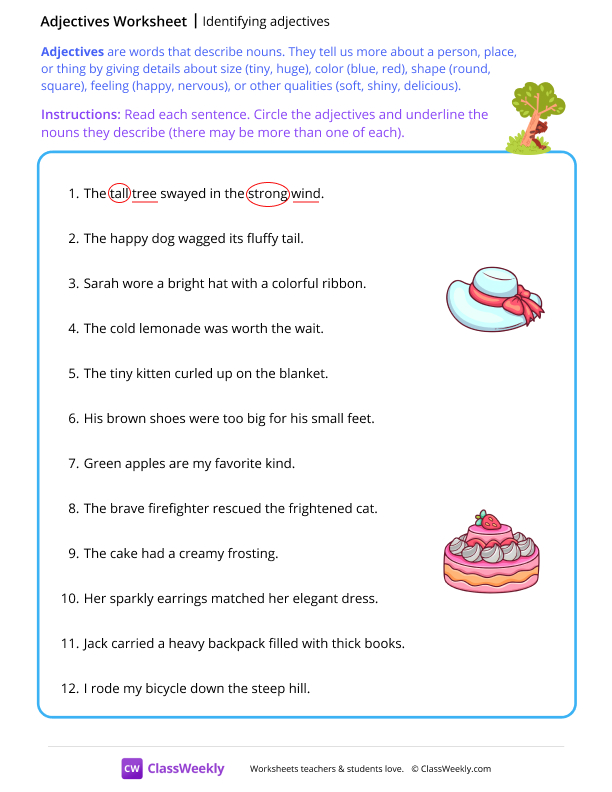
Free Adjective Worksheets
Curriculum-aligned printable worksheets for 1st – 4th Grade. Download free.