What Is a Sentence?
Taught in US schools

Key Takeaways
- A complete sentence needs a subject (who/what) and a predicate (what they do or are).
- Four sentence types: declarative (statement), interrogative (question), imperative (command), exclamatory (strong feeling).
- Fragment = missing subject or predicate. Run-on = two sentences incorrectly joined.
- Simple, compound, and complex sentences are the three structural types - variety improves writing quality.
What Is a Sentence?
A sentence is a group of words that expresses a complete thought.
Every sentence must have:
- A subject - the who or what the sentence is about
- A predicate - what the subject does, has, or is
"The dog (subject) barked loudly (predicate)."
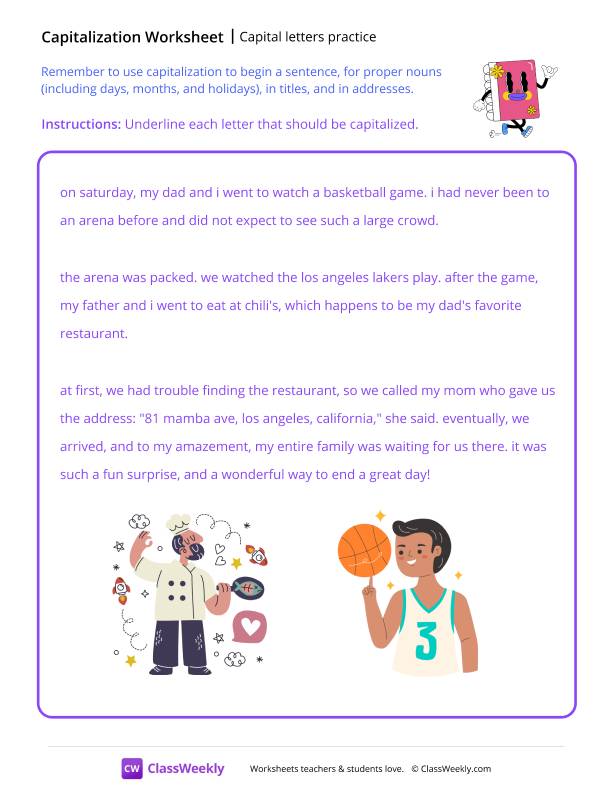
Sentences begin with a capital letter and end with a punctuation mark (period, question mark, or exclamation mark).
Subject and Predicate
Simple subject: The key noun or pronoun doing the action.
Complete subject: The simple subject plus all its modifiers.
The old brown dog barked. (complete subject = "the old brown dog"; simple subject = "dog")
Simple predicate: The verb.
Complete predicate: The verb plus all other words in the predicate.
The dog barked loudly at the mail carrier. (complete predicate = everything after "dog"; simple predicate = "barked")
Four Types of Sentences
Declarative: States a fact or opinion - .
Interrogative: Asks a question - ?
Imperative: Gives a command or request - . or !
Exclamatory: Expresses strong emotion - !
Three Sentence Structures
Simple: One independent clause.
"The cat slept on the couch."
Compound: Two independent clauses joined by a coordinating conjunction (FANBOYS: for, and, nor, but, or, yet, so) or a semicolon.
"The cat slept, but the dog kept barking."
Complex: An independent clause + a dependent clause, joined by a subordinating conjunction.
"Because it was raining, we stayed inside."
Good writers vary sentence structure - using all three types creates rhythm and avoids monotony.
Fragments and Run-Ons
Fragment - incomplete sentence (missing subject, predicate, or complete thought):
✗ "Running down the hall." → ✓ "She was running down the hall." ✗ "Because it was cold." → ✓ "We wore jackets because it was cold."
Run-on - two sentences incorrectly combined:
✗ "I went to the store I bought apples." (fused) ✗ "I went to the store, I bought apples." (comma splice) ✓ "I went to the store and bought apples." (fixed with conjunction) ✓ "I went to the store. I bought apples." (fixed with period)
What Grade Do Kids Learn Sentences?
Kindergarten: Produce complete sentences; recognize fragments (L.K.1f).
1st Grade: Produce and expand simple and compound sentences (L.1.1j).
2nd Grade: Produce complete sentences; recognize and correct fragments and run-ons (L.2.1f).
3rd Grade: Produce simple, compound, and complex sentences (L.3.1i).
4th Grade: Use correct sentence structure; correct inappropriate shifts in sentence construction (L.4.1f).
Common Misconceptions
"A long sentence can't be a fragment." Length doesn't make a sentence complete. "Because she had been studying for three weeks for the hardest test she had ever taken" is still a fragment - it doesn't express a complete thought.
"Compound sentences always need a comma." A comma is needed before the coordinating conjunction in a compound sentence, not within a simple sentence with a compound predicate. "She ran and jumped" is a simple sentence; no comma.
"Complex sentences are harder than compound." Both are standard 3rd grade expectations. Students often find complex sentences more natural ("I ran because I was late") than compound.
Practice Activities
-
Subject/predicate split: Give sentences; students draw a line between the complete subject and complete predicate.
-
Fragment fix: Provide fragments; students add what's missing to make complete sentences.
-
Run-on repair: Correct run-on sentences using three different methods (period, conjunction, semicolon).
-
Sentence type sort: Sort sentence cards by type (declarative/interrogative/imperative/exclamatory).
-
Combine sentences: Give 2-3 simple sentences; students combine into a compound or complex sentence.
Frequently Asked Questions
What is the difference between a subject and a predicate?
The subject is the who or what the sentence is about - it contains the noun or pronoun doing the action or being described. 'The old brown dog' is a complete subject; 'dog' is the simple subject. The predicate is what the subject does, has, or is - it contains the verb and everything else in the sentence. 'barked loudly at the mail carrier' is a complete predicate; 'barked' is the simple predicate (verb). Every sentence must have both a subject and a predicate to express a complete thought.
What is a sentence fragment?
A sentence fragment is an incomplete sentence - it's missing either the subject, the predicate, or both, and doesn't express a complete thought. 'Because it was raining.' (Has a subject and verb but doesn't complete the thought - it's a dependent clause.) 'Running down the street.' (Missing the subject - who is running?) 'The big red barn.' (Has a subject but no predicate - what about it?) Fixing fragments is one of the most common editing skills in 2nd-5th grade writing.
What is a run-on sentence?
A run-on sentence incorrectly joins two or more independent clauses without proper punctuation or conjunctions. 'I went to the store I bought apples.' (Fused run-on - no punctuation between two complete thoughts.) 'I went to the store, I bought apples.' (Comma splice - comma alone can't join two independent clauses.) Fix: add a period ('I went to the store. I bought apples.'), add a coordinating conjunction ('...and I bought apples'), add a semicolon ('...store; I bought apples'), or restructure as a complex sentence.
What are the four types of sentences?
Declarative: makes a statement and ends with a period. 'The sun rises in the east.' Interrogative: asks a question and ends with a question mark. 'Where does the sun rise?' Imperative: gives a command or makes a request; may end with a period or exclamation mark; the subject 'you' is implied. 'Close the door, please.' Exclamatory: expresses strong feeling and ends with an exclamation mark. 'What an incredible sunset!' Students learn all four types in 1st-2nd grade and use them purposefully in writing.
What is the difference between simple, compound, and complex sentences?
Simple sentence: one independent clause with one subject and one predicate. 'The dog barked.' Compound sentence: two independent clauses joined by a coordinating conjunction (FANBOYS: for, and, nor, but, or, yet, so) or a semicolon. 'The dog barked, and the cat hid.' Complex sentence: one independent clause + one dependent clause, joined by a subordinating conjunction (because, although, when, if, since). 'Because it was raining, we stayed inside.' Sentence variety - mixing all three types - is a key element of strong writing style.
Free Sentence Worksheets
Curriculum-aligned printable worksheets for Kindergarten – 4th Grade. Download free.