What Is Compare and Contrast?
Taught in US schools
Key Takeaways
- Comparing means finding similarities; contrasting means finding differences.
- The Venn diagram is the most commonly used graphic organizer for compare and contrast.
- Compare and contrast is both a reading comprehension skill and a writing structure.
- Signal words help readers identify when an author is comparing (both, similarly, alike) or contrasting (however, but, unlike).
What Is Compare and Contrast?
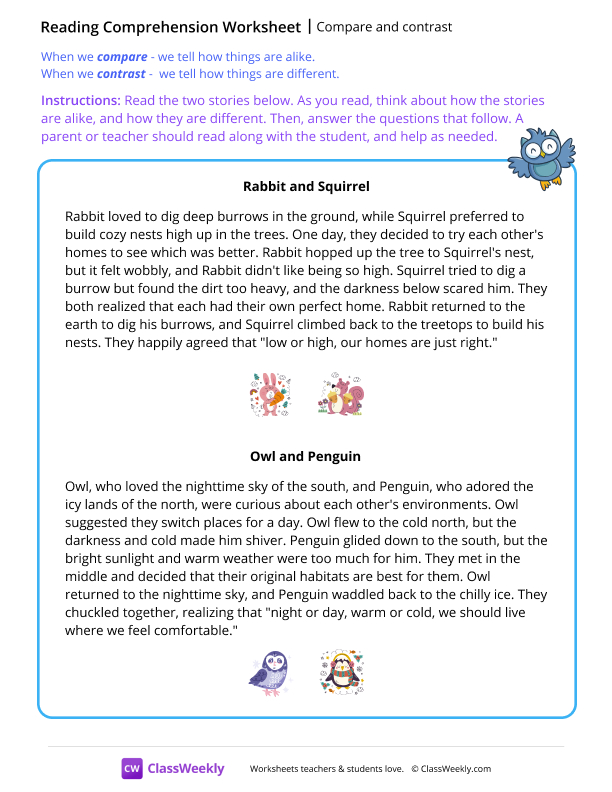
Comparing means identifying similarities between two or more things. Contrasting means identifying differences. Together, comparing and contrasting is one of the most versatile thinking skills students use across reading, writing, math, science, and social studies.
The ability to look at two things side-by-side and systematically analyze their similarities and differences builds analytical thinking and organized writing.
Compare and Contrast in Reading
Authors use compare-contrast text structure in nonfiction to organize information. Students recognize it through:
Signal words for comparison: both, similarly, in the same way, also, alike, share, all three
Signal words for contrast: however, but, unlike, although, on the other hand, while, yet, different from
When students encounter these words, they know the author is explicitly drawing comparisons or distinctions.
The Venn Diagram
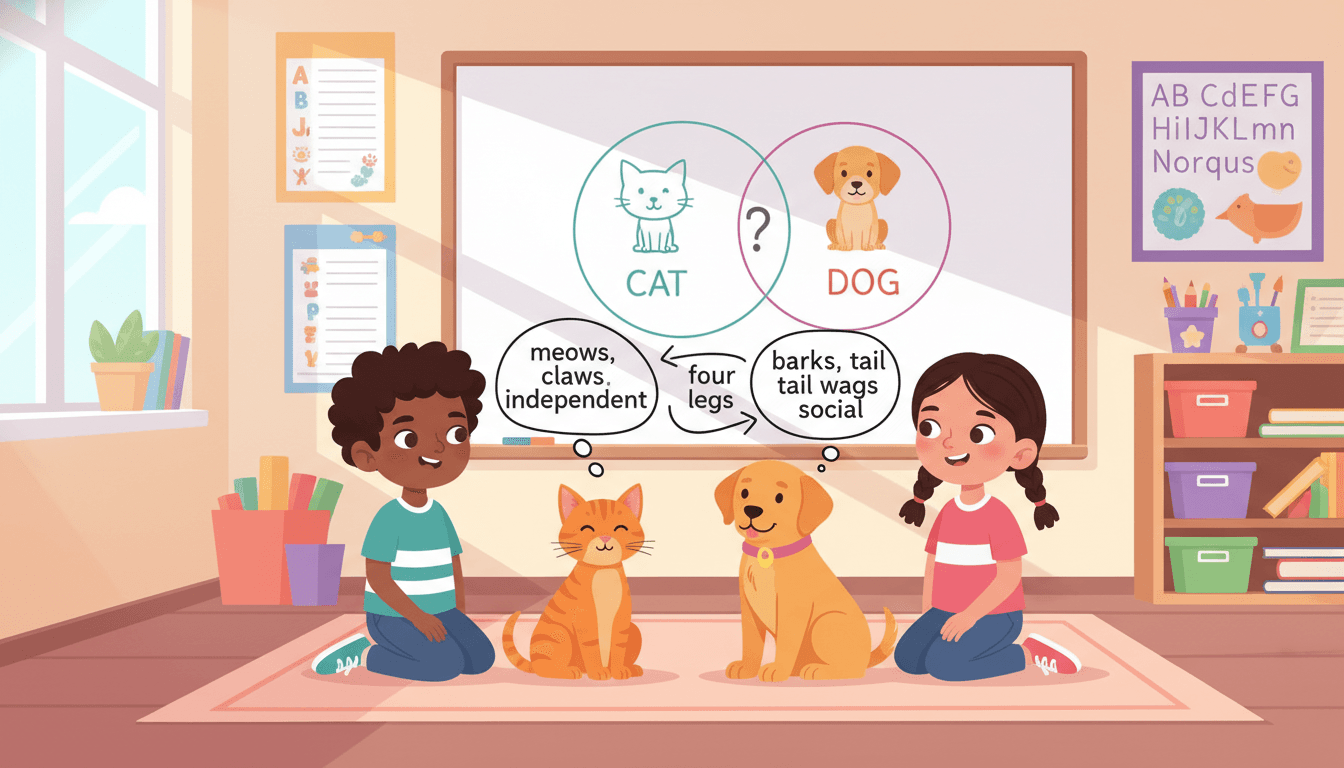
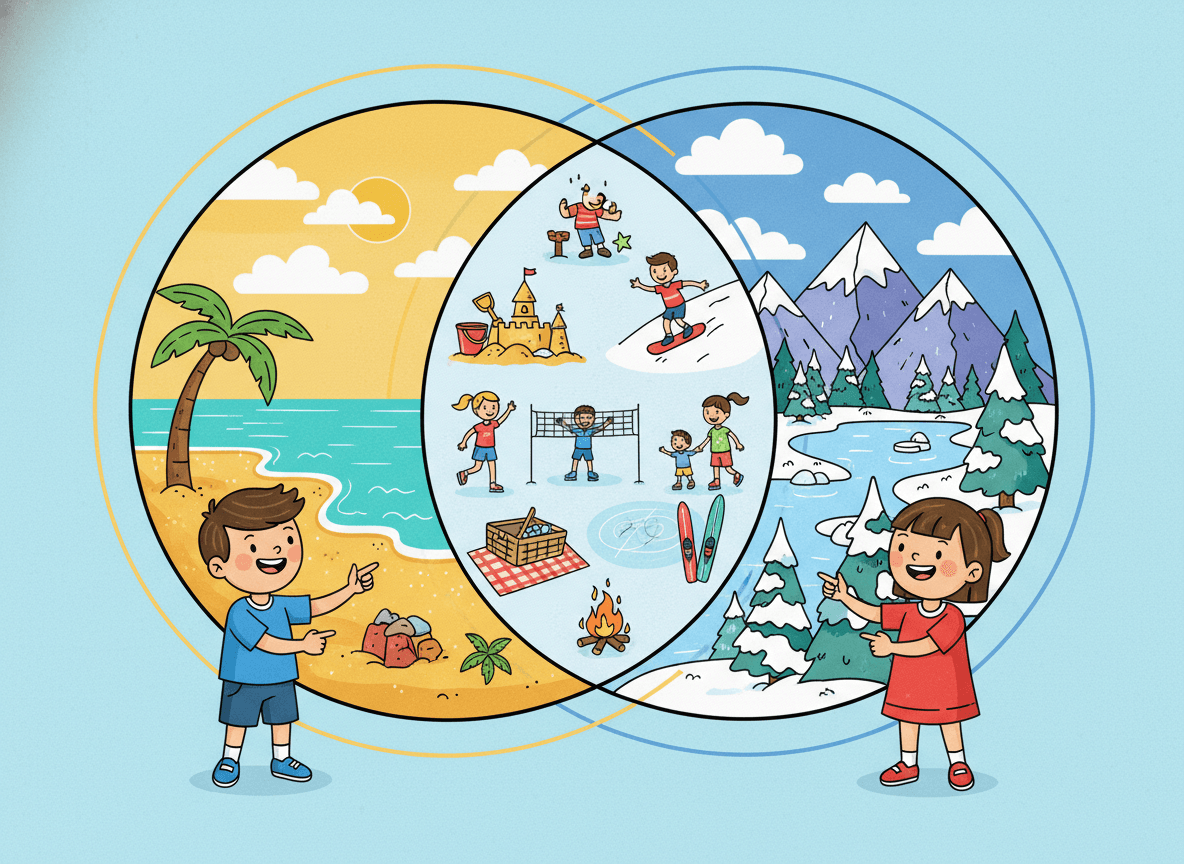
The Venn diagram (two overlapping circles) is the standard graphic organizer:
-
Left circle: Unique to Subject A
-
Right circle: Unique to Subject B
-
Center (overlap): Shared by both
Variations include a triple Venn diagram for three subjects or a T-chart for simpler comparisons.
What Students Compare Across Grades
2nd grade (RL.2.9): Compare and contrast two versions of the same story (e.g., two Cinderella retellings from different cultures).
3rd grade (RI.3.9): Compare and contrast the most important points from two texts on the same topic.
4th grade (RL.4.9, RI.4.9): Compare and contrast the treatment of similar themes across texts; compare firsthand and secondhand accounts of the same event.
5th grade (RI.5.9): Integrate information from several texts about the same topic.
Compare and Contrast Writing Structure
Point-by-point: Address one attribute at a time, covering both subjects: Paragraph 1: Both animals' diets. Paragraph 2: Both animals' habitats. Paragraph 3: Both animals' sizes.
Block: Cover all attributes of Subject A, then all attributes of Subject B: Paragraphs 1–2: Everything about wolves. Paragraphs 3–4: Everything about foxes. Paragraph 5: Conclusion drawing comparisons.
Common Misconceptions
Comparing only means finding similarities: Compare and contrast includes BOTH similarities and differences. Some students focus only on differences when asked to "compare" two things.
Any two things can be compared: Effective comparison requires meaningful criteria - things being compared should have enough in common to make the comparison informative. Comparing a pencil to a dinosaur may be technically possible but not useful.
A Venn diagram is the only option: While Venn diagrams are common, T-charts, comparison matrices, and prose paragraphs are all valid ways to organize compare-contrast thinking.
Practice Activities
-
Venn diagram partner work: Partners read two texts and fill in a shared Venn diagram before discussing.
-
Same topic, different books: Read two nonfiction books on the same animal; compare what each emphasizes.
-
Two versions of a fairy tale: Compare Cinderella from different cultures - what elements are the same? What differs?
-
Signal word hunt: Highlight compare/contrast signal words in an informational passage.
-
Compare and contrast paragraph: Use a completed Venn diagram to write a 3-sentence comparison paragraph.
Frequently Asked Questions
What does compare and contrast mean?
To compare means to look for ways two or more things are similar. To contrast means to look for ways they are different. Compare and contrast is a critical thinking skill used in reading (analyzing two texts), writing (organizing an essay), and content areas (comparing two ecosystems, two historical periods, or two mathematical approaches).
What is a Venn diagram?
A Venn diagram is a graphic organizer made of two (or more) overlapping circles. Each circle represents one subject. The overlapping center section contains similarities. The outer parts of each circle contain characteristics unique to that subject. It is the most commonly used tool for compare and contrast activities in elementary school.
What are compare and contrast signal words?
Comparison signal words: both, similarly, also, in the same way, alike, just as, all three, have in common. Contrast signal words: however, but, unlike, on the other hand, in contrast, while, yet, although, even though, different from. Teaching students to recognize these words in informational text helps them identify the compare-contrast text structure.
How is compare and contrast used in writing?
Compare and contrast essays are a common writing form in 4th and 5th grade. Students organize their writing either point-by-point (comparing one attribute at a time across both subjects) or block style (all about subject A, then all about subject B). A strong introduction names what is being compared; the body covers specific points; the conclusion synthesizes what was learned.
What texts does CCSS ask students to compare?
Common Core standards ask students to compare and contrast: (1) Two versions of the same story (RL.2.9), (2) Two texts on the same topic (RI.3.9), (3) Two texts with different points of view (RL.4.9), (4) Two accounts of the same event - firsthand vs. secondhand (RI.4.9). The complexity of what students compare increases across grade levels.
Free Compare and Contrast Worksheets
Curriculum-aligned printable worksheets for 2nd – 5th Grade. Download free.