What Are Volcanoes and Earthquakes?
Taught in US schools
Key Takeaways
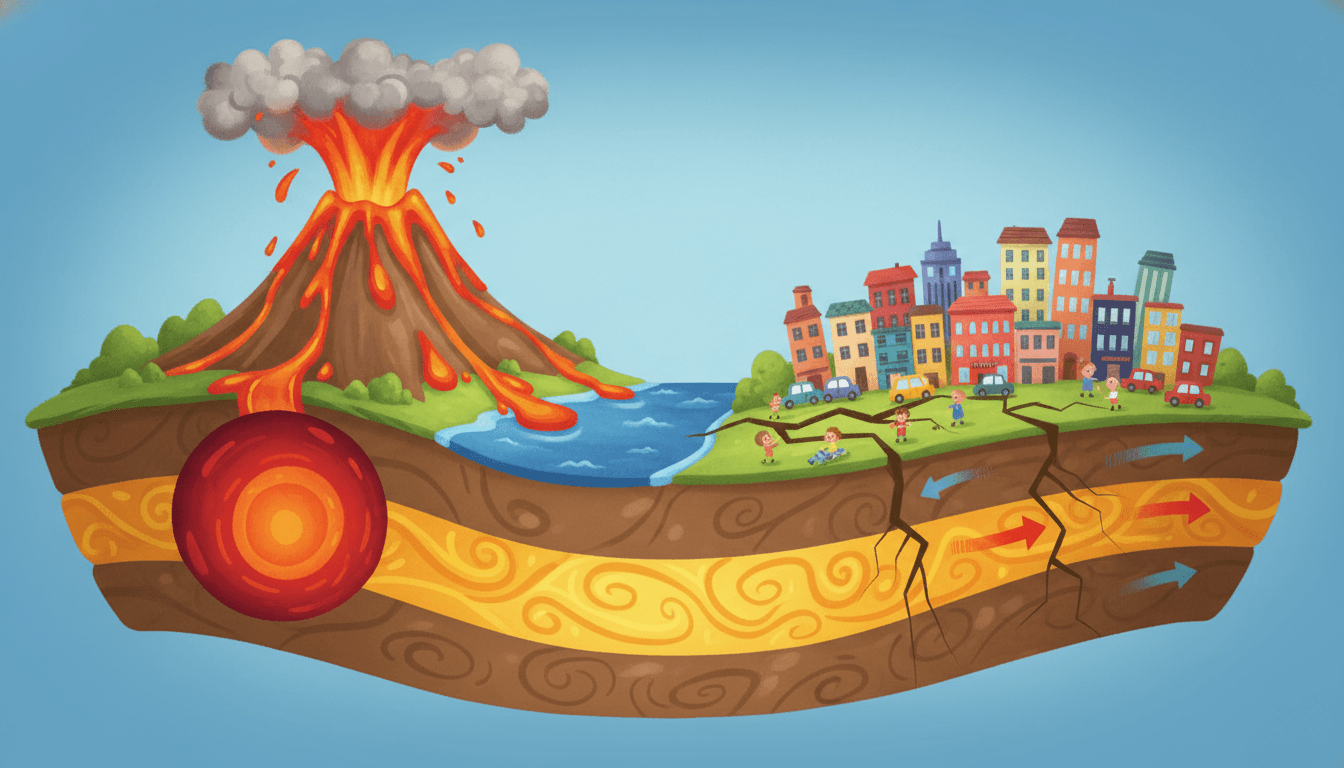
- Both volcanoes and earthquakes are caused by the movement of tectonic plates - the large sections of Earth's outer crust that slowly shift and collide.
- Volcanoes form where magma (molten rock) escapes through openings in Earth's crust; when magma reaches the surface, it is called lava.
- Earthquakes occur when stress along a fault line is suddenly released, sending seismic waves through the ground.
What Are Volcanoes and Earthquakes?
Volcanoes and earthquakes are two of the most dramatic events on Earth, and they share a common cause: the movement of tectonic plates - the giant sections of rock that make up Earth's outer shell (the crust and upper mantle).
Earth's surface is not one solid piece. It is broken into about 15 large tectonic plates and many smaller ones that slowly drift, collide, and slide past each other - driven by heat from Earth's interior.
Tectonic Plates: The Root Cause
Three things happen at plate boundaries:
Convergent: Two plates collide - Mountains, trenches, subduction, volcanoes
Divergent: Two plates pull apart - Rift valleys, new ocean floor, some volcanoes
Transform: Two plates slide sideways past each other - Earthquakes (e.g., San Andreas Fault)
Volcanoes
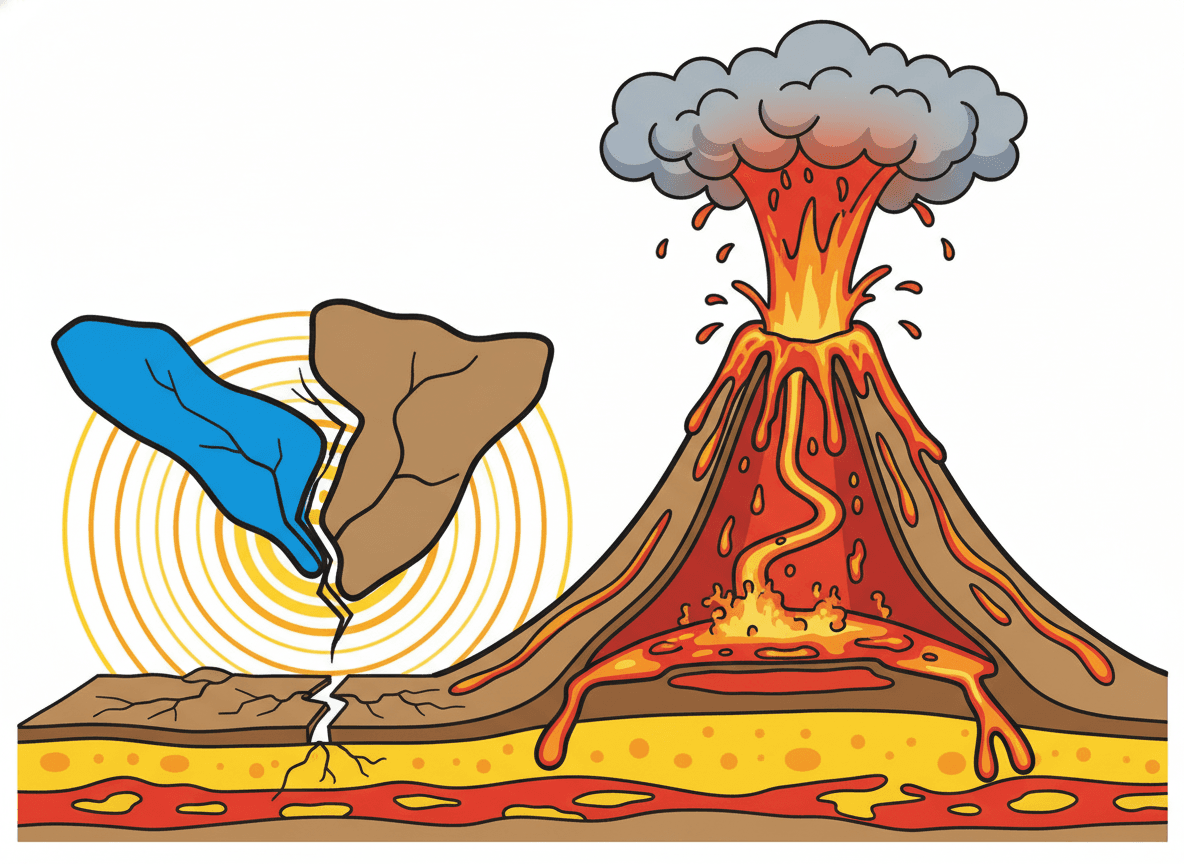
A volcano is an opening in Earth's crust where magma (molten rock) escapes to the surface. Once outside, magma is called lava.
Types of Volcanoes
Shield Volcano: Broad, gently sloping - Mauna Loa, Hawaii
****Composite (Stratovolcano): Tall, steep, cone-shaped - Mount St. Helens, Mount Fuji
Cinder Cone: Small, steep cone, single vent - Paricutin (Mexico)
Parts of a Volcano
-
Magma chamber: The underground reservoir of molten rock
-
Vent: The opening through which lava erupts
-
Crater: The bowl-shaped depression at the top
-
Lava flow: The stream of molten rock moving down the slope
Earthquakes
An earthquake is a sudden release of energy in Earth's crust that causes the ground to shake. The energy travels outward as seismic waves - like ripples in water.
****Focus (Hypocenter): The underground point where the earthquake originates
Epicenter: The point on Earth's surface directly above the focus
Fault: A crack in Earth's crust where two blocks of rock can move
Seismograph: An instrument that records seismic waves
Magnitude: A measure of the earthquake's energy, using the moment magnitude scale
The Ring of Fire
The Ring of Fire is a zone around the Pacific Ocean that accounts for roughly 75% of the world's volcanoes and 90% of the world's earthquakes. It runs along the west coasts of the Americas, Alaska, Japan, the Philippines, and New Zealand - tracing the boundaries of Pacific tectonic plates.
Tsunamis
When an earthquake occurs under the ocean, it can displace a massive amount of water, triggering a tsunami - a series of enormous waves. Tsunamis travel across the ocean at speeds of up to 500 miles per hour and can devastate coastal areas far from the earthquake's origin.
Practice Activities
- Build a model volcano using baking soda and vinegar to simulate an eruption, then label its parts.
- Create a map of the Ring of Fire and plot major volcanoes and earthquake zones.
- Compare the three types of volcanoes using a T-chart or Venn diagram - shape, eruptive style, example.
- Read a news article about a recent earthquake and identify the magnitude, epicenter, and impact.
- Investigate how scientists predict volcanic eruptions and earthquakes - and what tools they use.
Frequently Asked Questions
What is the difference between magma and lava?
Magma is molten rock beneath Earth's surface. Once it erupts through a volcano and reaches the surface, it is called lava. Same material - different names depending on whether it is underground or above ground.
How are earthquakes measured?
Earthquakes are measured by the magnitude of energy released. The moment magnitude scale (which replaced the older Richter scale) rates earthquakes on a logarithmic scale - a magnitude 6 earthquake releases about 32 times more energy than a magnitude 5.
What is the Ring of Fire?
The Ring of Fire is a horseshoe-shaped zone around the Pacific Ocean where a large number of Earth's earthquakes and volcanic eruptions occur. It follows the boundaries of several tectonic plates and is home to over 75% of the world's volcanoes.
Free Volcanoes and Earthquakes Worksheets
Curriculum-aligned printable worksheets for 4th – 5th Grade. Download free.


