What Is Whole Body Listening?
Taught in US schools
Key Takeaways
- Whole Body Listening teaches children to use their whole body - not just ears - to show they are listening and engaged.
- The framework names specific body parts and what each does during listening: eyes watch, ears hear, brain thinks, mouth is quiet.
- It supports the development of listening skills for K-2 students who are still building self-regulation.
- Whole Body Listening works best as a taught concept, not a demand - pair with modeling, practice, and positive reinforcement.
What Is Whole Body Listening?
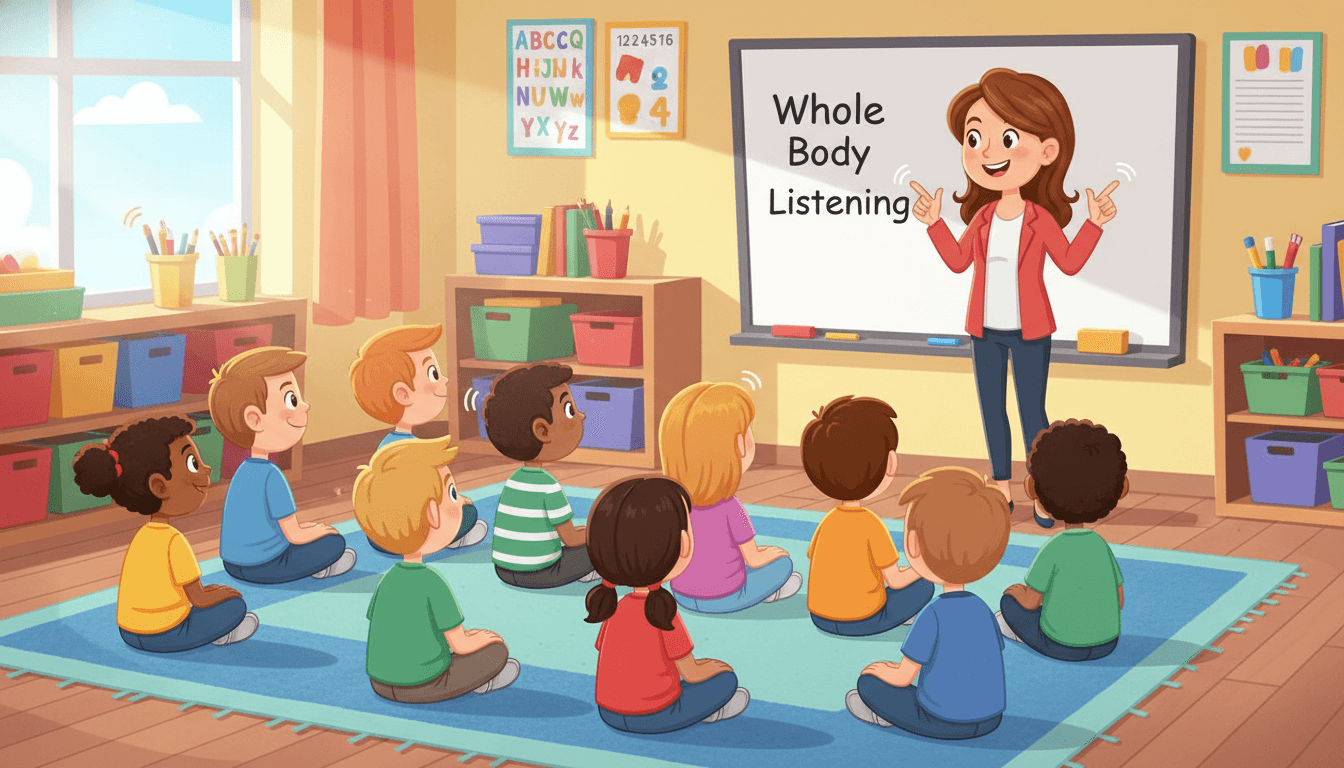
Whole Body Listening is a framework that teaches young students - primarily in kindergarten through 2nd grade - to listen and demonstrate engagement using their entire body. Rather than simply telling children to "listen," it breaks listening into specific, concrete behaviors associated with each part of the body.
Developed by Susanne Poulette Truesdale and popularized through classroom use and children's books, Whole Body Listening makes an invisible skill (attention) visible through physical cues that teachers can model, teach, and reinforce.
The Whole Body Listening Framework
Each body part has a role:
Eyes: Looking at the person who is speaking. Eyes send the message: "I see you and I'm paying attention to you."
Ears: Both ears tuned in and ready to hear. Ears catch the words.
Brain: Thinking about what the speaker is saying. The brain stores the information, makes connections, and prepares responses.
Mouth: Quiet - not talking, humming, or making sounds. The mouth's job during listening is to wait.
Hands: Still and calm - not playing with objects, touching others, or fidgeting in distracting ways.
Feet: On the floor or still in a seated position. Not tapping, swinging, or moving in distracting ways.
Body: Turned toward the speaker; at rest; not leaning away.
Heart: Caring about what the other person is sharing - the emotional dimension of listening.
How to Teach Whole Body Listening
Step 1: Introduce with an anchor chart. Create or display a visual showing a figure with each body part labeled and its listening job described.
Step 2: Model and contrast. Model "Whole Body Listening" - sit up, make eye contact, hands still. Then model the opposite - look away, fidget, make noises. Students identify the difference.
Step 3: Practice during structured routines. Morning Meeting circle time is ideal - low-stakes, predictable, daily. "This is when we practice Whole Body Listening together."
Step 4: Specific praise. "Marcus, I notice you have your eyes on me and your hands are still. That's Whole Body Listening!" Specific feedback is more effective than general "good listening."
Step 5: Self-monitoring. Teach students to check themselves: "Am I doing Whole Body Listening right now? Let me check my body."
Classroom Integration
Morning Meeting: Opening rituals where the class practices listening to each other.
Read-aloud: Before reading, "Let me see Whole Body Listening." A visual check before beginning.
Transitions: "Before I give directions, I need Whole Body Listening." Students adjust before instructions are delivered.
Partner work: "When your partner is talking, practice Whole Body Listening."
Differentiating for Individual Needs
Some students - particularly those with sensory processing differences, ADHD, autism, or developmental differences - may find certain physical listening postures genuinely difficult or unhelpful for their attention. Best practices:
- Focus on whether the student is comprehending and engaging rather than whether they perfectly match every physical criterion
- Allow some students to listen while standing, holding a fidget, or not making sustained eye contact
- Use Whole Body Listening as a support tool, not a compliance demand
- Check comprehension through questions, not just through posture
Common Misconceptions
Still body = listening brain: Physical stillness correlates with but does not equal active listening. Some students actually attend better with mild movement (a child squeezing a fidget while listening). The goal is comprehension and engagement - body posture is a scaffold to that goal, not the goal itself.
Whole Body Listening replaces social skills instruction: It is one component of social skills. It teaches the physical posture of attention but doesn't replace explicit teaching of listening comprehension, empathy, and communication skills.
Students should already know how to listen when they start school: Many kindergartners genuinely have not been in settings where sustained group listening was required or explicitly taught. Making listening explicit is a valid instructional move, not a remediation.
Practice Activities
-
Whole Body Listening poster: Co-create with students a class chart showing each body part and its job - student-generated descriptions stick better than teacher-written ones.
-
Show me / freeze: Practice signal - "Show me Whole Body Listening - freeze!" Students check and hold the position; teacher gives a specific compliment to individuals or the group.
-
Partner listening practice: One student tells a brief story; the partner demonstrates Whole Body Listening; they switch; the group reflects on what it felt like to be listened to.
-
Listening check-in card: A small card students can reference at their desks showing the 7 body parts and their listening jobs.
-
"Best listener" recognition: End of Morning Meeting, briefly name one thing you noticed about the class's listening that day - keeps attention on the skill without making it a competition.

Frequently Asked Questions
What is Whole Body Listening?
Whole Body Listening is a framework developed by Susanne Poulette Truesdale that teaches children to demonstrate engaged listening using their entire body. Rather than just telling young students to 'listen,' it breaks listening into visible, concrete behaviors: eyes are on the speaker, ears are ready to hear, brain is thinking about the message, mouth is quiet, hands are still, feet are on the floor, and the body is turned toward the speaker. By making each component explicit, children in K-2 can understand, practice, and self-monitor their listening behavior.
How do you teach Whole Body Listening in the classroom?
Teach it as an explicit lesson: introduce each body part and what it does during listening. Use a poster or anchor chart showing a figure with each body part labeled. Read-aloud books about Whole Body Listening are available (the 'Listening with My Whole Body' series). Role-play both good and poor listening so students can see the contrast. Practice during Morning Meeting and other whole-group times. Reinforce with specific praise ('I noticed you had your eyes on me and your hands still - that's Whole Body Listening'). Revisit the expectations at the start of each week in the early months of school.
What grade levels is Whole Body Listening for?
Whole Body Listening is primarily designed for Kindergarten, 1st grade, and 2nd grade, when students are still building the self-regulation skills needed for sustained attention. Many kindergartners genuinely don't know what listening is supposed to look like - making the implicit explicit is highly effective at this age. By 3rd grade, most students have internalized listening expectations and the explicit framework is less necessary, though some students benefit from the continued scaffold.
Is Whole Body Listening the same as active listening?
Whole Body Listening and active listening share goals but serve different age groups. Active listening is a broader communication skill developed through life - it includes paraphrasing, asking clarifying questions, and giving feedback to the speaker. Whole Body Listening is a simplified, developmentally appropriate version for young children that focuses on the physical posture and behaviors that support attention: eyes, ears, body orientation. As children develop, Whole Body Listening naturally grows into more sophisticated active listening practices.
Are there any criticisms of Whole Body Listening?
Some educators and occupational therapists have raised concerns that Whole Body Listening creates unrealistic expectations - particularly for students with sensory processing differences, ADHD, or autism, for whom certain physical postures (sitting still, making eye contact) may actually be harder without supporting attention. The concern is that enforcing the appearance of listening without attending to whether actual comprehension is occurring puts form over function. Many teachers address this by teaching Whole Body Listening as a goal and a support tool while acknowledging that different students may demonstrate engagement in different ways.
Free Whole Body Listening Worksheets
Curriculum-aligned printable worksheets for Kindergarten – 2nd Grade. Download free.