
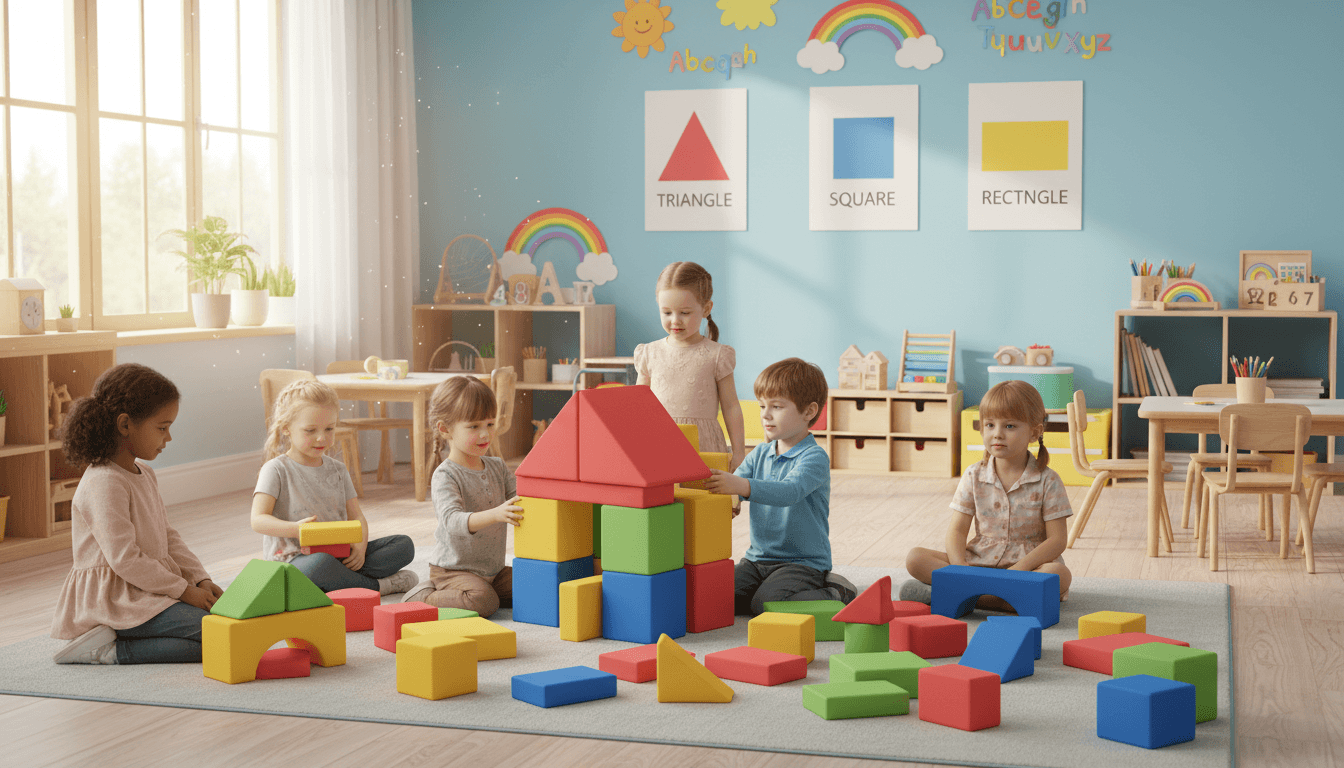
Geometry and Shapes Activities for Kindergarten
Get 30 days of free worksheet downloads
Key Takeaways
- Start with just four shapes (circle, square, triangle, rectangle) and spend about a week on each before introducing hexagons.
- Always show shapes in different sizes, colors, and orientations so kids learn that shape is defined by sides and corners, not appearance.
- A shape hunt around the classroom or school is one of the most effective ways to connect geometry to the real world for kindergartners.
- Composing shapes by building pictures with pattern blocks directly teaches the kindergarten geometry standard and doubles as a creative activity.
- For 2D vs. 3D, match real solid objects to their flat shape shadows rather than focusing on memorizing formal 3D shape names.
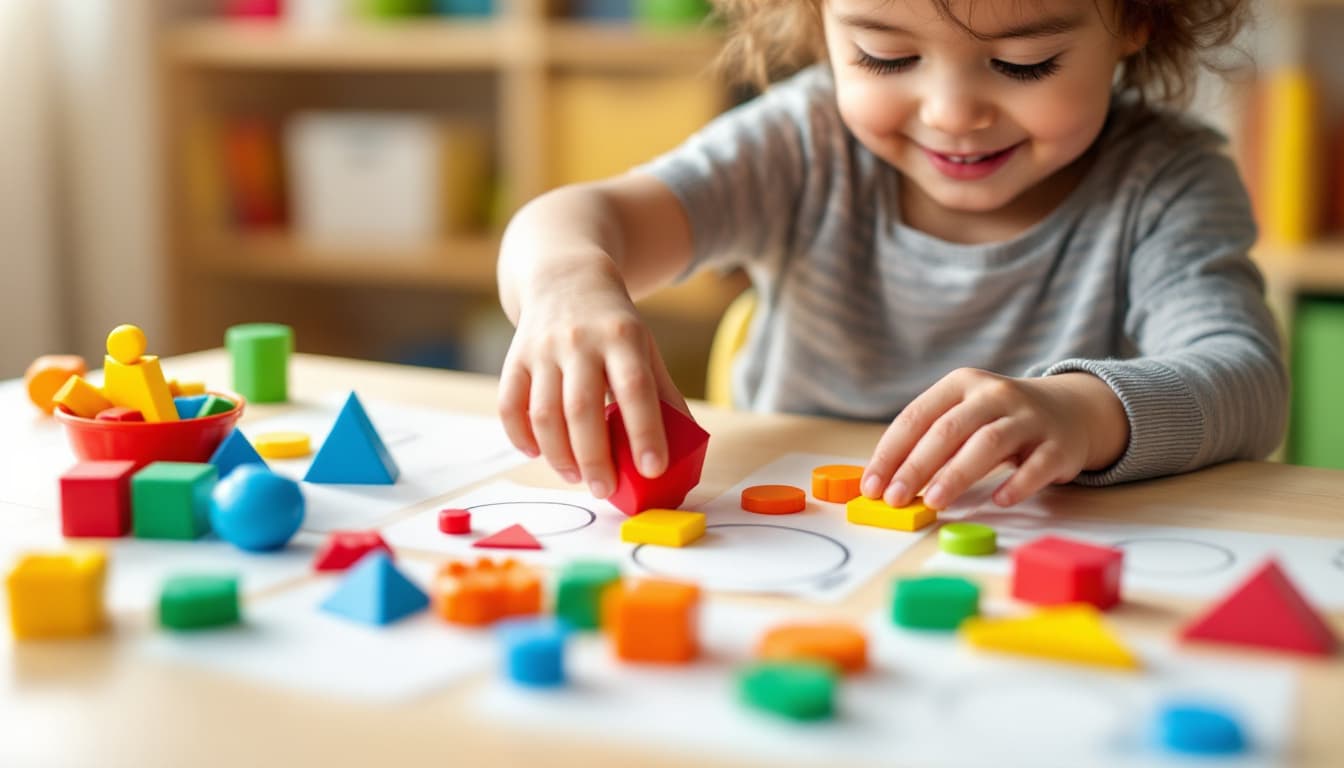
Kindergartners live in a world full of shapes, and they don't even know it. The clock is a circle. The door is a rectangle. Their sandwich is a triangle (if you cut it right). Once you start pointing out shapes, kids see them everywhere.
Geometry in kindergarten is one of the most hands-on, visual, and fun areas of math. Here's how to teach it so it sticks.
What Kindergartners Need to Learn
According to Common Core K.G, kindergartners should:
- Identify and describe shapes (circles, squares, triangles, rectangles, hexagons)
- Describe shapes using words like "sides," "corners" (vertices), "flat," "round"
- Compare 2D and 3D shapes
- Compose simple shapes to form larger shapes
No measuring. No area. No perimeter. Just: what shapes exist, what do they look like, and how can we put them together?
Free Kindergarten Shape Worksheets


Start With the Big Four
Don't introduce all shapes at once. Start with the four shapes kids already know from everyday life:
- Circle , round, no sides, no corners (the clock, a coin, a pizza)
- Square , 4 equal sides, 4 corners (a window pane, a cracker)
- Triangle , 3 sides, 3 corners (a yield sign, a slice of pizza)
- Rectangle , 4 sides (2 long, 2 short), 4 corners (a door, a book)
To be fair, not every kid responds to this approach the same way.
Spend about a week on each one. Learn the name, find it everywhere, count its sides and corners, draw it.
Then add hexagon (a stop sign without the letters, or a honeycomb cell). Hexagons are in the kindergarten standards, and kids think they're cool because the name sounds impressive.
8 Activities Your Kiddos Will Love
1. Shape Hunt
Walk around the school or classroom. Find shapes in the real world.
- Circle: clock, plate, wheel
- Square: window, tile, calendar
- Triangle: coat hanger, yield sign, roof
- Rectangle: door, whiteboard, bookshelf
Give each student a "shape hunt" checklist. They check off each shape as they find it. Take photos for a class "Shapes Around Us" display.
2. Shape Sorting
Give kids a mixed pile of shape cutouts (different sizes, colors, orientations). They sort by shape.
The trick: include shapes in different sizes and orientations. A triangle isn't always pointing up. A rectangle can be tall and skinny or short and wide. This teaches that shape is defined by properties (sides and corners), not appearance.
3. Building With Shapes
Use pattern blocks (those colorful wooden shapes) to build pictures. A house is a square + triangle. A tree is a triangle + rectangle. A face is a circle + two small circles + a curved line.
This teaches composing shapes, which is part of the kindergarten geometry standard. Plus, it's basically art class and math class combined.
4. Shape Monsters
Kids create "monsters" using only geometric shapes. Circle head, rectangle body, triangle teeth, square eyes. Glue them on paper. Label each shape.
Display them in the hallway. Everyone stops to look. Math becomes a source of pride.
5. Geoboards
If you have geoboards (boards with pegs), kids can stretch rubber bands to create shapes. It's tactile, it's visual, and it teaches that shapes are defined by their sides and corners.
No geoboards? Use dot paper and pencils. Same concept, lower cost.
6. Shape Yoga
"Make your body into a circle!" (kids curl up) "Make a triangle with your arms!" (hands together above head) "Make a rectangle with a partner!" (stand side by side, arms out)
Movement makes shapes physical. Kids remember what their body does.
7. Shape Snacks
Graham crackers are rectangles. Cut them in half diagonally: triangles. Arrange cheese slices into squares. Pretzels form circles (sort of).
Learning you can eat is always popular with kiddos.
8. Shape Worksheets
Once kids can identify and name shapes, worksheets provide great independent practice: tracing shapes, coloring by shape, matching shapes to names, and finding shapes in pictures.
2D vs. 3D: Keep It Simple
Kindergartners should know the difference between flat shapes (2D) and solid shapes (3D):
- A circle is flat. A sphere (ball) is solid.
- A square is flat. A cube (block) is solid.
- A triangle is flat. A cone (party hat) is solid.
- A rectangle is flat. A rectangular prism (cereal box) is solid.
Activity: Bring in real 3D objects. Match each one to its flat shape "shadow." A can makes a circle shadow. A block makes a square shadow.
Don't overthink the 3D names. For kindergarten, "ball shape" and "box shape" are perfectly acceptable alongside the formal names.
Common Mistakes
Showing shapes in only one orientation. If every triangle you draw points up, kids will say a triangle that points down "isn't a triangle." Show shapes rotated, flipped, and in different sizes from day one.
Calling all four-sided shapes "squares." A rectangle with unequal sides is NOT a square. But a square IS a rectangle (it's a special one where all sides are equal). This is confusing even for adults. For kindergarten, teach: "squares have all sides the same length. Rectangles have two long sides and two short sides."
Skipping the vocabulary. Teach the words "side," "corner" (vertex), "flat," "round," "curved," "straight." These are the tools kids need to describe and compare shapes.
For Parents
Shapes are the easiest math topic to practice at home:
- "What shape is your plate?" (circle)
- "How many sides does that window have?" (four: it's a rectangle!)
- "Can you find something shaped like a triangle?"
- Build with blocks together and name the shapes
- Draw pictures using only geometric shapes
Keep Reading
- Shape Activities for Preschoolers: Hands-On Geometry Fun
- How to Teach Addition to Kindergartners: Hands-On Activities That Build Understanding
- How to Teach Number Sense to Kindergartners: Activities That Build Real Understanding
Start With the Shape Hunt
Tomorrow morning, stand at the classroom door and say: "Today we're going on a shape hunt. Look around this room. Can you find a circle?"
Watch every head turn. That's the beginning of geometry for your kindergartners.
For structured practice, our kindergarten geometry worksheets include shape identification, tracing, sorting, and composing activities designed for little learners. 🙌

Adi Ackerman
Head Teacher
Adi is the Head Teacher at ClassWeekly, with years of experience teaching elementary students. She designs our curriculum-aligned worksheets and writes practical guides for teachers and parents.
Keep Reading
Ready to download? Try ClassWeekly free for 30 days.
Unlimited worksheets for PreK through 5th grade. Cancel anytime.