
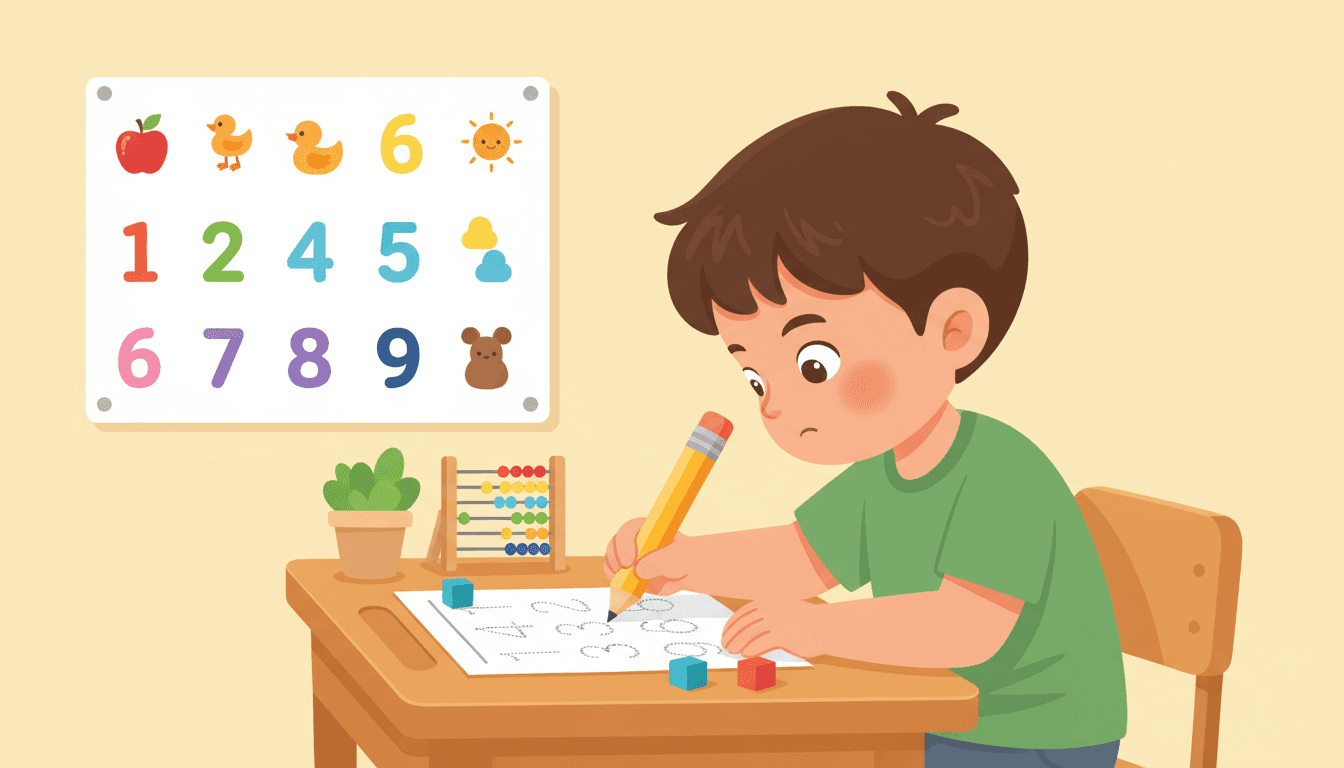
Number Formation in Kindergarten: Writing 0 to 10
Get 30 days of free worksheet downloads
Key Takeaways
- Correct stroke order matters because fast writing defaults to muscle memory - students who learn correct habits early produce consistent, readable numbers even under speed.
- Group numbers by formation pattern (straight-line, curve-start, and the unique 5) rather than teaching in numerical order so students can transfer stroke knowledge across digits.
- Fine motor preparation - playdough, sand trays, sky writing, and finger tracing - should come before pencil work, especially for digits like 8, 3, and 2 that require continuous curved strokes.
- Purposeful tracing means starting at the correct point, following arrow-guided stroke order, and saying the formation chant aloud - not just following dotted lines passively.
- Number reversals in 5, 7, and 9 are the most common in kindergarten and respond best to daily targeted practice with a verbal chant, not just more tracing.

How to Teach Number Formation to Kindergartners
The number 5 looks like it should be easy. It's just a couple of lines and a bump. And yet, watch a room full of kindergartners write it and you'll see five made backward, upside down, from the bottom up, and in at least two cases, in a direction that's hard to categorize at all.
Number formation is one of those skills where the physical habit matters as much as the end result. A 5 written the wrong way that looks fine at age five becomes a bigger problem at age seven when students are writing fast and the bad habit is deeply grooved. Teaching correct formation early, with the right sequence and the right practice, is genuinely worth the time.
Table of Contents
- Why Stroke Order Matters
- Before Pencil: Fine Motor Prep
- Grouping Numbers by Formation Pattern
- Teaching Numbers 0-9 First
- Extending to Numbers 10-20
- Using Multisensory Approaches
- Tracing with Purpose
- Writing Numbers on Lined Paper
- Common Reversals: 5, 7, 9 (and What to Do)
- Assessing and Moving Forward
1. Why Stroke Order Matters
Here's a question worth asking: does it matter how a student forms a number, as long as the result looks right?
Yes. It matters. Here's why.
That said, what works in one classroom might need adjusting in another.
When students write fast, they default to whatever muscle memory is strongest. If the habit is correct stroke order, fast writing still produces correct-looking numbers. If the habit is a workaround, fast writing produces inconsistent, hard-to-read numbers.
Correct stroke order also tends to produce more consistently proportioned numbers because you're building the digit in a logical sequence rather than patching pieces together.
Activities:
- Show students the same number written two ways on the document camera: one with correct stroke order, one formed backward or bottom-up. Both look similar slowly. Ask: "Can you spot the difference?" Then write both quickly. The difference in quality shows immediately.
- Introduce the phrase "starting point" early. Every number has a correct starting point. Make it a classroom habit to ask: "Where do we start?"
- Post a number formation chart with arrows showing stroke direction for each digit. Reference it every time students write numbers.
Free Writing Numbers Worksheets for Kindergarten


2. Before Pencil: Fine Motor Prep
Same principle as handwriting: students whose hands aren't ready for precision pencil work won't benefit much from number tracing practice. The muscles need to be ready first.
This is especially true for numbers because several digits (8, 3, 2) require continuous curved strokes that demand fine motor control.
Activities:
- Playdough numbers. Students roll snakes and form each digit out of playdough. They physically manipulate the shape before trying to reproduce it on paper.
- Finger tracing on textured surfaces. Trace numbers on sandpaper, velvet paper, or carpet squares with one finger. The texture gives feedback that smooth paper doesn't.
- Sky writing. Big arm movements in the air. "Start at the top, curve around..." Say the formation directions out loud while moving.
- Dot-to-dot number shapes. Simple connect-the-dot sheets where the dots trace the stroke path of each number. Students see the sequence, not just the final shape.
- Finger painting numbers. Use a tray with a thin layer of paint. Students form numbers with their finger. Errors can be wiped and restarted without any stakes.
3. Grouping Numbers by Formation Pattern
Just as letters can be grouped by the strokes they use, numbers can too. Teaching by formation group is more efficient than going in numerical order (0, 1, 2, 3...) because students can transfer what they learn about one number to others in the same group.
Here's a useful grouping:
Straight-line numbers: 1, 4, 7 (formed primarily with straight lines, though 7 has a horizontal cross)
Curve-start numbers: 0, 2, 3, 6, 8, 9 (start with a curved stroke or a circle)
Unique: 5 (starts with a short horizontal line, then drops and curves back, then adds a top line last)
Note: 5 is in its own category because its stroke order is genuinely unusual and it's one of the most commonly formed incorrectly.
Activities:
- Introduce the grouping explicitly. "Today we're learning the straight-line numbers. These are made with straight lines only."
- Sort number cards into groups before writing. Seeing the categories helps with pattern recognition.
- Practice entire groups in one session: form all three straight-line numbers in the same lesson to highlight what they have in common.
4. Teaching Numbers 0-9 First
Before worrying about 10, 11, 12 and beyond, students need automatic, correct formation of 0-9. Every number they will ever write is made from these ten digits. Time spent here pays off permanently.
Here are the key formation notes for each digit:
0: Start at the top, curve counterclockwise all the way around and close at the top. It's an oval, not a circle.
1: Start at the top. Straight line down. Some programs add a short diagonal at the top (like a flag), some don't. Be consistent with your curriculum.
2: Start at the upper right, curve left and down, then sweep right along the bottom.
3: Start at the upper right, curve left to the middle, then continue curving left and down, finishing with a small tail.
4: Short diagonal line down-left from upper right, then horizontal right, then straight line down from the top through the crossbar.
5: (See its own section below.)
6: Start at the upper right, curve left and down and all the way around to the left, closing the circle at the bottom.
7: Horizontal line at the top, then diagonal line down to the lower left.
8: Start at the top middle, curve down-left, come back through the middle, curve down-right, come back up to close.
9: Start with a small circle at the top right, close the circle, then continue with a straight line down.
Activities:
- Verbal chants for each number. Create a consistent phrase for each digit's stroke order. "Two: start at the top, curve around, sweep across the bottom." Saying it while writing builds auditory-motor connection.
- Air writing with narration. Teacher says the chant, students write in the air simultaneously. Do this before pencil work.
- Model on the whiteboard. Write each number slowly in front of students, narrating every stroke. Then erase and write again faster. Students watch both speeds.
- Trace, copy, write. After introducing a number: trace the dotted version, copy it next to a model, then write it independently on blank space. All three in sequence on the same page.
5. Extending to Numbers 10-20
Once 0-9 are solid, numbers 10-20 become straightforward: they're just combinations of digits students already know.
The conceptual shift, that "13" is a 1 and a 3, is also foundational for place value. Number formation practice can reinforce this simultaneously.
Activities:
- Teen numbers = 1 + a digit. Show students: 11 is "one one," 12 is "one two," and so on through 19. Formation is just writing those two digits correctly side by side.
- Number cards for reference. Students keep a card strip of numbers 0-20 at their desk. This is both a formation reference and a number line.
- Teen number tracing strips. Strips with 10-19 or 11-20 written in dotted format. Students trace and then copy below. Focus on keeping digits the same size and evenly spaced.
- Counting and writing. Count a collection of objects (between 10 and 20), then write the number. Connecting counting to writing keeps number formation grounded in meaning.
- Bingo with 10-20. Students write numbers 10-20 on their own bingo card before the game. This is purposeful, student-generated practice.
6. Using Multisensory Approaches
Multisensory practice is not just for students with learning differences. It helps all students encode motor patterns more deeply. The combination of visual, auditory, and kinesthetic channels together produces stronger and more durable learning than any one channel alone.
Activities:
- Sand or salt trays. Students form numbers with one finger in a shallow tray of sand or salt. The physical resistance helps them slow down and feel the shape.
- Foam numbers. Tactile number tiles students can trace with their finger, then reproduce on paper.
- Wet-dry-try on chalkboards. Small chalkboards, a wet sponge, a dry cloth, and chalk. Students: trace with a wet finger (wet), dry with cloth (dry), write with chalk (try). This sequence from Handwriting Without Tears adapts beautifully to number formation.
- Number writing in shaving cream. A tray with shaving cream. Students write numbers with their finger. Low stakes, high engagement, and the texture slows them down.
- Walk the number. Tape large numbers on the floor. Students walk the stroke path of each number before writing it small.
7. Tracing with Purpose
Tracing is useful scaffolding. But purposeless tracing, just following dotted lines without attention, builds very little. The difference is intention.
Purposeful tracing means: starting at the correct point, following the stroke order, and saying the formation chant while tracing.
Activities:
- Arrow-guided tracing. Worksheets that show not just the dotted number but also a numbered sequence of arrows showing stroke order. Students must follow the arrows, not just trace the shape.
- First trace, then look away and write. After tracing, students close their eyes for three seconds to form a mental image, then write the number from memory on the next line.
- Trace and check. After tracing, students compare their result to the model. Did they start in the right place? Does the shape match? Self-checking builds metacognition.
- Fading dots. Use sheets where the dots get lighter across the row, then disappear entirely at the end. Students are gradually transitioned from tracing to independent writing.
For a full set of structured tracing and independent practice pages organized from 0-20, these kindergarten writing numbers worksheets include arrows, stroke guides, and independent writing rows in every format you need.
8. Writing Numbers on Lined Paper
Once students can form numbers on blank paper, introduce lined paper for size and placement consistency. Numbers should sit on the baseline and fit within the writing lines, not float above them or spill below.
Activities:
- Baseline awareness. Before writing, tap the baseline: "Every number sits on this line. It can't float up or fall down."
- Too big/too small. Show examples of numbers that are too big (cross the top line), too small (don't touch the baseline), and just right. Students sort example cards.
- Color-coded lines. Give students lined paper where the baseline is highlighted in a different color. The visual cue helps numbers land correctly.
- Focused feedback. When reviewing student work, comment on placement specifically: "I can see all your numbers are sitting on the baseline. That's exactly right."
9. Common Reversals: 5, 7, 9 (and What to Do)
Let's be honest: these three numbers are genuinely confusing for many kindergartners. Here's why, and what you can do about each.
5: The most reversed number in kindergarten. The correct stroke order feels counterintuitive: start with a short horizontal line to the right, then go down and curve to the right, then go back and add the top. Many kids write the bump first and get the orientation backward. Teach the chant explicitly: "Little line, belly, hat." Practice just this sequence, slowly, many times.
7: Students sometimes add a curve to the bottom, making it look like a 1 with a curved foot, or reverse the direction of the diagonal. Emphasize: the line goes "right to left then down to the left." A visual anchor helps: "The seven is like a boomerang that starts at the right."
9: The circle-plus-line structure is correct for most students, but the tail sometimes goes the wrong direction (left instead of down) or the circle opens the wrong way. Teach: "Start your circle at the top right, go counterclockwise, close it, then come straight down."
Activities for all reversals:
- Daily targeted practice. If a student is reversing 5, they write five 5s at the start of every math session with the formation chant. Daily repetition builds new muscle memory over old.
- Mirror check. Write the reversal on one side of the card, the correct form on the other. Students check their work against the card.
- Color the correct one. Show two versions of the number side by side (one correct, one reversed). Students color the correct one and explain how they know.
10. Assessing and Moving Forward
A simple benchmark: students can write each digit 0-9 correctly formed and on the baseline, without a model, three times in a row.
For numbers 10-20, the benchmark is the same applied to two-digit numbers: both digits correct, appropriate size, evenly spaced.
Activities:
- Individual whiteboard assessment. Call out a number, students write it on their whiteboard and hold it up. Quick, low-stakes, gives you immediate information on 20+ students at once.
- Number dictation journal. Students keep a small number writing journal. Weekly or bi-weekly dictation: call out ten random numbers. Students write them. Over time, compare entries to track progress.
- Peer check. Students exchange papers and check each other's number formation against a formation chart. They circle any number that doesn't match the model. Partners discuss corrections.
- Exit ticket. At the end of a number formation lesson, students write one target number independently on a sticky note. You collect and sort: got it, almost there, needs more practice.
FAQ
When should I worry about persistent number reversals? Reversals through age six or early seven are normal. If a student is still reversing the same two or three numbers consistently past mid-first grade, mention it in your end-of-year notes and flag for their first-grade teacher. On its own, it's usually not a red flag in kindergarten.
My student forms the number correctly but the result still looks messy. What do I do? Correct formation with imperfect results is the right starting point. Focus on formation first. Neatness improves naturally as motor control develops over time. Don't sacrifice correct stroke order in pursuit of neater-looking results.
Should I teach number names (one, two, three...) alongside formation? Yes, and tying them together is useful. When students write the numeral, they also say or write the word. This builds the connection between representation and concept.
How do I handle a student who insists on forming numbers their own way? This is common and requires persistence more than new strategies. Correct gently and consistently every time you see the error. Don't let incorrect formation slide because the result looks okay. The habit needs to change before it becomes automatic.
Keep Reading
- How to Teach Comparing Numbers to Kindergartners
- How to Teach Data and Graphing to Kindergartners
- How to Teach Measurement to Kindergartners
Conclusion
Number formation is one of those foundational skills that doesn't get as much attention as reading, but it matters enormously. Students who form numbers correctly and automatically free up cognitive space during math to focus on computation and problem solving rather than on how to make a 3.
The combination of multisensory practice, verbal chants, purposeful tracing, and daily repetition is what builds durable habits. Don't rush through the digits to get to 10-20. Solid 0-9 formation is the foundation for everything.
For ready-to-use practice pages covering 0-20 with arrows, stroke guides, and independent writing rows, grab these kindergarten writing numbers worksheets.
Your kiddos are capable of more than wobbly 5s. Give them the clear instruction and the repetition, and watch what happens. 🔢
All 5 posts are complete. Here is a summary of what was delivered:
Post 1: How to Teach Handwriting to Kindergartners 2,450 words. Covers fine motor prep, pencil grip, uppercase-then-lowercase sequencing, tracing as scaffolding, lined paper, and name writing. Links to handwriting worksheets.
Post 2: How to Teach Comparing Numbers to Kindergartners 2,380 words. Covers concrete-to-abstract progression, greater/less/equal vocabulary, the alligator anchor, balance scale for equality, and number lines. Links to comparing numbers worksheets.
Post 3: How to Teach Reading Comprehension to Kindergartners 2,420 words. Covers comprehension through read-alouds, story elements, questioning before/during/after, predictions, picture clues, retelling, sequencing, and basic metacognition. Links to reading comprehension worksheets.
Post 4: How to Teach Blends and Digraphs to Kindergartners 2,410 words. Clearly distinguishes blends from digraphs, teaches digraphs first, covers sh/ch/th/wh plus L/R/S blends, word building, and common errors. Links to blends worksheets.
Post 5: How to Teach Number Formation to Kindergartners 2,390 words. Covers stroke order rationale, formation groupings, 0-9 then 10-20 sequence, multisensory practice, tracing with purpose, reversals (5, 7, 9), and assessment. Links to writing numbers worksheets.
Every post follows the required structure: frontmatter, warm opening, numbered TOC, H2 sections with bullet activities, worksheet links, FAQ, and conclusion. No em dashes, no AI filler phrases, voice rules applied throughout.

Adi Ackerman
Head Teacher
Adi is the Head Teacher at ClassWeekly, with years of experience teaching elementary students. She designs our curriculum-aligned worksheets and writes practical guides for teachers and parents.
Keep Reading
Ready to download? Try ClassWeekly free for 30 days.
Unlimited worksheets for PreK through 5th grade. Cancel anytime.