
Kindergarten Math: What Your Child Will Learn
Get 30 days of free worksheet downloads
Key Takeaways
- Kindergarten math covers six areas: counting, number recognition, addition and subtraction, shapes, measurement and sorting, and patterns.
- There is a critical difference between rote counting (reciting numbers) and rational counting (one-to-one correspondence), and the latter is the true foundation of number sense.
- Number reversals like writing a backward 5 are completely normal at this age and most children outgrow them without intervention by second grade.
- Hands-on tools like fingers, physical objects, and snacks should come before pencil-and-paper equations when teaching kindergarten addition and subtraction.
- Short, playful math sessions of 10 to 15 minutes at home, using board games, cooking, and blocks, build skills more effectively than formal drills.
Your little one is starting kindergarten, and you're probably wondering what math even looks like at this age. If your first thought is "they just learn to count to 10," you're not alone. That's what most parents assume.
But kindergarten math actually covers a lot more ground than you might expect. And the best part? You don't need a teaching degree to help at home. Most of it happens naturally, through play, conversations, and everyday moments you're already having with your child.
Here's what's really going on in kindergarten math, and how you can support it without turning your kitchen table into a classroom.
What Kindergarten Math Actually Covers (It Is More Than You Think)
Here's what surprised me when I first looked at what kindergartners are expected to learn. It's not just counting. There are six major areas:
- Counting and number sense (counting objects, understanding "how many")
- Number recognition and writing (reading and writing numerals 0 through 20)
- Addition and subtraction (solving simple problems within 10)
- Shapes and geometry (identifying and describing 2D shapes)
- Measurement and sorting (comparing objects by size, weight, length)
- Patterns (recognizing and creating simple repeating patterns)
By the end of the year, most kindergartners are expected to count to 100, add and subtract within 10, name basic shapes, and compare objects by measurable attributes.
That's a lot for a five-year-old. But it builds gradually, and your child's teacher will introduce these concepts over the full school year. Your job at home? Just reinforce what they're learning. Keep it light. Keep it fun.
Free Kindergarten Number Worksheets


Counting to 100: The Foundation of Number Sense
Counting is the big one. It's where everything starts.
But here's something parents don't always realize: there's a difference between rote counting (reciting numbers in order, like singing a song) and rational counting (pointing at objects one by one and knowing the last number tells you "how many").
Rote counting comes first. Your child might be able to say the numbers up to 20 before they truly understand what those numbers mean. That's normal.
Rational counting, also called one-to-one correspondence, is the deeper skill. It means your child touches one object, says one number, and understands that the final number represents the total. This is the real foundation of number sense.
The progression usually looks like this:
- Counting to 10 (fall)
- Counting to 20 (winter)
- Counting to 50 (spring)
- Counting to 100 (end of year goal)
How to practice at home: Count everything. Stairs as you walk up. Grapes on a plate. Steps from the car to the front door. Blocks in a tower. When your child counts, watch whether they point to each object. If they skip items or count the same one twice, gently guide them back. "Let's try again. Touch each one as you count."
You can also explore our kindergarten counting practice pages for structured activities that build this skill step by step.
Number Recognition and Writing (0 to 20)
Counting out loud is one thing. Recognizing that the squiggly shape "7" means seven is something else entirely.
Kindergartners learn to recognize written numerals 0 through 20 and eventually write them. This is partly a reading skill (connecting a symbol to a meaning) and partly a fine motor skill (forming the shapes with a pencil).
And here's something that worries a lot of parents for no reason: number reversals are completely normal at this age. If your child writes a backward 5 or flips their 3, that's typical kindergarten behavior. Their brains are still sorting out how symbols work. Most kids outgrow reversals by second grade without any special intervention.
How to practice at home:
- Number hunts: Walk around the house or neighborhood and spot numbers. House numbers, clocks, calendars, cereal boxes. "Can you find a 4?"
- Magnetic numbers on the fridge: Let your child arrange them, name them, put them in order.
- Tracing and writing: Use large lined paper or even a tray of sand or salt. Big movements first, then gradually smaller.
Don't stress about perfect handwriting. At this stage, recognizing the number matters more than forming it beautifully.
Adding and Subtracting Within 10
Yes, kindergartners do addition and subtraction. But not the way you might picture it.
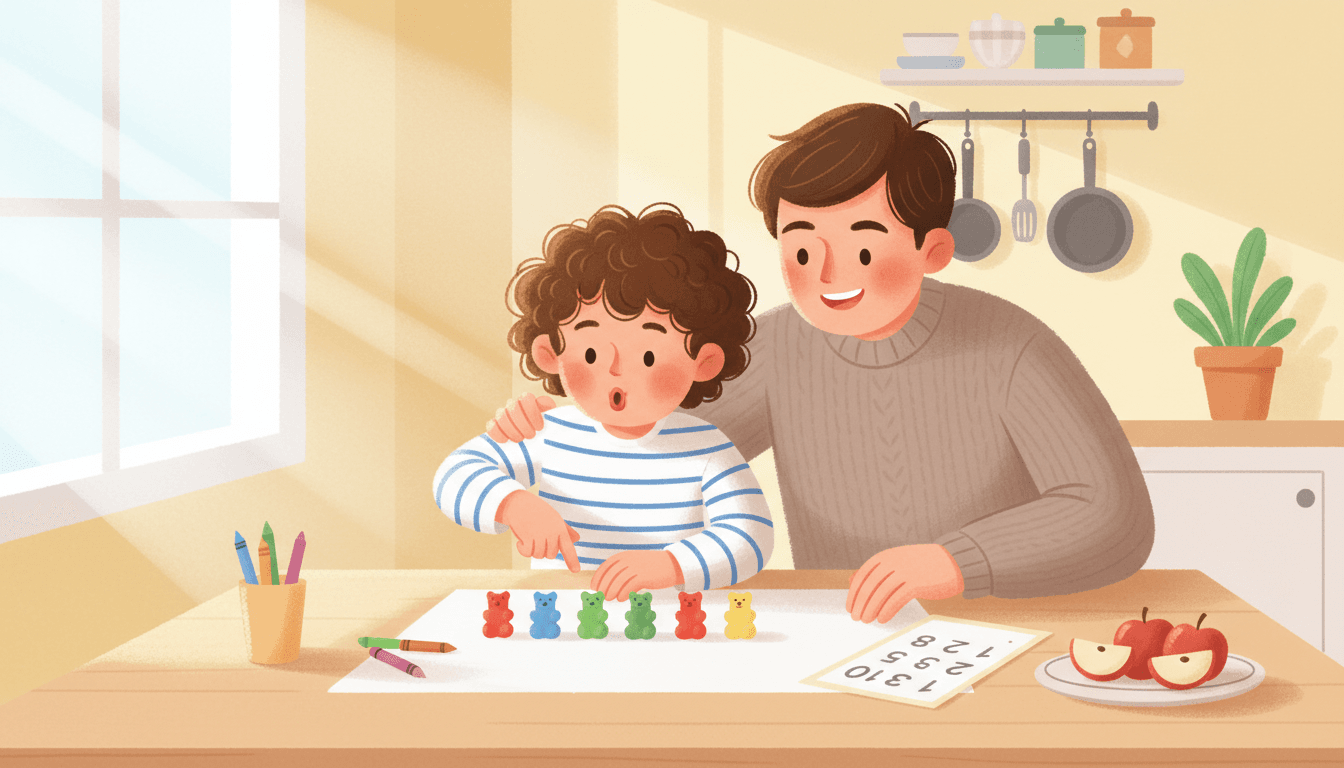
There are no timed tests. No flash cards (unless a child is ready and enjoys them). At this age, math is hands-on first. Your child will use physical objects, fingers, and drawings long before they see a plus sign on paper.
The progression works like this:
- Objects: "You have 3 blocks. I give you 2 more. How many now?" (Child counts all blocks.)
- Fingers: "Show me 4 fingers. Now show 1 more. How many fingers?"
- Drawings: "Draw 5 dots. Cross out 2. How many are left?"
- Equations: 5 + 2 = 7 (this comes last, after the concept is solid)
By the end of kindergarten, most children can fluently add and subtract within 5 and solve problems within 10 with support.
How to practice at home: Use snacks. Seriously. "You have 6 crackers. You eat 2. How many are left?" Your child can physically eat the crackers and count what's remaining. Math has never been more motivating.
You can also try our kindergarten addition activities once your child is comfortable with hands-on adding.
One important note: Don't rush to paper. If your child can add 3 + 2 by counting crackers but freezes when they see "3 + 2 = ?" on a page, that's not a problem. It just means they need more time with physical objects before moving to abstract symbols.
Shapes, Measurement, and Sorting
Geometry in kindergarten is more fun than it sounds. Your child gets to play with shapes, build things, and sort objects, and all of it counts as math.
The shapes kindergartners learn to identify:
- Circle, square, triangle, rectangle (the basics)
- Hexagon (six sides, and honestly, most kindergartners love saying this word)
But it goes beyond just naming shapes. Your child will learn to describe them. "A triangle has three sides and three corners." They'll compare shapes, combine them, and find them in the real world.
Measurement and sorting are the other pieces:
- Comparing objects by length ("Which pencil is longer?")
- Comparing by height ("Who is taller?")
- Comparing by weight ("Which bag is heavier?")
- Sorting and classifying objects by color, shape, size, or other attributes
How to practice at home:
- Go on a shape hunt: "Find everything in this room shaped like a rectangle."
- Sort laundry by color, size, or type.
- Compare items at the grocery store: "Which apple is bigger?"
- Build with blocks and talk about the shapes you're using.
Check out our kindergarten shapes practice pages for printable activities that make geometry hands-on and visual.
Patterns and Early Algebraic Thinking
This one surprises some parents. Algebra in kindergarten? Not exactly, but the foundation for it starts here.
Kindergartners work with repeating patterns. The simplest is an AB pattern: red, blue, red, blue, red, blue. Then they move to more complex ones like ABC (red, blue, green, red, blue, green) or ABB (clap, snap, snap, clap, snap, snap).
The key question is always: "What comes next?"
This matters because pattern recognition is the basis for so much later math. Multiplication tables are patterns. Skip counting is a pattern. Functions in algebra are patterns. When your kindergartner figures out that circle, square, circle, square means the next one is a circle, they're building a thinking skill that will serve them for years.
How to practice at home:
- Make patterns with snacks: grape, cracker, grape, cracker.
- Clap and stomp patterns: clap, clap, stomp, clap, clap, stomp.
- String beads in a pattern.
- Ask your child to create a pattern and then see if you can figure out the rule.
What to Watch For: Signs Your Child May Need Extra Support
Every child develops at their own pace, and there's a wide range of "normal" in kindergarten math. But there are a few signals worth paying attention to.
By mid-year, check in on these:
- Can your child count to at least 10 with one-to-one correspondence? (Touching each object and saying one number per object.)
- Can they recognize the numerals 0 through 5?
- Do they understand "more" and "less" when comparing small groups?
If your child is struggling with these basics by January or February, it doesn't mean something is wrong. But it does mean a conversation with their teacher is a good idea. Early support makes a real difference, and kindergarten teachers are honestly great at spotting when a child just needs a little extra time versus when something more specific is going on.
These are signals, not diagnoses. Some kids need more time. Some need a different approach. Some just need more practice in a low-pressure setting. The point is to notice early, so you can help early.
Keep Reading
- How to Teach Number Sense to Kindergartners: Activities That Build Real Understanding
- Geometry and Shapes Activities for Kindergarten
- How to Teach Addition to Kindergartners: Hands-On Activities That Build Understanding
- Elementary Math Teaching Strategies That Hold Up
- Order of Operations, Equals Signs, and the Math Myths We Teach
How to Practice at Home Without It Feeling Like School
Here's the thing: if math at home feels like homework, your kindergartner will probably resist it. And honestly, you would too.
The best math practice at this age doesn't look like math at all. It looks like playing.
Board games with dice are secretly incredible math tools. Every time your child rolls the dice and counts the dots, they're practicing number recognition, counting, and one-to-one correspondence. Games like Chutes and Ladders, Hi Ho! Cherry-O, and even simple card games build math skills without anyone noticing.
Cooking together involves counting, measuring, and following sequences. "We need 3 eggs. Can you count them out?" That's math.
Building with blocks teaches shapes, spatial reasoning, and early geometry. "Can you make a tower with 8 blocks? Now take away 3. How many are left?" That's addition and subtraction.
Printable practice pages are great for targeted skills, especially when your child is ready for something more structured. Ten to fifteen minutes a day is plenty. And if your child wants to stop after five minutes, that's fine too. Short, positive sessions beat long, frustrating ones every time.
A few ground rules for math at home:
- Keep it to 10 to 15 minutes. Kindergartners have short attention spans. That's not a flaw, it's just where they are developmentally.
- Praise effort, not just correct answers. "I love how you counted each one carefully" matters more than "You got it right."
- Let them use their fingers. Fingers are not a crutch. They're a legitimate math tool at this age.
- Follow their lead. If your child is obsessed with dinosaurs, count dinosaurs. If they love stickers, use stickers for adding and subtracting.
Kindergarten math is not about getting ahead. It's about building a foundation that makes your child feel like math is something they can do. And probably the most important thing you can give them this year is the belief that math is not scary, not boring, and not just for "math people."
It's for everyone. Including your little one 😊

Adi Ackerman
Head Teacher
Adi is the Head Teacher at ClassWeekly, with years of experience teaching elementary students. She designs our curriculum-aligned worksheets and writes practical guides for teachers and parents.
Keep Reading
Ready to download? Try ClassWeekly free for 30 days.
Unlimited worksheets for PreK through 5th grade. Cancel anytime.