What Is a 504 Plan?
Taught in US schools

Key Takeaways
- A 504 Plan provides accommodations that give students with disabilities equal access to education - without changing the curriculum or providing specialized instruction.
- Unlike an IEP, a 504 Plan does not include annual goals, specialized instruction, or a special education placement.
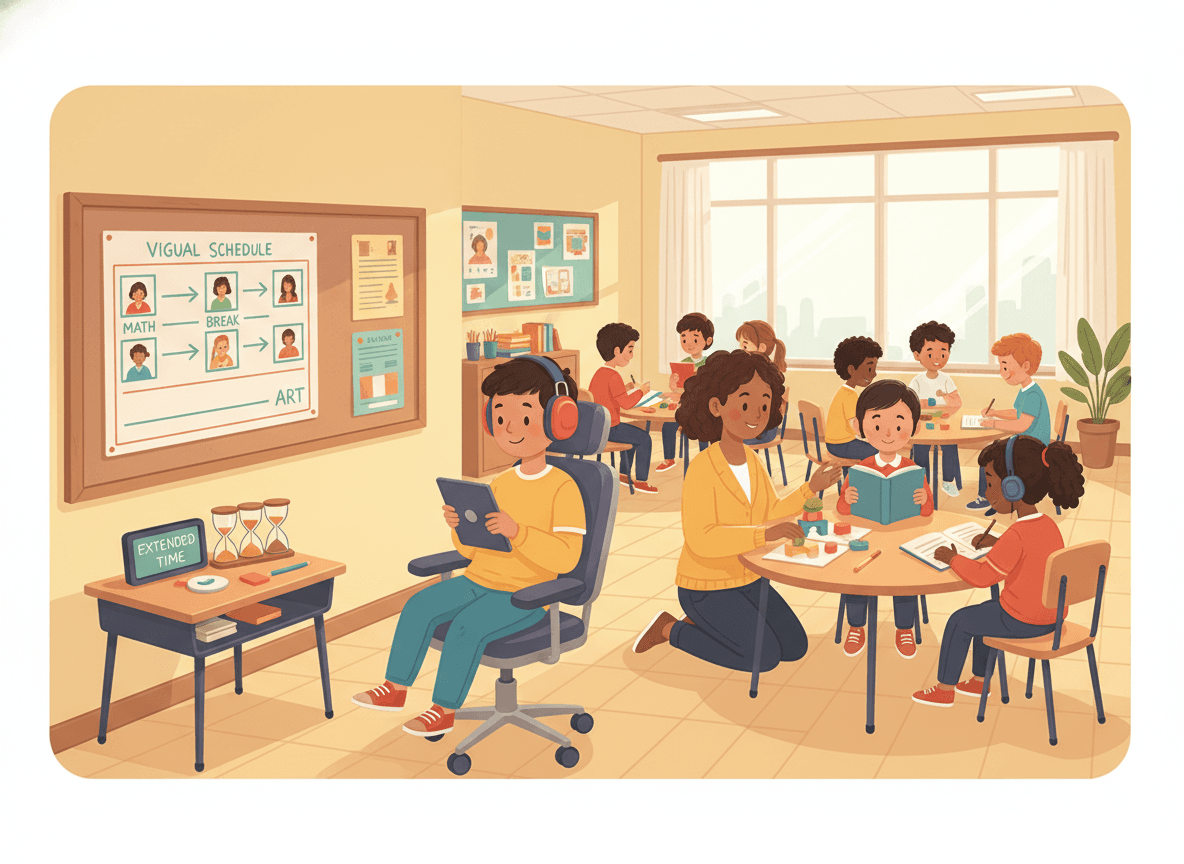
- Common 504 accommodations include extended time, preferential seating, breaks, larger print, and use of assistive technology.
What Is a 504 Plan?
A 504 Plan is a written plan that outlines accommodations for a student with a disability to ensure they have equal access to education. It is named after Section 504 of the Rehabilitation Act of 1973, a federal civil rights law that prohibits discrimination against people with disabilities in schools that receive federal funding.
A 504 Plan does not provide specialized instruction - it simply removes barriers that would otherwise prevent the student from participating fully in the general education program.
Who Qualifies for a 504 Plan?
A student qualifies for a 504 Plan when:
- The student has a physical or mental impairment that
- Substantially limits one or more major life activities
Major life activities include: learning, reading, concentrating, thinking, communicating, walking, seeing, hearing, and self-care.
Examples of conditions that commonly lead to 504 Plans:
- ADHD (when it affects concentration but does not require specialized instruction)
- Anxiety or depression
- Asthma or severe allergies
- Diabetes or other medical conditions requiring monitoring
- Mild dyslexia not severe enough to qualify for an IEP
What Is in a 504 Plan?
Unlike an IEP, a 504 Plan does not require a specific federal format, but it typically includes:
Student information: Name, grade, disability, and how it affects school performance
Accommodations: Specific, concrete adjustments the school will provide
Personnel responsible: Which staff members will implement each accommodation
Review date: When the plan will be reviewed (typically annually)
Common 504 Accommodations
Time: Extended time on tests and assignments, reduced homework
Environment: Preferential seating (near the teacher, away from distractions), separate testing room
Presentation: Larger print materials, audio versions of text, simplified directions
Response: Allow oral responses instead of written, use of a scribe, speech-to-text software
Scheduling: Frequent breaks, flexible deadlines, modified schedule
Equipment: Calculator, text-to-speech software, fidget tools, noise-canceling headphones
Medical: Nurse check-ins, snacks for blood sugar management, medication administration
504 Plan vs. IEP: Key Differences
Governing law: Rehabilitation Act (civil rights)
Eligibility standard: Disability that limits a major life activity
****Specialized instruction?: No
****Annual goals?: No
****Special education placement?: No - general ed only
****Team required?: No formal team required
Reevaluation: No required timeline
When to use which: If a student needs a different way to learn (a different curriculum, approach, or teacher) → IEP. If the student can learn grade-level content but needs adjustments to how it is delivered or assessed → 504.
The 504 Meeting
While 504 Plans do not require the same formal team as an IEP, schools typically hold a 504 meeting that includes:
- Parents/Guardians
- General education teacher
- School counselor or psychologist (sometimes)
- An administrator or 504 coordinator
Parents have the right to review and consent to the plan.
Practice Activities
- Compare a sample IEP accommodation list and a sample 504 accommodation list - which accommodations appear on both? Which are only on one?
- Discuss a case study: a student with ADHD who is struggling to focus but is performing at grade level - IEP or 504? Justify the reasoning.
- Research five common accommodations and explain how each one removes a barrier for a specific type of learner.
- Role-play a parent-teacher conversation about requesting a 504 evaluation for a student.
- Create an infographic for parents explaining the difference between a 504 Plan and an IEP in simple, jargon-free language.
Frequently Asked Questions
What law governs 504 Plans?
504 Plans are governed by Section 504 of the Rehabilitation Act of 1973, a federal civil rights law that prohibits discrimination against people with disabilities in programs that receive federal funding, including public schools. Unlike IDEA (which governs IEPs), Section 504 is a civil rights protection, not a special education law.
Who qualifies for a 504 Plan?
Any student with a physical or mental impairment that substantially limits one or more major life activities (including learning, reading, concentrating, walking, seeing, or hearing) may qualify for a 504 Plan. The disability does not need to be severe enough to require specialized instruction - only enough to need adjustments for equal access.
Can a student have both a 504 Plan and an IEP?
No. A student cannot have both at the same time. If a student qualifies for an IEP (specialized instruction under IDEA), the IEP includes both the specialized services AND any needed accommodations. A 504 Plan is used when the student needs accommodations but does not need specialized instruction.
Free 504 Plan Worksheets
Curriculum-aligned printable worksheets for Kindergarten – 5th Grade. Download free.