What Is Response to Intervention (RTI)?
Taught in US schools

Key Takeaways
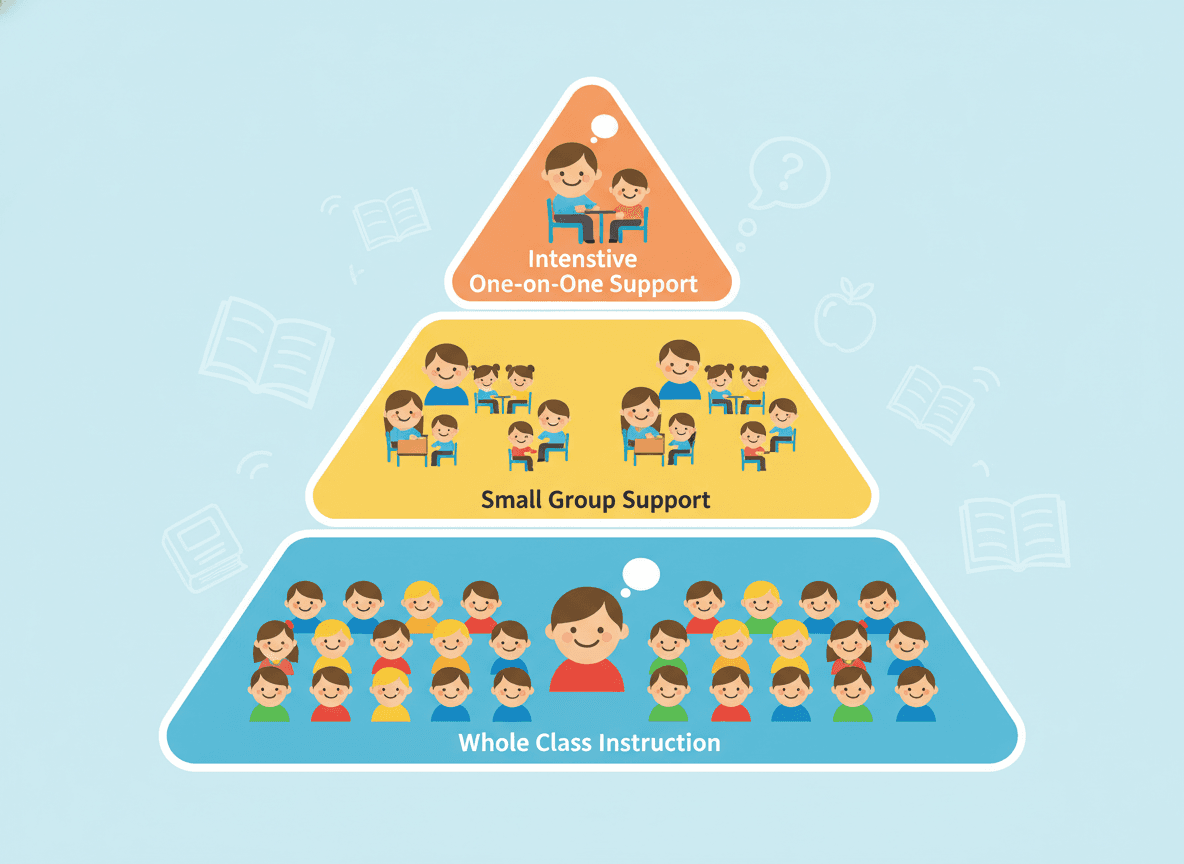
- RTI is a three-tiered framework: Tier 1 (whole class), Tier 2 (small group intervention), Tier 3 (intensive support).
- Universal screening identifies students who may need additional support before they fall far behind.
- Progress monitoring tracks student response to intervention - is the support working? If not, intensify it.
- RTI is a prevention model, not just a referral pathway - the goal is to catch and address difficulties early.
What Is Response to Intervention (RTI)?
Response to Intervention (RTI) is a school-wide framework for identifying students who are struggling academically and providing them with increasingly intensive instruction before they fall significantly behind. Rather than waiting for a student to fail before providing help, RTI catches difficulties early through universal screening and addresses them systematically through a tiered support structure.
RTI was formalized in the Individuals with Disabilities Education Act (IDEA) reauthorization of 2004. Today it is often subsumed under the broader Multi-Tiered Systems of Support (MTSS) framework, which extends tiered support to social-emotional and behavioral needs as well as academics.
The Three Tiers of RTI
Tier 1: Core Instruction (All Students)
Who: Every student in the general education classroom.
What: High-quality, evidence-based instruction delivered by the classroom teacher.
Goal: Approximately 80% of students should meet grade-level benchmarks through Tier 1 alone.
If fewer than 80% of students meet benchmarks, the issue is likely with the quality of Tier 1 instruction, not individual student need.
Tier 2: Supplemental Intervention (Some Students - ~15%)
Who: Students not meeting benchmarks after Tier 1 instruction.
What: Small-group (3-5 students) supplemental instruction, typically 20-30 minutes, 3-4 times per week, targeting specific skill gaps.
Who provides it: Classroom teacher, reading specialist, interventionist.
Duration: Typically 6-8 weeks with progress monitoring throughout.
Tier 2 does not replace Tier 1 - it adds to it.
Tier 3: Intensive Intervention (Few Students - ~5%)
Who: Students who do not make adequate progress at Tier 2.
What: More intensive, individualized intervention - smaller groups or one-on-one, longer sessions, more frequent, more structured.
Who provides it: Specialist, intervention team.
Next step: If Tier 3 is insufficient, a comprehensive evaluation for learning disability may be considered.
The RTI Cycle
- Universal Screening - All students are screened 3x/year (fall, winter, spring) using brief, standardized tools.
- Data analysis - Teams examine screening data to identify who needs support.
- Tiered placement - Students are matched to the appropriate tier based on data.
- Evidence-based intervention - Students receive research-backed instruction at their tier.
- Progress monitoring - Students at Tier 2 and 3 are monitored weekly or bi-weekly.
- Data-based decisions - Teams review progress data regularly (every 6-8 weeks) and adjust: fade, continue, or intensify.
Common RTI Screening and Monitoring Tools
Reading:
- DIBELS (Dynamic Indicators of Basic Early Literacy Skills) - widely used in K-3
- STAR Reading - adaptive assessment
- AIMSWeb - benchmark and progress monitoring
Math:
- AIMSWeb Math
- STAR Math
- easyCBM
Common Misconceptions
RTI is a pathway to special education: RTI is primarily a prevention and support framework, not a referral system. The goal is to provide effective instruction so students don't need special education services. When a student does eventually need evaluation, RTI data enriches that process - but most students who receive Tier 2 support return to Tier 1 within 8-12 weeks.
Tier 2 students leave the classroom for all their learning: Tier 2 provides supplemental instruction in addition to core Tier 1 - not instead of it. Students continue receiving classroom instruction; the additional support time is built into the schedule separately.
RTI is only for reading: RTI frameworks apply to math, writing, and social-emotional skills, not just reading. Many schools have well-developed reading RTI systems and are building similar structures in math.
Practice Activities
-
Student data notebook: Each student keeps a simple graph of their reading benchmark scores - visual progress tracking builds motivation and metacognitive awareness.
-
Tier 2 scheduling: Build a consistent 20-30 minute intervention block into the daily schedule so it doesn't compete with core instruction.
-
Problem-solving team meetings: Monthly grade-level data meetings review progress monitoring charts and make placement decisions as a team.
-
Skill-specific grouping: Form Tier 2 groups around a specific, narrow skill (e.g., short vowel decoding) so instruction is focused and groups can dissolve when the skill is mastered.
-
Parent communication: Share RTI progress data with parents in parent-friendly language - what skill is being worked on, how the student is progressing, what parents can do at home to support.
Frequently Asked Questions
What is Response to Intervention (RTI)?
Response to Intervention (RTI) is a multi-tiered school-wide framework for identifying students who are struggling and providing them with appropriately intensive support. It emerged from IDEA 2004 (Individuals with Disabilities Education Act) as an alternative to the 'wait to fail' model where students had to be significantly behind before receiving help. RTI uses universal screening, tiered instruction, and progress monitoring to identify difficulties early and match support to student needs. RTI is also known as Multi-Tiered Systems of Support (MTSS), which adds social-emotional and behavioral supports alongside academic ones.
What are the three tiers of RTI?
Tier 1 is high-quality core instruction for all students - what every student receives in the general education classroom. Approximately 80% of students should meet grade-level expectations through Tier 1 alone. Tier 2 is supplemental small-group instruction for students who need additional support beyond core instruction - typically 3-5 students meeting 3-4 times per week for 20-30 minutes. About 15% of students may need Tier 2 at some point. Tier 3 is intensive, individualized intervention for students who are not making adequate progress at Tier 2 - smaller groups or one-on-one instruction, more frequent and longer sessions. About 5% of students may need Tier 3.
What is universal screening in RTI?
Universal screening is a brief assessment given to all students (not just those suspected of difficulty) typically three times per year (fall, winter, spring). Common screening tools include DIBELS (Dynamic Indicators of Basic Early Literacy Skills) for reading and AimsWeb or STAR for both reading and math. Screening identifies which students are on track, which may need monitoring, and which likely need Tier 2 support - before they fall significantly behind. The earlier a difficulty is identified, the more efficiently it can be addressed.
What is progress monitoring?
Progress monitoring is the frequent, ongoing assessment of a student's response to intervention - typically weekly or bi-weekly for students receiving Tier 2 or Tier 3 support. Brief, standardized probes measure whether a student is making adequate progress. If progress is sufficient, the intervention may be adjusted or faded. If progress is insufficient after a defined period (typically 6-8 weeks), the intervention is intensified or the student is considered for a more comprehensive evaluation. Progress monitoring data is graphed so the trend is visible and decisions are data-driven, not subjective.
How does RTI relate to special education?
RTI is not special education - it is a general education framework. Students receive RTI supports within general education. However, for students who do not respond adequately to Tier 3 interventions, RTI data provides documentation that the student has received research-based instruction at increasing intensity, which is part of the evaluation process for a potential learning disability identification. RTI shifts the question from 'does this child have a disability?' to 'does this child respond to instruction?' - a more instructionally useful frame, and one that prevents over-identification of students whose difficulties stem from insufficient teaching rather than a disability.
Free Response to Intervention (RTI) Worksheets
Curriculum-aligned printable worksheets for Kindergarten – 5th Grade. Download free.