What Are Angles?
Taught in US schools
Key Takeaways
- An angle is formed by two rays sharing a common endpoint (vertex). Measured in degrees (°).
- Right angle = 90° (corner of a square). Acute < 90°. Obtuse > 90° but < 180°. Straight = 180°.
- A full rotation = 360°. A right angle is 1/4 of a full rotation.
- Angles are added: two adjacent angles combine to form a larger angle (3.MD.C → 4.MD.C.7).
What Are Angles?
An angle is formed when two rays share a common endpoint (vertex).
The opening between the two rays determines the angle's size, measured in degrees (°).
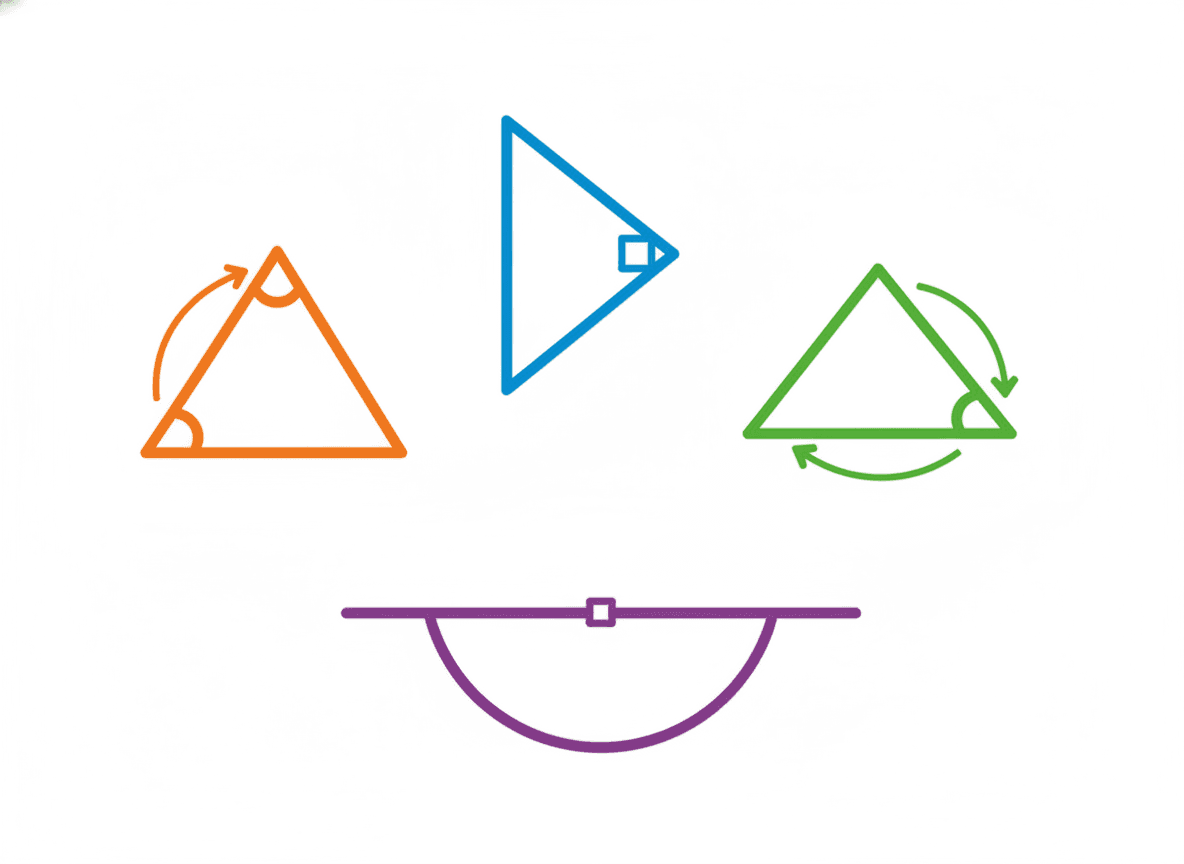
Think of it as a rotation: a right angle (90°) is exactly a quarter turn; a full rotation is 360°.
Types of Angles
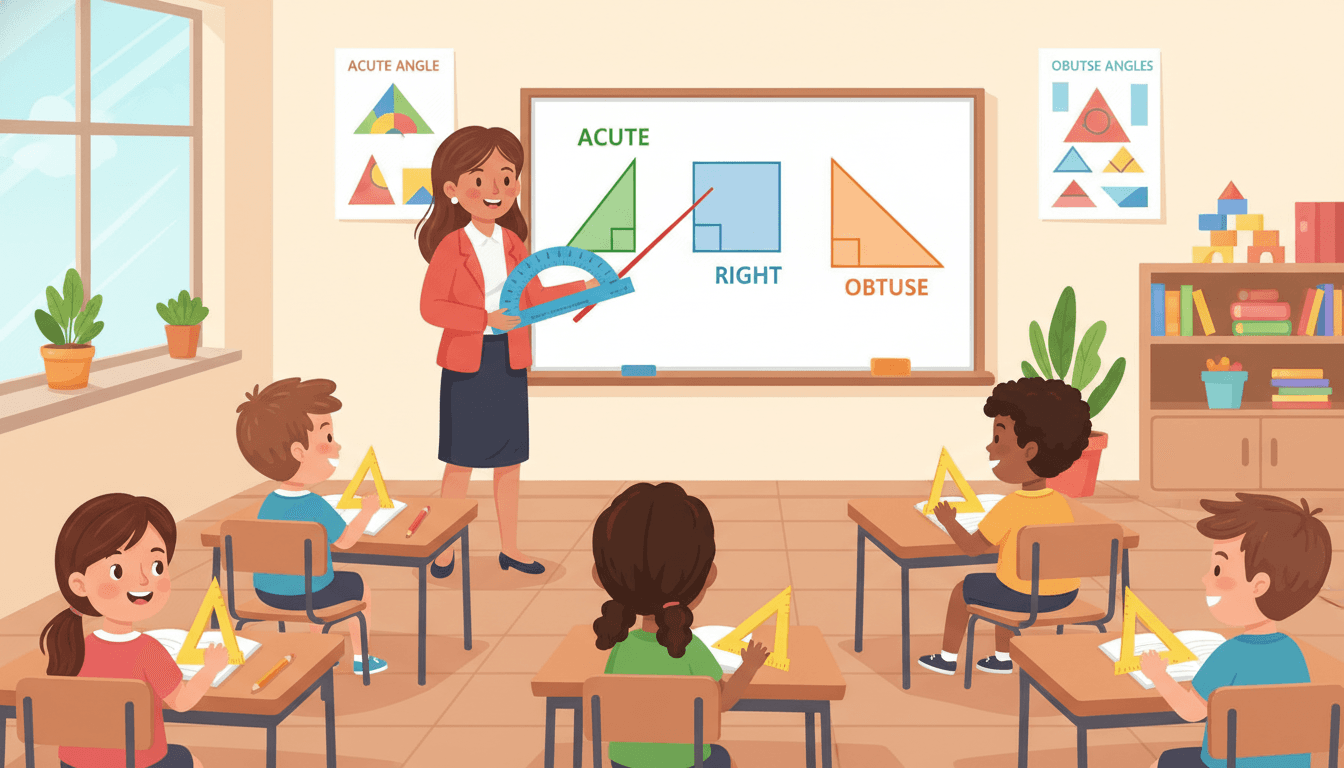
Acute: Less than 90° - Sharp, pointed
Right: Exactly 90° - Corner of a square (marked with □)
Obtuse: Greater than 90°, less than 180° - Wide, open
Straight: Exactly 180° - A straight line
Memory trick: Acute angles look sharp (like a sharp point). Obtuse angles look blunt and wide. Right angles look like the corner of a piece of paper.
Measuring Angles with a Protractor
A protractor measures angles in degrees (0°–180°).
Steps:
- Place the center hole on the vertex of the angle
- Align one ray with the 0° baseline
- Read the degree mark where the other ray crosses the scale
Avoid the double-scale trap: Protractors have two scales. Always check: does my reading make sense? If the angle looks acute, it must be less than 90°.
Angles as Fractions of a Circle
A full rotation = 360°
1/4 turn: 90° - Right angle
1/2 turn: 180° - Straight angle
3/4 turn: 270° - -
1 full turn: 360° - Full rotation This connection makes Common Core's angle measurement standard (4.MD.C.5) visual: angles are portions of a circle.
Angle Addition
Adjacent angles (sharing a side) can be added together:
Angle A = 40°, Angle B = 50°, together they form → 90°
Problem type: "The total angle is 130°. One part is 75°. What is the other part?" → 130 − 75 = 55°
What Grade Do Kids Learn Angles?
3rd Grade: Identify right angles; distinguish between shapes with and without right angles; recognize acute and obtuse angles (3.G.A.1).
4th Grade: Understand angle concepts (degree as a unit, angle as a fraction of a circle); use a protractor to measure and draw angles; solve addition/subtraction problems involving angles (4.MD.C.5, C.6, C.7); identify and classify lines and angles in geometry (4.G.A.1).
Common Misconceptions
"The longer the rays, the bigger the angle." Angle size depends only on the opening between the rays, not their length. A right angle with short rays is still 90°.
"Right angles only appear in squares." Right angles appear in rectangles, at corners of rooms, on the edge of a piece of paper, and wherever perpendicular lines meet.
"Reading the wrong scale on the protractor." Always estimate first: acute or obtuse? Then read the matching range on the scale.
Practice Activities
-
Angle sort: Cards with angles drawn; students sort into acute / right / obtuse without measuring.
-
Protractor practice: Measure pre-drawn angles; draw angles of specified degrees.
-
Angle hunt: Walk around the classroom; find and classify real-world angles.
-
Angle addition puzzles: Given a large angle and one part, find the missing part using subtraction.
-
Patty paper angles: Fold patty paper to model specific fractions of a rotation (1/4 = right angle, 1/2 = straight angle).
Frequently Asked Questions
What are the four types of angles?
Right angle: exactly 90°. Marked with a small square symbol. The corner of a square, sheet of paper, or room wall forms a right angle. Acute angle: less than 90°. 'Acute' comes from the Latin word for sharp - acute angles look sharp and pointed. Obtuse angle: greater than 90° but less than 180°. 'Obtuse' means blunt - obtuse angles look wider and more open than right angles. Straight angle: exactly 180°. A straight line forms a straight angle. Reflex angle (greater than 180°): exists but is not a K-5 standard.
How do you measure an angle with a protractor?
Step 1: Place the protractor's center point on the angle's vertex. Step 2: Align one ray with the protractor's 0° baseline. Step 3: Read the number where the other ray crosses the protractor's scale. Important: protractors have two scales (inner and outer). If the angle opens to the right, use the scale that starts from 0 on the right. If it opens to the left, use the left-starting scale. A key estimation check: if the angle looks acute (less than 90°), the measurement should be less than 90. If it looks obtuse, it should be more than 90. Reading the wrong scale is the most common protractor error.
How do angles relate to turns and rotations?
An angle can be thought of as a turn. A full rotation (360°) is one complete turn. A right angle (90°) is one-quarter turn. A straight angle (180°) is one-half turn. This connection is made explicit in Common Core 4.MD.C.5: 'An angle is measured with reference to a circle with its center at the common endpoint.' Thinking of angles as turns or 'openings' builds intuition - more open = more degrees.
What is the angle addition postulate?
When two angles share a side (are adjacent), their measures add to the total angle. If angle A = 35° and angle B = 55°, and they share a side, the combined angle A+B = 90°. This is the angle addition postulate. In 4th grade, it's applied in problems like: 'The total angle is 120°. One part is 45°. What is the other part?' (120 − 45 = 75°). This connects angle measurement to addition and subtraction of whole numbers.
Where do angles appear in everyday life?
Right angles: corners of books, rooms, windows, and computer screens. Acute angles: the hands of a clock at 2:00 or 10:00, the peak of a steep roof. Obtuse angles: the back of a reclining chair, the hands of a clock at 8:00. Straight angles: a flat horizon, an unfolded piece of paper. Right angles are the most common in built environments - most buildings are designed with perpendicular walls and floors. The angle hunt (walking around finding examples of each type) is a powerful experiential lesson.
Free Angles Worksheets
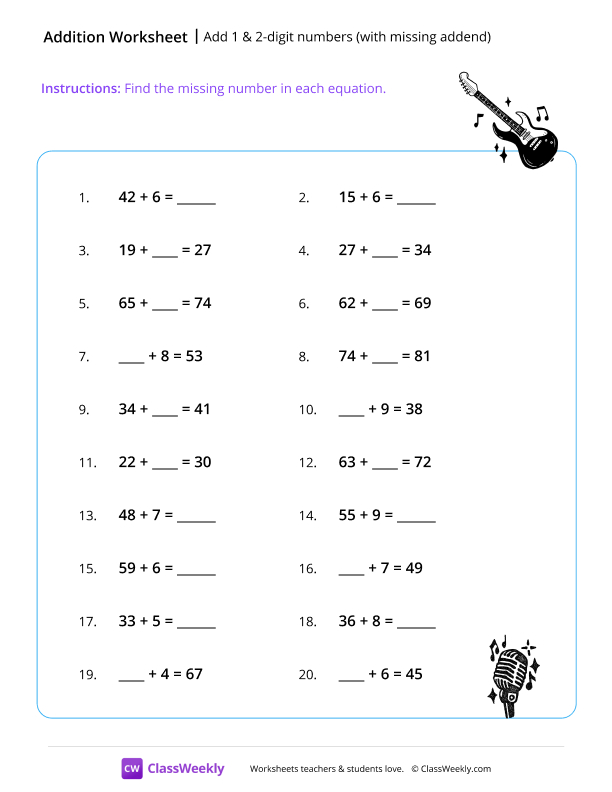
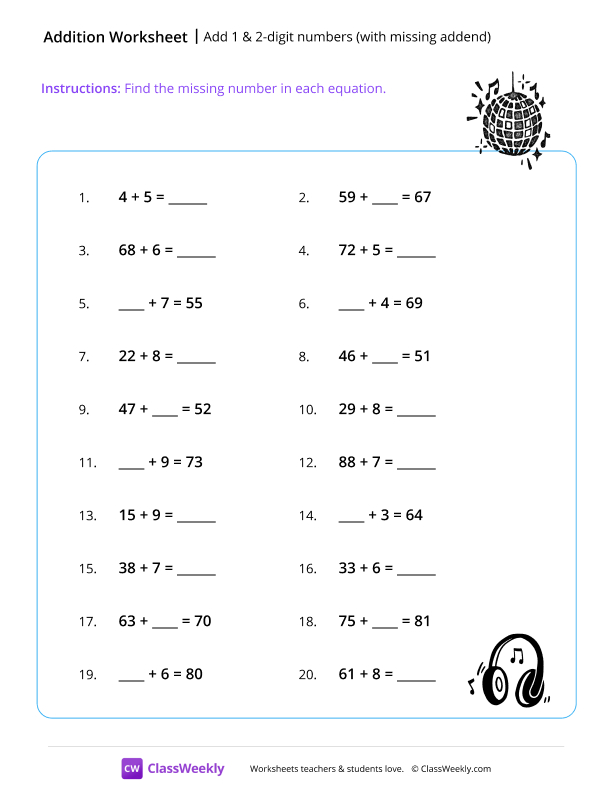
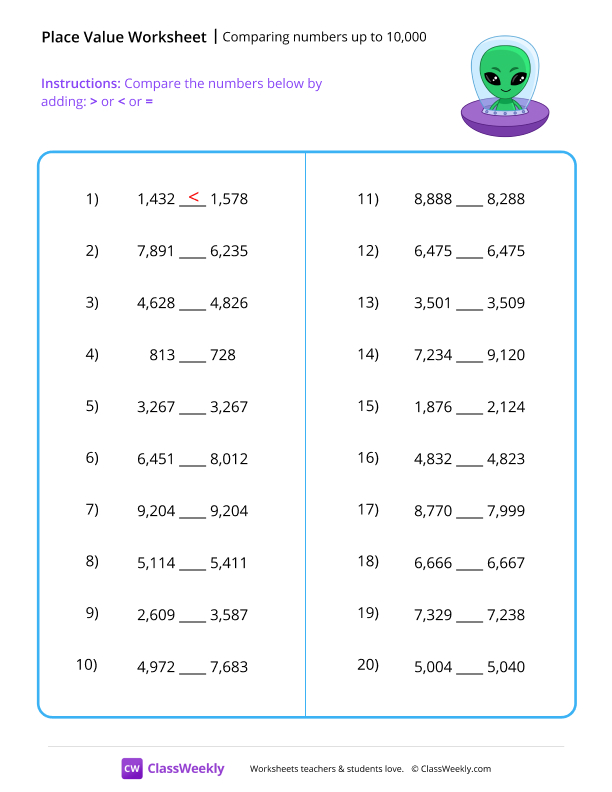
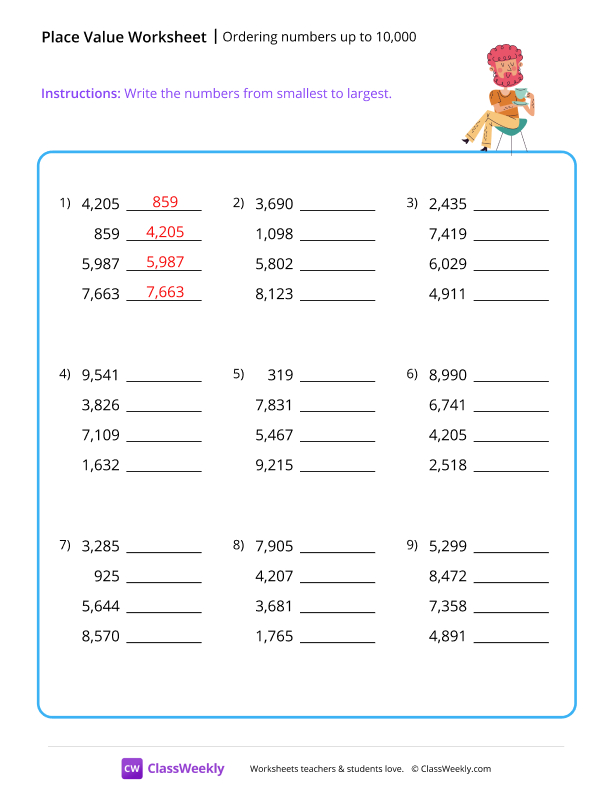
Curriculum-aligned printable worksheets for 3rd – 4th Grade. Download free.