What Is Symmetry?
Taught in US schools
Key Takeaways
- A shape has a line of symmetry if folding along that line makes both halves match exactly.
- Some shapes have multiple lines of symmetry (circle = infinite; square = 4; rectangle = 2).
- A shape that has no line of symmetry is asymmetrical.
- Symmetry connects to geometry, art, and the natural world - leaves, butterflies, snowflakes.
What Is Symmetry?
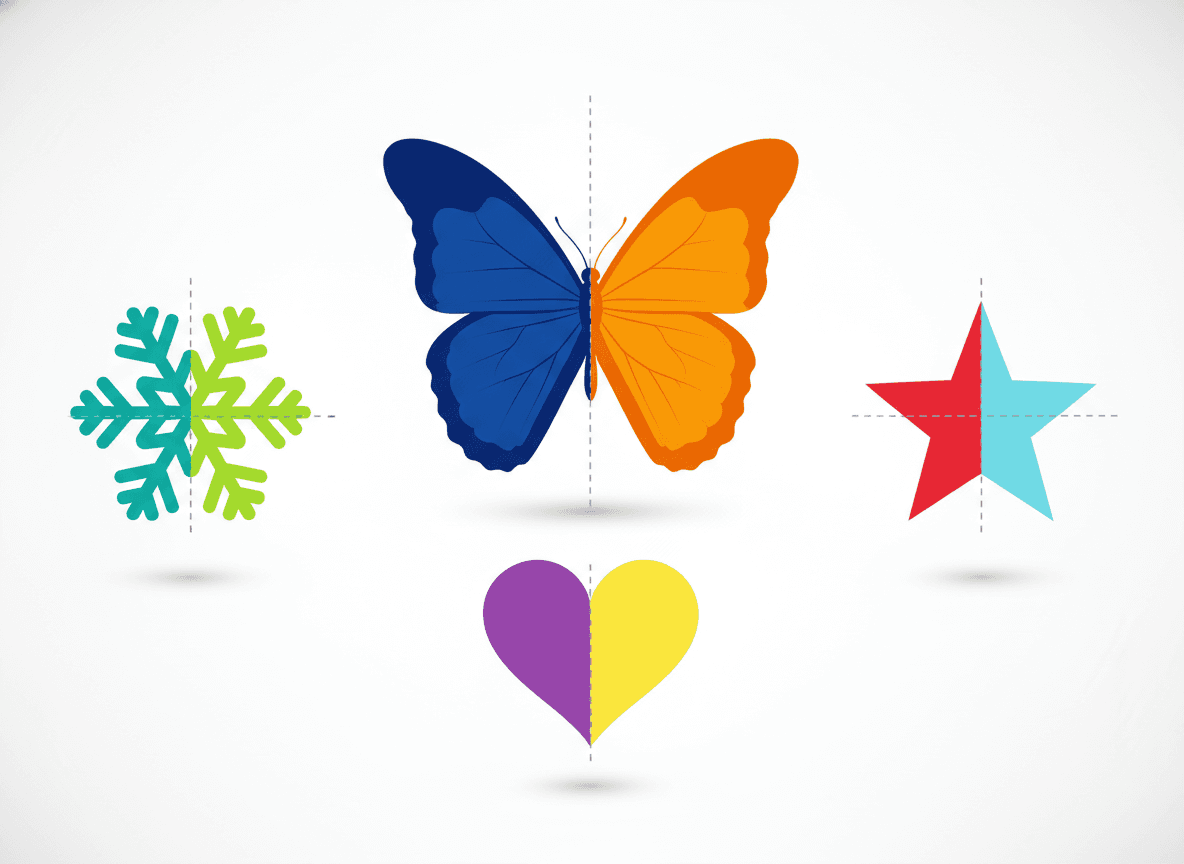
Symmetry exists when a shape can be divided into two halves that are exact mirror images of each other.
The dividing line is called the line of symmetry.
Test: Fold the shape along the line. If both halves match perfectly, the shape is symmetrical.
Line Symmetry
A line of symmetry divides a figure into two congruent, mirror-image halves.
Shapes and their lines of symmetry:
Circle: Infinite
Square: 4
Equilateral triangle: 3
Regular pentagon: 5
Regular hexagon: 6
Rectangle (non-square): 2
Isosceles triangle: 1
Scalene triangle: 0
Parallelogram: 0
Finding Lines of Symmetry
Strategies for identifying lines of symmetry:
- Fold test: If you can fold the shape so both halves match, that fold line is a line of symmetry
- Trace and flip: Trace one half; flip it across the line; does it match?
- Mirror: Hold a small mirror along the edge of the shape - if the reflection looks like the complete shape, that's a line of symmetry
Symmetry in the Real World
-
Butterflies: Left wing mirrors right wing (bilateral symmetry)
-
Snowflakes: 6 lines of symmetry
-
Letters: A, H, I, M, O, T, V, W, X, Y are vertically symmetric
-
Architecture: Many buildings have symmetrical designs
-
Human face: Approximate bilateral symmetry
Asymmetry
A shape or figure that has no line of symmetry is called asymmetrical.
Most real-world objects are not perfectly symmetric. An irregular polygon with no matching halves is asymmetrical.
What Grade Do Kids Learn Symmetry?
4th Grade: Recognize a line of symmetry for a two-dimensional figure; identify line-symmetric figures and draw lines of symmetry (4.G.A.3).
Informal exposure to symmetry - folding shapes, noticing it in art and nature - often happens in earlier grades.
Common Misconceptions
"A rectangle has 4 lines of symmetry like a square." A non-square rectangle has only 2 lines of symmetry (horizontal and vertical). Diagonal lines are NOT lines of symmetry for rectangles - folding diagonally doesn't produce matching halves.
"Any fold creates a line of symmetry." Only folds where the two halves match exactly count. Folding a rectangle corner to corner does not produce matching halves.
"Symmetrical means the same on all sides." Symmetry applies to a specific line (or axis). A shape can be symmetric across one axis but not others.
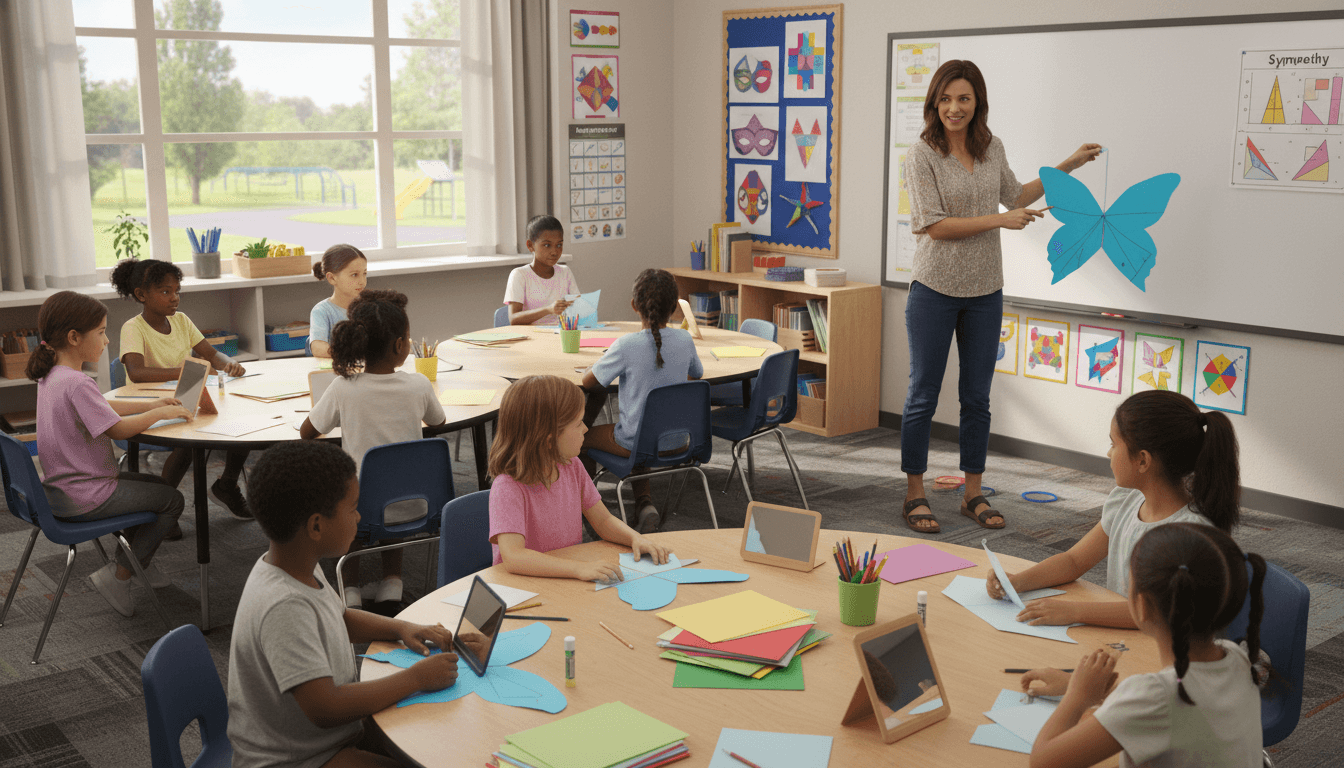
Practice Activities
-
Fold and cut: Fold paper and cut a shape along the fold - open to see a symmetric figure.
-
Complete the figure: Given one half of a shape, draw the other half to create a symmetric figure.
-
Line of symmetry drawing: Using dot paper or grid paper, draw all lines of symmetry for various shapes.
-
Symmetry hunt: Find symmetric letters, shapes, and objects in the classroom.
-
Ink blot art: Drop paint on one side of folded paper, fold and press - unfold to see symmetric design (connects symmetry to art).
Frequently Asked Questions
What is a line of symmetry?
A line of symmetry is an imaginary line that divides a figure into two congruent (matching) halves that are mirror images of each other. If you fold the shape along the line, the two halves align perfectly. A square has 4 lines of symmetry (horizontal, vertical, and two diagonal). A rectangle has 2 (horizontal and vertical - NOT diagonal). A circle has infinite lines of symmetry (any diameter). An irregular shape may have 0 lines of symmetry (asymmetrical).
How many lines of symmetry do common shapes have?
Circle: infinite (every diameter is a line of symmetry). Square: 4 (vertical, horizontal, and 2 diagonals). Equilateral triangle: 3 (one from each vertex to the midpoint of the opposite side). Rectangle (non-square): 2 (vertical and horizontal - NOT diagonal). Regular pentagon: 5. Regular hexagon: 6. Isosceles triangle: 1 (vertical from apex to base midpoint). Scalene triangle: 0. Parallelogram (non-rectangular): 0. A common error is thinking rectangles have diagonal lines of symmetry - they do not, because folding diagonally doesn't produce matching halves.
What is the difference between symmetry and congruence?
Congruent figures have the same shape and size - they can be placed on top of each other to match exactly (through translation, rotation, or reflection). Symmetry specifically involves reflection across a line - the two halves of a symmetric figure are mirror images. A symmetric figure contains congruent halves, but two congruent figures placed side by side are not necessarily part of a symmetric figure. Both concepts involve matching shapes and support the development of spatial reasoning.
Where does symmetry appear in the real world?
Symmetry is everywhere in nature and design. Butterflies: bilateral symmetry (left side mirrors right). Snowflakes: 6 lines of rotational symmetry. Human face: approximate bilateral symmetry. Leaves: often have a central line of symmetry. Architecture: many buildings are designed with symmetrical facades. Art: many compositions use symmetry for visual balance. Letters of the alphabet: A, H, I, M, O, T, U, V, W, X, Y are vertically symmetric; B, C, D, E, K are horizontally symmetric. Spotting symmetry in real objects deepens the concept beyond shape identification.
What is rotational symmetry?
Rotational symmetry exists when a shape can be rotated less than 360° and still look the same as the original. A square has rotational symmetry at 90°, 180°, and 270°. An equilateral triangle has rotational symmetry at 120° and 240°. A circle has rotational symmetry at every angle. Rotational symmetry is different from reflective symmetry (line symmetry) - a parallelogram has rotational symmetry (180°) but no line symmetry. Rotational symmetry is typically introduced in upper elementary but is not formally addressed until middle school standards.
Free Symmetry Worksheets
Curriculum-aligned printable worksheets for 4th Grade. Download free.
Common Core Standards