What Is an Array?
Taught in US schools
Key Takeaways
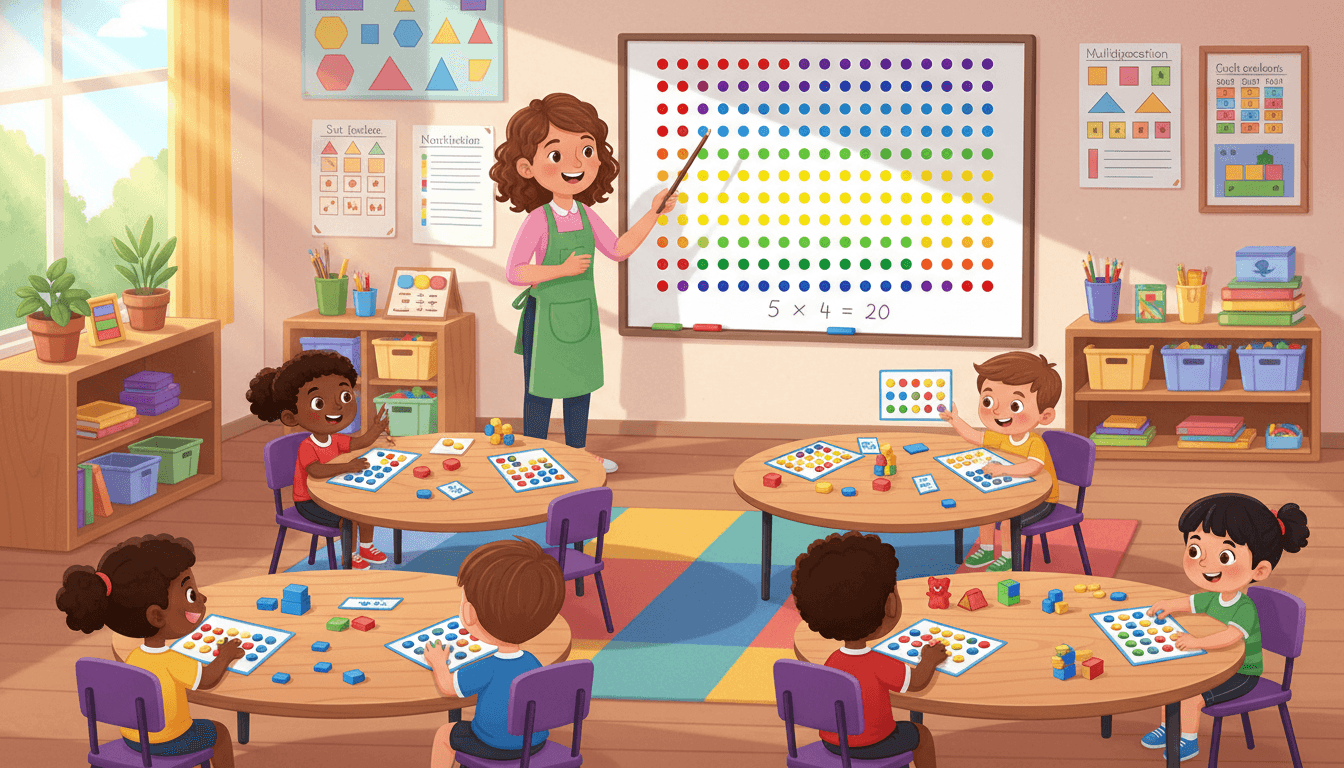
- An array organizes equal groups into rows and columns to show multiplication visually.
- The number of rows × the number of columns = the total, connecting arrays to multiplication facts.
- Arrays reinforce the commutative property: 3 × 4 and 4 × 3 show different arrays but the same product.
- Arrays also model division by asking how many rows or columns fit in a total.
What Is an Array?
An array is a mathematical arrangement of objects organized into equal rows and equal columns. Every row has the same number of objects, and every column has the same number of objects - making arrays one of the clearest visual models for multiplication in elementary school.
Think of an egg carton: 2 rows of 6 eggs = 12 eggs total. That egg carton is an array, and it perfectly represents 2 × 6 = 12.
How Arrays Model Multiplication
Arrays connect the physical act of arranging objects to the abstract multiplication equation:
-
Rows = the first factor (how many groups)
-
Columns = the second factor (how many in each group)
-
Total objects = the product
A 3 × 5 array has 3 rows of 5 dots = 15 dots. Students can count each dot individually first, then connect that count to repeated addition (5 + 5 + 5 = 15), then finally to the multiplication sentence (3 × 5 = 15). This progression builds conceptual understanding before procedural fluency.
What Grade Do Kids Learn Arrays?
2nd grade: Students arrange objects in equal rows using repeated addition (2.OA.C.4). They write equations like 2 + 2 + 2 + 2 = 8 for a 4 × 2 array.
3rd grade: Arrays become the primary visual model for introducing multiplication and division facts (3.OA.A.1, 3.OA.A.3). Students draw arrays, label rows and columns, and write both multiplication and division equations for the same array.
4th grade and beyond: Arrays evolve into area models that support multi-digit multiplication and partial products.
Arrays and the Commutative Property
One of the best uses of arrays is demonstrating the commutative property - that the order of factors doesn't change the product. A 3 × 4 array (3 rows, 4 columns) and a 4 × 3 array (4 rows, 3 columns) both contain 12 objects. Turning the array 90 degrees shows students that 3 × 4 = 4 × 3 without any computation.
Common Misconceptions
Rows vs. columns confusion: Students often mix up which dimension is the row and which is the column. Rows run horizontally (left to right) and columns run vertically (up and down). Using a memory trick - "rows go across like a row of seats" - helps.
Arrays must use dots or stars: Some students think arrays only work with drawn objects. In fact, tiled floors, graph paper squares, and even building windows are real-world arrays.
Arrays only show multiplication: Students may not realize that the same array can be read two ways for division. A 4 × 6 array answers both "What is 4 × 6?" and "If 24 is divided into 4 equal rows, how many are in each row?"
Practice Activities
-
Dot array cards: Give students grid paper to draw arrays for each fact family (e.g., all arrays for the number 12).
-
Real-world arrays: Find arrays in the classroom - window panes, ceiling tiles, cubbies - and write multiplication sentences.
-
Rotate and compare: Draw a 2 × 8 array, then rotate paper 90° to see the 8 × 2 array. Discuss why the product stays the same.
-
Array scavenger hunt: Students photograph rectangular arrangements at home and share their arrays with the class.
-
Division from arrays: Give students an array and ask them to write two multiplication and two division sentences using the same three numbers.
Frequently Asked Questions
What is an array in math?
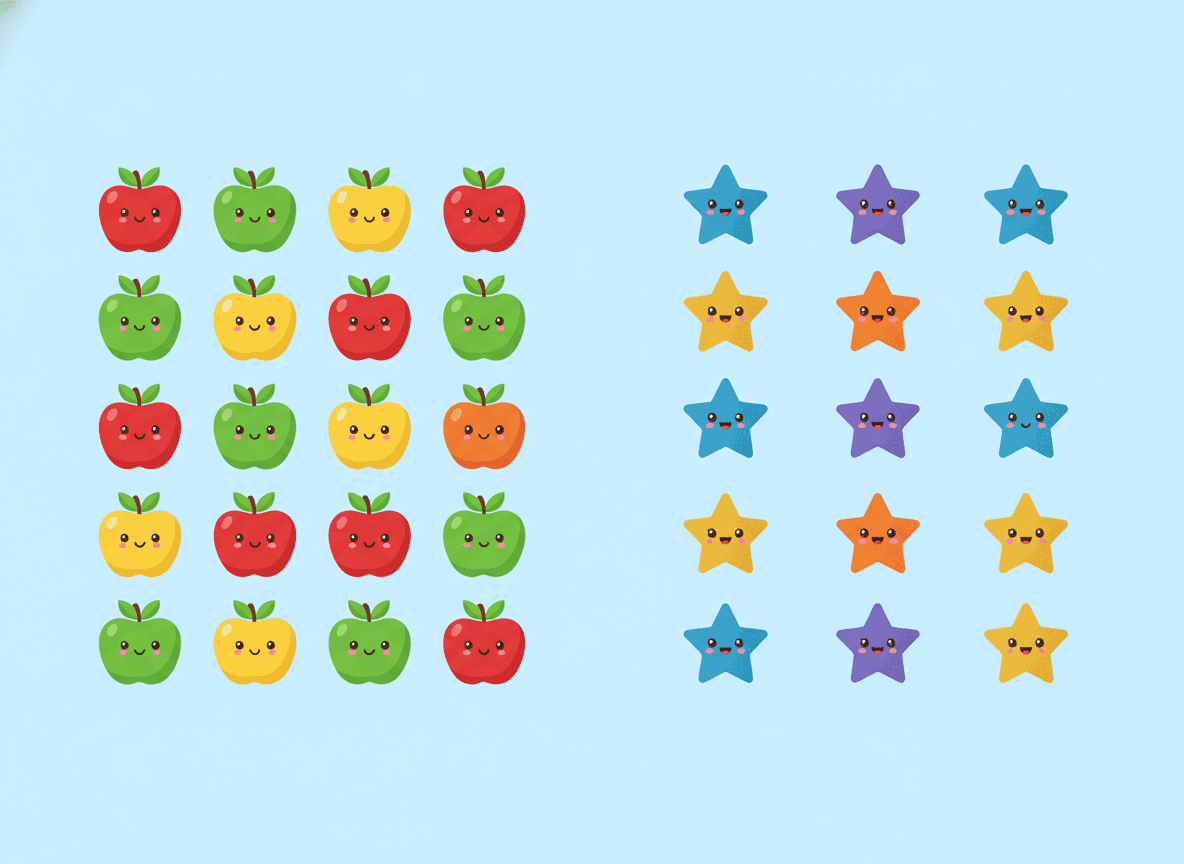
An array is a set of objects arranged in equal rows and equal columns. For example, 3 rows of 4 stars = 12 stars total. Arrays give students a visual model for multiplication, making abstract number sentences concrete and easy to understand.
How do arrays relate to multiplication?
Each array directly represents a multiplication equation. The number of rows is the first factor, the number of columns is the second factor, and the total number of objects is the product. A 4 × 6 array has 4 rows of 6 objects, equaling 24 - matching the equation 4 × 6 = 24.
What grade do students learn arrays?
Students begin exploring arrays in 2nd grade through equal groups and repeated addition. By 3rd grade, arrays are a core model for learning multiplication and division facts. Fourth graders use area models (a cousin of arrays) to multiply multi-digit numbers.
Can arrays be used for division?
Yes. Division can be modeled as: given 24 objects arranged in 4 equal rows, how many columns are there? Students work backward from the total to find the missing factor, connecting multiplication and division as inverse operations.
What is the difference between an array and an area model?
Both use rows and columns, but an array uses individual objects (dots, stars, squares) while an area model uses a rectangle divided into sections. Area models extend the concept to larger multiplication, such as 23 × 14, by breaking numbers into place-value parts.
Free Array Worksheets
Curriculum-aligned printable worksheets for 2nd – 4th Grade. Download free.