Who Was Benjamin Franklin?
Taught in US schools

Key Takeaways
- Benjamin Franklin was a Founding Father who helped draft the Declaration of Independence and served as the American ambassador to France during the Revolution.
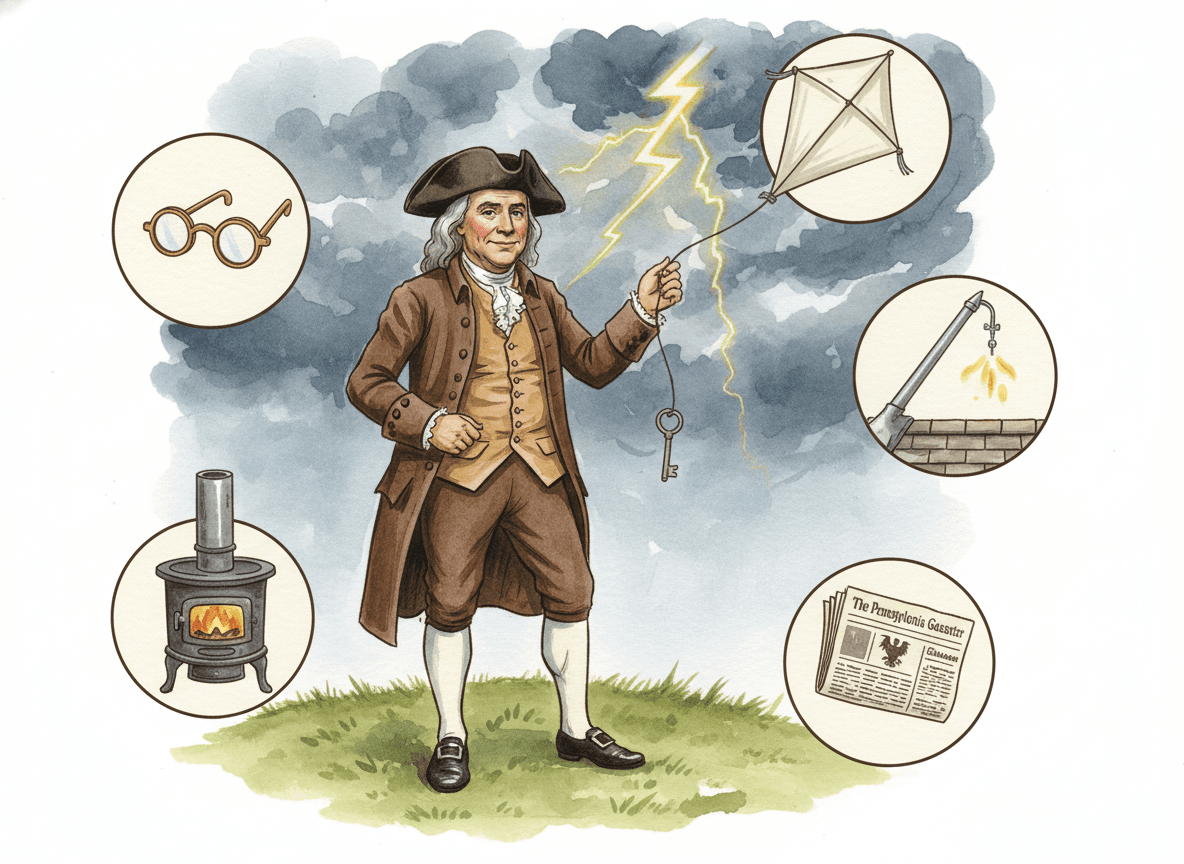
- He was a prolific inventor and scientist - his most famous discoveries involve electricity, and his inventions include bifocals, the lightning rod, and the Franklin stove.
- Franklin published Poor Richard's Almanack (1732-1758), was America's first Postmaster General, and founded the first public library in America.
Who Was Benjamin Franklin?
Benjamin Franklin (1706–1790) was one of the most remarkable men of his era - a self-educated printer who became a world-famous scientist, a beloved author, a brilliant diplomat, and a key architect of American democracy. He is one of only a few Founding Fathers who never served as president but who appears on U.S. currency.
Early Life
Benjamin Franklin was born on January 17, 1706, in Boston, Massachusetts - the 15th of 17 children. His family was poor, and he left school at age 10 to work in his father's candle-making shop. He taught himself by reading voraciously and eventually became a printer's apprentice.
At age 17, Franklin ran away to Philadelphia, where he established himself as a printer and began his rise to prominence.
Writer and Publisher
Franklin founded a printing business and became the publisher of the Pennsylvania Gazette, a widely-read newspaper. From 1732 to 1758, he published Poor Richard's Almanack under the pen name "Richard Saunders." The Almanack was filled with weather forecasts, poems, and the witty sayings Franklin is still famous for:
"Early to bed and early to rise, makes a man healthy, wealthy, and wise." "An investment in knowledge pays the best interest."
Scientist and Inventor
Franklin was one of the leading scientists of the 18th century:
Kite experiment (electricity = lightning): 1752 - Proved lightning is electrical
Lightning rod: 1752 - Protects buildings from strikes
Bifocals: c. 1784 - Near and far vision in one lens
Franklin stove: 1741 - More efficient home heating
Gulf Stream chart: 1768 - Improved Atlantic ocean navigation Franklin's work on electricity earned him honorary degrees from Harvard, Yale, Oxford, and Edinburgh, and election to the Royal Society of London.
Founding Father and Diplomat
Franklin played a crucial role in founding the United States:
- Helped draft the Declaration of Independence (1776)
- Served as U.S. Ambassador to France - his charm and wit helped win French military support for the Revolution, which was essential to American victory
- Helped negotiate the Treaty of Paris (1783) that ended the Revolutionary War
- Served as a delegate to the Constitutional Convention (1787) - at 81, he was the oldest delegate
- Signed the Declaration of Independence, the Constitution, the Treaty of Alliance with France, and the Treaty of Paris - the only person to sign all four foundational documents
Civic Contributions
Franklin founded or helped establish:
- The first public lending library in America (1731)
- The University of Pennsylvania (1749)
- The Philadelphia fire department (1736)
- The U.S. Postal System - he served as the first Postmaster General
Death and Legacy
Benjamin Franklin died on April 17, 1790, at age 84. An estimated 20,000 people attended his funeral - a remarkable number for the time. He is remembered as a symbol of American ingenuity, practicality, and democratic ideals.
Practice Activities
- Create a "Franklin's Famous Firsts" list - research one of his inventions or founding contributions in depth.
- Read excerpts from Poor Richard's Almanack and discuss: what values do these sayings reflect? Do they still apply today?
- Compare Franklin's kite experiment with modern electrical safety - why do we NOT fly kites in thunderstorms?
- Design your own "almanack" page with a weather prediction, three pieces of advice, and one invention idea.
- Debate: should someone who was never president appear on U.S. currency? Use evidence from Franklin's life to support your argument.
Frequently Asked Questions
Did Benjamin Franklin really fly a kite in a thunderstorm?
Yes - in 1752, Franklin conducted his famous kite experiment to prove that lightning is electrical in nature. He flew a kite with a metal key attached during a thunderstorm; when lightning struck nearby, electrical charge traveled down the wet string to the key, producing a spark. This experiment inspired his invention of the lightning rod, which protects buildings from lightning strikes.
What did Benjamin Franklin invent?
Franklin's key inventions include: the lightning rod (1752, protects buildings from lightning), bifocals (eyeglasses with two different lens powers), the Franklin stove (a metal fireplace insert that heated rooms more efficiently), the flexible urinary catheter, and an odometer. He also charted the Gulf Stream ocean current and improved the design of street lamps.
Why is Benjamin Franklin on the hundred-dollar bill?
Benjamin Franklin appears on the $100 bill to honor his contributions to American democracy, science, and culture. Although he was never president (which is the typical qualification for appearing on U.S. currency), his role as a Founding Father, diplomat, and symbol of American ingenuity and wisdom made him an iconic choice.
Free Benjamin Franklin Worksheets
Curriculum-aligned printable worksheets for 2nd – 5th Grade. Download free.