What Is Cause and Effect?
Taught in US schools
Key Takeaways
- A cause is WHY something happened; an effect is WHAT happened as a result of the cause.
- Signal words like because, so, therefore, as a result, and since help readers identify cause-and-effect relationships in a text.
- Cause and effect is both a reading comprehension skill and a common nonfiction text structure - understanding it helps readers analyze both stories and informational texts.
What Is Cause and Effect?
Cause and effect describes the relationship between two connected events or ideas:
- A cause is WHY something happened - the reason or event that led to a result.
- An effect is WHAT happened as a result of the cause.
Simple example: It rained all day (cause), so the soccer game was cancelled (effect).
Understanding cause and effect helps readers follow the logic of a story, understand historical events, and analyze scientific explanations.
Signal Words to Look For
Signal words alert readers that a cause-and-effect relationship is present:
because: so
since: therefore
as a result of: consequently
due to: which led to
the reason is: as a result
Tip: Not every cause-and-effect relationship uses a signal word. Sometimes students must infer the relationship from context.
Cause and Effect in Fiction
In stories, cause and effect drives the plot:
- A character makes a choice (cause) → something happens (effect)
- An event occurs (cause) → the character changes (effect)
Story example: Goldilocks ate all of Baby Bear's porridge (cause), which made Baby Bear very sad when he came home (effect).
Cause and Effect in Nonfiction
Cause and effect is one of the five major nonfiction text structures. Authors use this structure to explain:
- Why historical events happened (e.g., causes of the American Revolution)
- How scientific processes work (e.g., deforestation causes habitat loss)
- Why natural phenomena occur (e.g., warming oceans cause stronger hurricanes)
Cause-and-Effect Chains
Sometimes causes and effects form a chain: one event causes another, which causes another.
Heavy rain → flooding → soil erosion → damaged crops → food shortage
Students can map these relationships using a cause-and-effect graphic organizer with arrows between boxes.
Graphic Organizers for Cause and Effect
Simple arrow (cause → effect): One cause, one effect
Multiple arrows from one box: One cause, multiple effects
Multiple arrows pointing to one box: Multiple causes, one effect
Chain diagram: Sequential cause-and-effect
Common Mistakes
-
Confusing sequence with causation - just because event A happened before event B does not mean A caused B. (Example: The sun rose before I woke up, but sunrise did not cause me to wake up.)
-
Switching cause and effect - students sometimes label the effect as the cause. The "because test" can help: "The game was cancelled because it rained" (correct) vs. "It rained because the game was cancelled" (incorrect).
Practice Activities
- Read a short paragraph and highlight signal words; draw an arrow from cause to effect on a sticky note.
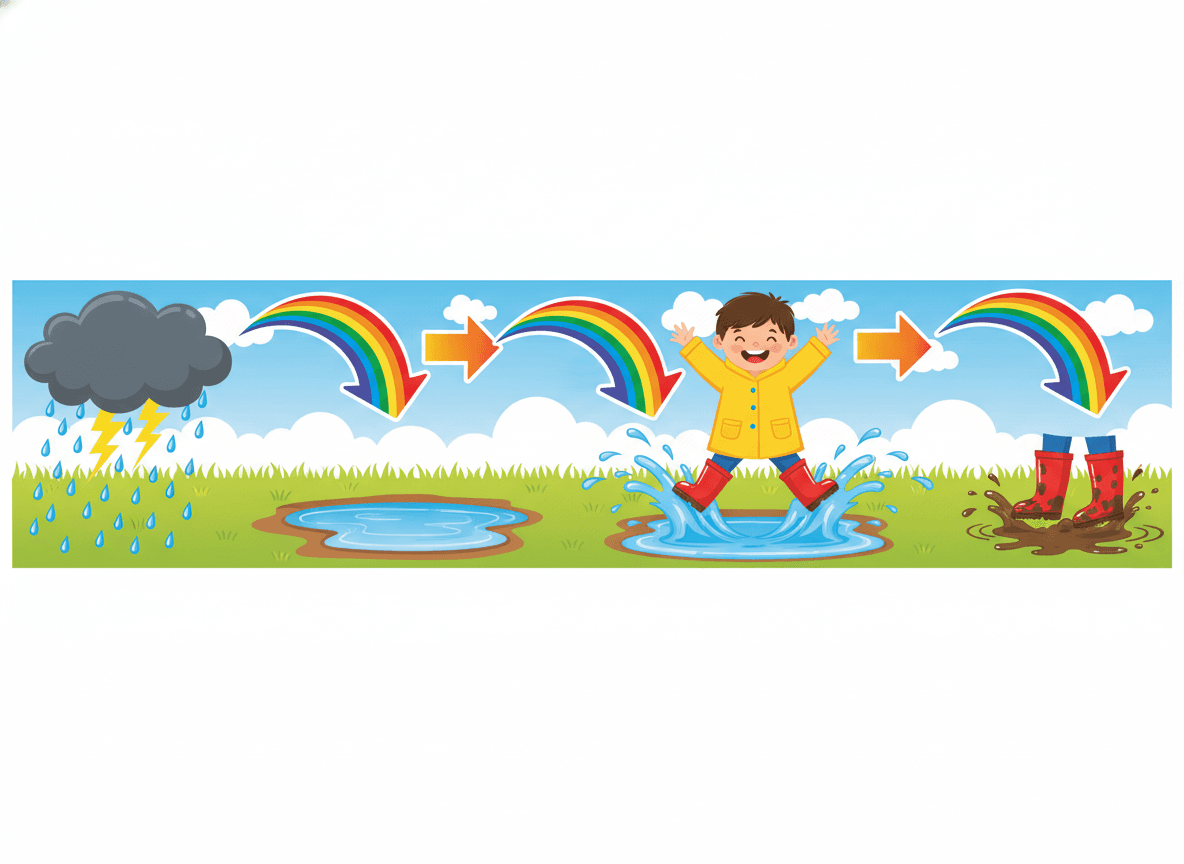
- Use picture cards showing events (e.g., spilled milk → wet floor) and have students sequence cause before effect.
- After reading an informational text, complete a cause-and-effect graphic organizer with multiple causes or effects.
- Challenge students to write their own cause-and-effect paragraph about a science topic being studied (e.g., what happens when plants don't get sunlight).
- Play "Because/So" sentence stems: teacher says a cause, students complete the effect using "so"; then reverse.
Frequently Asked Questions
How can students tell which is the cause and which is the effect?
A helpful trick is to use the 'because/so' test. Insert 'because' before the cause and 'so' before the effect. Example: 'It rained (cause) so the game was cancelled (effect).' If the sentence makes sense, you have the relationship right. You can also ask: 'Did this happen FIRST? That's the cause.' and 'What happened BECAUSE OF IT? That's the effect.'
Can one cause have multiple effects?
Yes - and one effect can also have multiple causes. For example, a drought (one cause) can lead to crop failure, water shortages, and wildfires (multiple effects). Teachers often use cause-and-effect chains or webs to help students map these more complex relationships.
Is cause and effect only found in nonfiction?
No. Cause and effect appears in both fiction and nonfiction. In a story, a character's action (cause) leads to a consequence (effect). In informational texts, events and phenomena are explained through cause-and-effect relationships. Recognizing this pattern improves comprehension in any genre.
Free Cause and Effect Worksheets
Curriculum-aligned printable worksheets for Kindergarten – 5th Grade. Download free.
Common Core Standards