What Are Cells?
Taught in US schools
Key Takeaways
- The cell is the smallest unit of life - all living things are made of one or more cells.
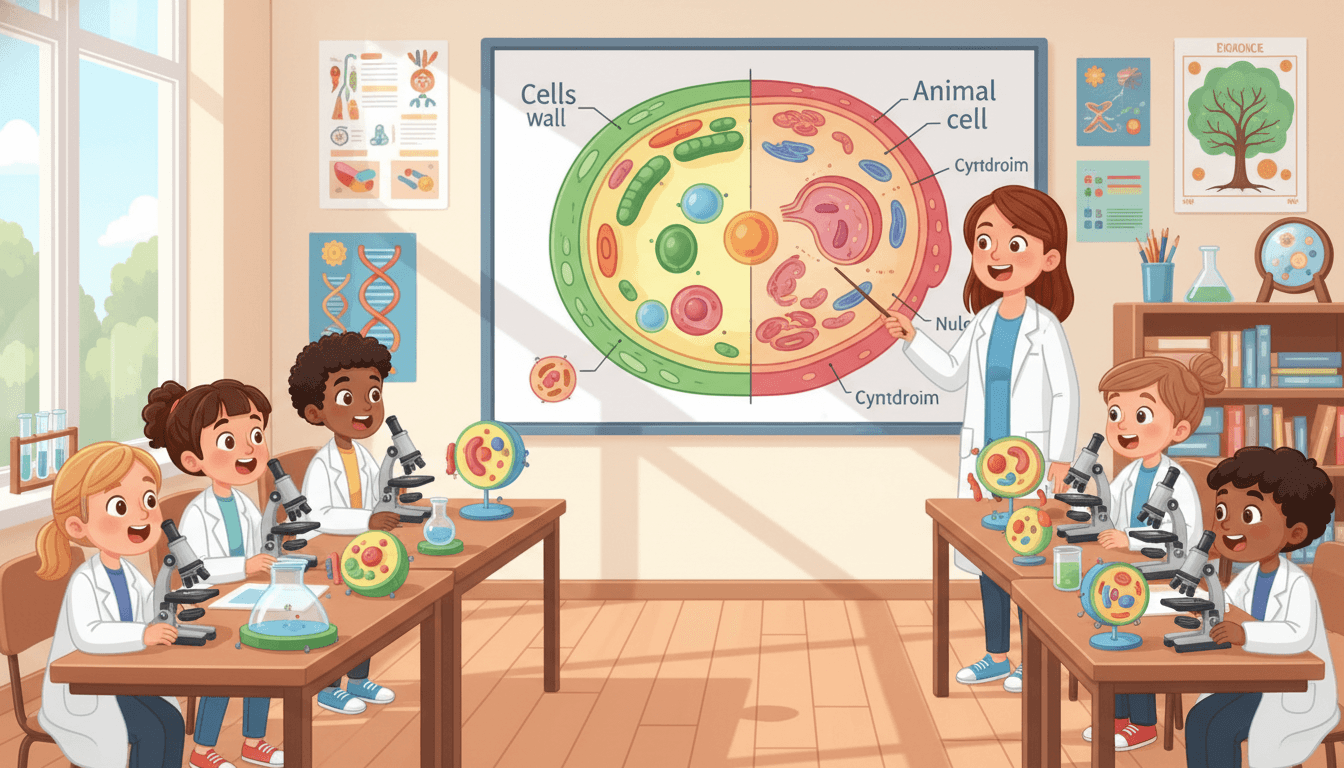
- Plant cells and animal cells share many structures (cell membrane, nucleus, cytoplasm, mitochondria) but plant cells also have a cell wall and chloroplasts.
- Unicellular organisms (like bacteria and amoebas) consist of a single cell; multicellular organisms (like humans and trees) are made of trillions of specialized cells.
What Are Cells?
A cell is the smallest unit of life - the basic building block of all living organisms. Every living thing, from the tiniest bacterium to the largest whale, is made of cells.
Cells were first observed by Robert Hooke in 1665 using an early microscope. He looked at cork and saw tiny box-like compartments, which he called "cells" (from the Latin word for small room). Most cells are far too small to see with the naked eye.
Cell Theory
Cell theory is one of the most important principles in biology. It states:
- All living things are made of one or more cells.
- The cell is the basic unit of life.
- All cells come from existing cells (through cell division).
Unicellular vs. Multicellular Organisms
Unicellular: Made of a single cell that performs all life functions - Bacteria, amoeba, paramecium, yeast
Multicellular: Made of many cells that are specialized for different jobs - Plants, animals, humans, fungi Humans have about 37 trillion cells. These cells are organized into tissues, then organs, then organ systems.
Parts of a Cell: Key Organelles
Organelles are the tiny structures inside a cell that carry out specific functions, like organs in a body.
Structures in BOTH Plant and Animal Cells
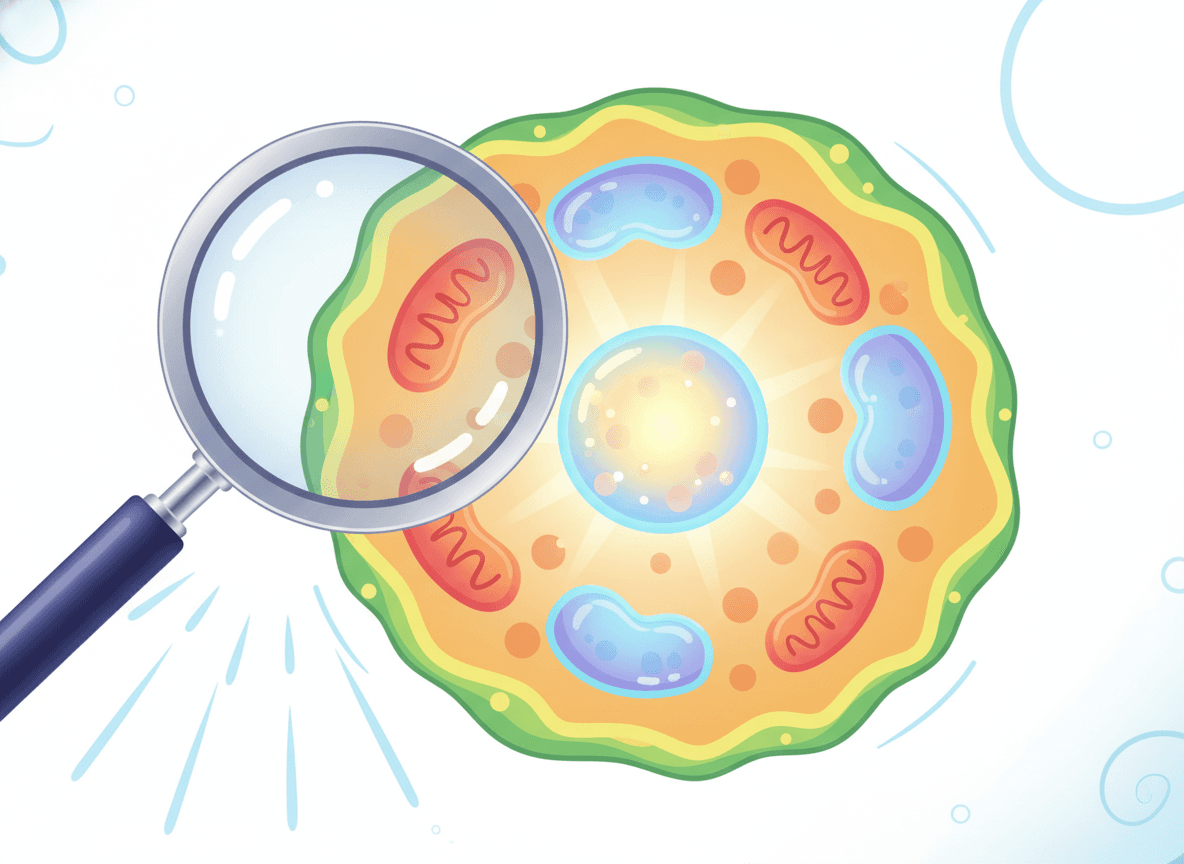
Cell membrane: Thin, flexible outer boundary; controls what enters and exits the cell
Nucleus: The "control center"; contains DNA with instructions for the cell
Cytoplasm: Jelly-like fluid filling the cell; organelles float in it
Mitochondria: "Powerhouse of the cell"; converts food into usable energy (ATP)
Structures in PLANT Cells Only
Cell wall: Rigid outer layer (outside the cell membrane); provides structure and support
Chloroplasts: Contain green pigment chlorophyll; capture sunlight for photosynthesis
Large central vacuole: Water storage; also helps maintain the cell's shape
Plant Cell vs. Animal Cell
Cell wall: Yes - No
Cell membrane: Yes - Yes
Chloroplasts: Yes - No
Large vacuole: Yes (central) - No (small, many)
Nucleus: Yes - Yes
Mitochondria: Yes - Yes A helpful visual: plant cells look like rectangular brick-like boxes (from the rigid cell wall); animal cells look rounder and more irregular.
Why Cells Are Important
Cells perform all the functions necessary for life:
- Take in nutrients and produce energy
- Grow and reproduce
- Respond to their environment
- Dispose of waste
When cells work together in a multicellular organism, they become specialized: muscle cells contract, nerve cells send signals, red blood cells carry oxygen.
Practice Activities
- Build a 3D cell model using craft materials - assign each material a specific organelle and label them.
- Create a Venn diagram comparing plant and animal cells: shared structures in the center, unique structures on each side.
- "Organelle analogy" writing: compare the cell to a school, city, or factory - what does each organelle's job remind you of?
- View prepared slides under a microscope (or virtual microscope app) to observe actual plant cells (onion skin) and animal cells (cheek cells).
- Watch a time-lapse of cell division and discuss: how does one cell become two? How could this explain how organisms grow?
Frequently Asked Questions
Who discovered cells?
Robert Hooke, an English scientist, first observed and named cells in 1665. He was looking at a thin slice of cork under a microscope and noticed it was divided into tiny box-like compartments that reminded him of the small rooms (cells) in a monastery. Later, scientists Matthias Schleiden and Theodor Schwann developed cell theory in the 1830s.
What is cell theory?
Cell theory has three main principles: (1) All living things are made of one or more cells. (2) The cell is the basic unit of life. (3) All cells come from existing cells (cells divide to make new cells). These principles, developed in the 1830s-1850s, are foundational to all of biology.
What is the difference between a plant cell and an animal cell?
Both plant and animal cells have a cell membrane, nucleus, cytoplasm, and mitochondria. Plant cells have two additional structures: a rigid cell wall (outside the membrane, provides support) and chloroplasts (green organelles that capture sunlight for photosynthesis). Plant cells also typically have a large central vacuole for water storage. Animal cells lack a cell wall and chloroplasts.
Free Cells Worksheets
Curriculum-aligned printable worksheets for 4th – 5th Grade. Download free.


