Who Was Christopher Columbus?
Taught in US schools
Key Takeaways
- Christopher Columbus was an Italian explorer who sailed west from Spain in 1492 with three ships - the Nina, the Pinta, and the Santa Maria - hoping to reach Asia.
- Columbus made four voyages to the Americas (1492-1504) and is credited with initiating sustained contact between Europe and the Americas, leading to the Columbian Exchange.
- Columbus's legacy is complex: his voyages opened new trade routes but also began European colonization that brought violence, enslavement, and devastating disease to Indigenous peoples.
Who Was Christopher Columbus?
Christopher Columbus (c. 1451–1506) was an Italian-born explorer who sailed under the Spanish flag in 1492, looking for a western sea route to Asia. Instead, he arrived in the Caribbean, establishing the first lasting contact between Europe and the Americas. His voyages changed the world - though the consequences were far from simple.
Early Life and Goals
Columbus was born around 1451 in Genoa (in present-day Italy). He was an experienced sailor and had a bold - and mistaken - belief: that by sailing west across the Atlantic Ocean, he could reach the East Indies (Asia) faster than by sailing around Africa.
He sought funding for years before Queen Isabella and King Ferdinand of Spain agreed to sponsor his voyage in 1492. Columbus promised Spain new trade routes and wealth.
The First Voyage: 1492
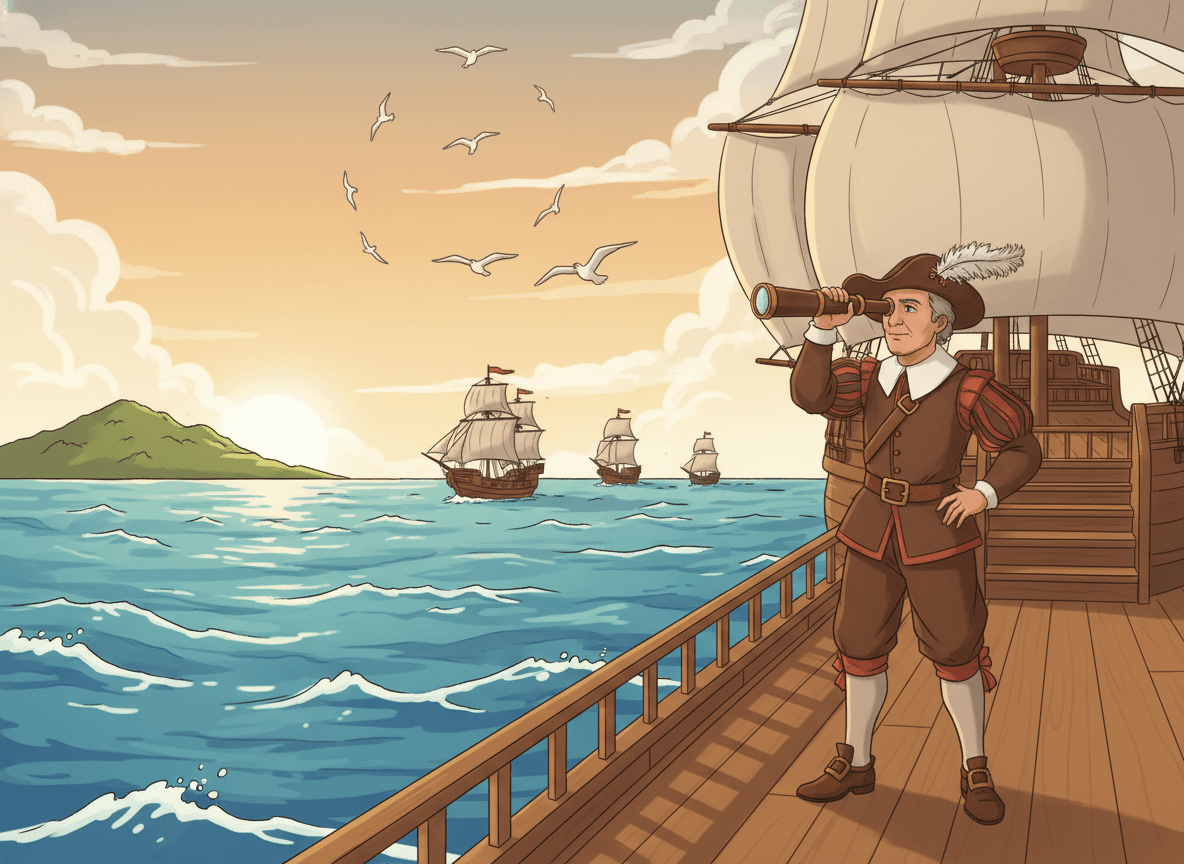
On August 3, 1492, Columbus set sail from Palos, Spain with three ships:
-
Niña
-
Pinta
-
Santa María
After a 10-week voyage, on October 12, 1492, Columbus landed in what is now the Bahamas, an island he named San Salvador. He believed he had reached the Indies and called the people he met "Indians" - a name that persisted for centuries despite being incorrect.
Memory aid: "In 1492, Columbus sailed the ocean blue."
Four Voyages
Columbus made four voyages to the Americas (1492, 1493, 1498, and 1502), exploring the Caribbean islands, Central America, and the northern coast of South America. He never reached the North American mainland and never acknowledged that he had found a previously unknown-to-Europeans continent.
The Columbian Exchange
Columbus's voyages set in motion the Columbian Exchange - the transfer of plants, animals, people, and diseases between the Americas and Europe, Africa, and Asia. This exchange permanently altered diets, ecosystems, and populations on both sides of the Atlantic.
Columbus's Complex Legacy
Columbus is remembered as a famous explorer, but his legacy includes serious harm:
- He enslaved Indigenous people he encountered and sent hundreds to Spain as slaves.
- European diseases (smallpox, measles, influenza) to which Indigenous peoples had no immunity killed millions - perhaps 90% of some populations.
- His voyages opened the door to centuries of European colonization that dispossessed and devastated Indigenous cultures across the Americas.
Columbus Day vs. Indigenous Peoples Day
October 12 has traditionally been celebrated in the U.S. as Columbus Day (a federal holiday since 1937). Many states and cities have renamed it Indigenous Peoples Day to honor the Native American communities whose histories were transformed - and often destroyed - by European colonization.
Teaching both perspectives gives students a more complete and honest understanding of history.
Practice Activities
- Map Columbus's four voyages - trace the routes on a map of the Atlantic and label where he landed each time.
- Compare what Columbus wrote about the Indigenous people he met with what historians know about their lives and cultures.
- Discuss: should Columbus Day be celebrated, replaced with Indigenous Peoples Day, or both observed? Students use evidence to support their view.
- Research the three ships - how big were they? What conditions were on board? What would it be like to sail 10 weeks across the ocean?
- Create a timeline connecting Columbus's 1492 voyage to key events that followed (Columbian Exchange, founding of colonies, etc.).
Frequently Asked Questions
Did Columbus discover America?
No - Indigenous peoples had lived in the Americas for thousands of years before Columbus arrived. Norse explorer Leif Eriksson reached North America around 1000 CE. Columbus did not land on the North American mainland during his four voyages. What Columbus's 1492 voyage did was establish the first sustained, consequential contact between Europe and the Americas - leading to the permanent exchange of people, plants, animals, and diseases known as the Columbian Exchange.
Why is Columbus Day controversial?
Columbus Day (celebrated on the second Monday of October) has become controversial because it honors an explorer whose arrival initiated a period of European colonization that brought violence, forced labor, and diseases that killed millions of Indigenous people. Many U.S. states and cities now celebrate Indigenous Peoples Day on the same date to honor the cultures and contributions of Native Americans. This shift reflects a more complete telling of the history.
What is the rhyme 'Columbus sailed the ocean blue'?
The mnemonic rhyme 'In 1492, Columbus sailed the ocean blue' is a memory device to help students remember the year of Columbus's first voyage. It is one of the most widely taught memory aids in American elementary schools. While the rhyme is useful for remembering the date, it is important for students to also learn the full, complex story of what happened after 1492.
Free Christopher Columbus Worksheets
Curriculum-aligned printable worksheets for 2nd – 4th Grade. Download free.