What Are the Continents and Oceans?
Taught in US schools
Key Takeaways
- Earth has seven continents: Africa, Antarctica, Asia, Australia/Oceania, Europe, North America, and South America.
- Earth has five oceans: Pacific, Atlantic, Indian, Southern, and Arctic - with the Pacific being the largest.
- Asia is the largest continent and Antarctica is the smallest by population (no permanent residents); Australia is the smallest continent by land area that has permanent residents.
What Are the Continents and Oceans?
Earth's surface is made up of land and water. The large landmasses are called continents, and the enormous bodies of salt water are called oceans. Together, the continents and oceans form the geography of our entire planet.
- Land covers about 29% of Earth's surface
- Water (mostly oceans) covers about 71% of Earth's surface
The Seven Continents
Asia: East - Largest continent; includes China, India, Japan; Mount Everest
Africa: Central-South - Second largest; Sahara Desert; Nile River; most countries of any continent
North America: West - Includes US, Canada, Mexico; Rocky Mountains; Mississippi River
South America: West - Amazon Rainforest; Andes Mountains; Angel Falls
Antarctica: South Pole - Covered in ice; no permanent residents; coldest place on Earth
Europe: North - Smallest inhabited continent; many countries; Alps; Mediterranean Sea
Australia/Oceania: South Pacific - Surrounded by water; Great Barrier Reef; kangaroos
A Memory Trick for the 7 Continents
"All Antelopes Need Soft And Easy Air" → Asia, Africa, North America, South America, Antarctica, Europe, Australia
The Five Oceans
Pacific: Between Americas and Asia/Australia - Largest; covers more area than all land combined
Atlantic: Between Americas and Europe/Africa - Second largest
Indian: South of Asia, west of Australia - Third largest; warmest ocean
Southern: Surrounding Antarctica - Fourth largest; added officially in 2000
Arctic: Surrounding the North Pole - Smallest; partially frozen year-round
Locating Continents and Oceans on a Globe
On a globe or world map:
- The equator is the imaginary line around Earth's middle, dividing it into the Northern and Southern Hemispheres
- The prime meridian divides Earth into Eastern and Western Hemispheres
- Most continents are in the Northern Hemisphere; Antarctica is entirely in the Southern Hemisphere
- The Americas are in the Western Hemisphere; Europe, Africa, Asia, and Australia are in the Eastern Hemisphere
Interesting Geography Facts
-
Longest river: Nile (Africa) or Amazon (South America) - debated
-
Tallest mountain: Mount Everest in Asia, 29,032 feet
-
Largest desert: Antarctic Desert (yes - a desert is defined by low precipitation, not heat)
-
Largest ocean: Pacific - it's bigger than all the land on Earth combined
-
Most populous continent: Asia (over 4.5 billion people)
Practice Activities
-
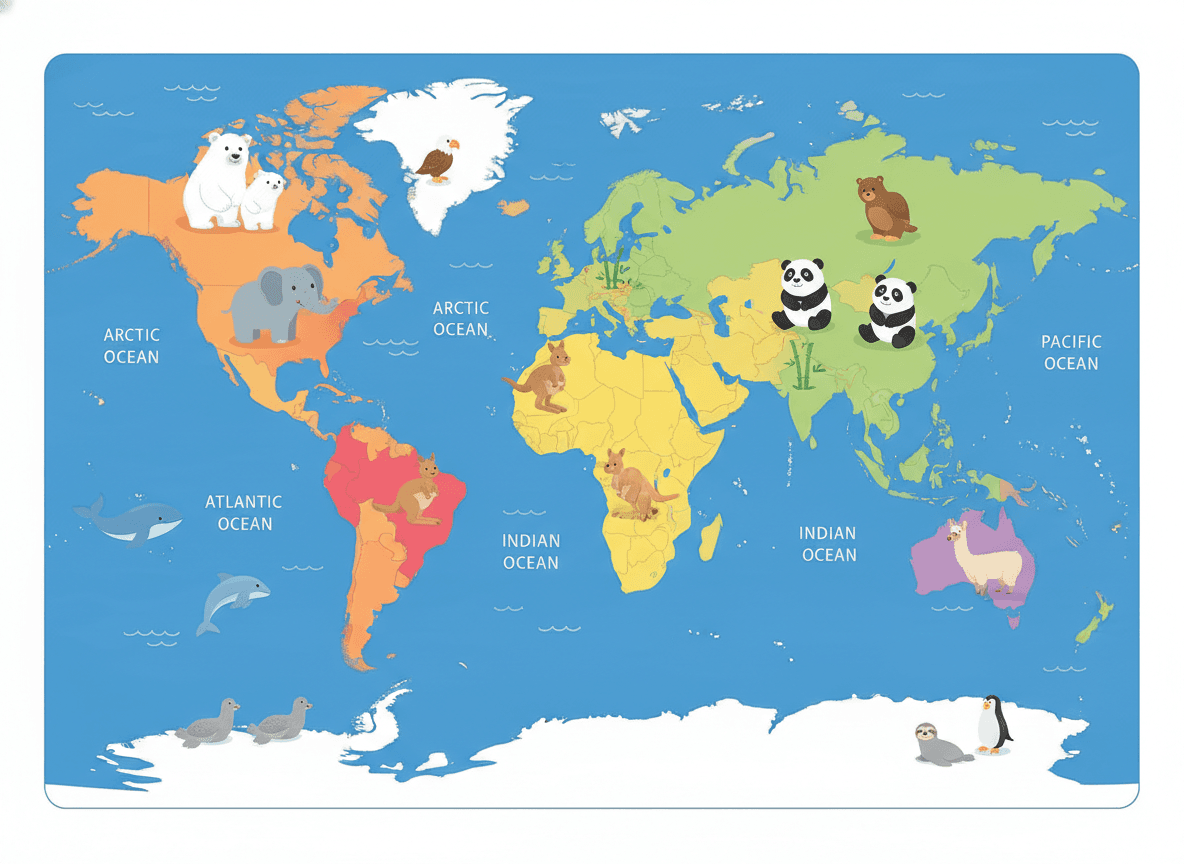
Continent and ocean labeling: Students label a blank world map with all 7 continents and 5 oceans.
-
Continent comparison chart: Students compare two continents on climate, famous landmarks, and animals.
-
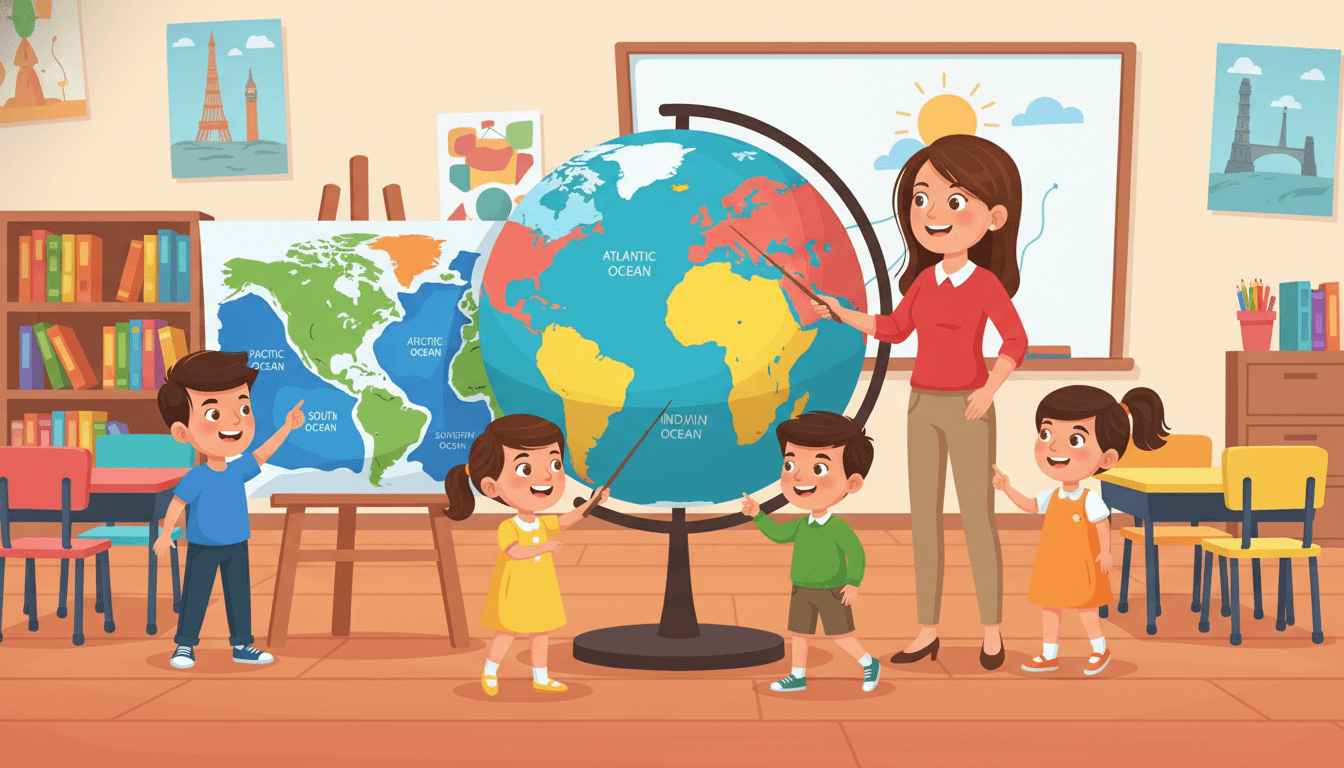
Globe exploration: Students use a physical globe to find each continent and ocean, then name their location relative to the equator.
-
Animal to continent match: Match animals (panda, kangaroo, elephant, bison) to the continent where they are found.
-
Continent song: Learn a continent song (many are available online) to memorize all seven continents.
Frequently Asked Questions
What are the seven continents in order from largest to smallest?
From largest to smallest by land area: Asia, Africa, North America, South America, Antarctica, Europe, and Australia/Oceania. Asia is by far the largest, covering about 30% of Earth's total land area.
What are the five oceans?
The five oceans are the Pacific Ocean (largest), Atlantic Ocean (second largest), Indian Ocean, Southern Ocean (surrounding Antarctica), and Arctic Ocean (smallest). Together they cover about 71% of Earth's surface.
Which continent has no permanent residents?
Antarctica has no permanent human residents. It is covered in ice and is the coldest, windiest, and driest continent. Scientists live there temporarily at research stations, but no one was born there or calls it home permanently.
Free Continents and Oceans Worksheets
Curriculum-aligned printable worksheets for Kindergarten – 3rd Grade. Download free.