What Are Inherited Traits?
Taught in US schools

Key Takeaways
- Inherited traits are physical characteristics or instinctive behaviors passed from parents to offspring through genes.
- Acquired traits are learned or developed through experience and environment - they cannot be passed to offspring through genes.
- Offspring resemble their parents but are not identical because they inherit a mix of traits from both parents, creating variation within a species.
What Are Inherited Traits?
Inherited traits are characteristics that are passed from parents to offspring through genes. Every living organism inherits a set of genes from its parents at the moment of conception - these genes carry the instructions for how the offspring will grow and look.
Inherited traits are present from birth. They are not learned or developed - they come "pre-loaded" in the organism's DNA.
Examples of Inherited Traits
Eye color: Fur color and pattern - Flower color
Hair color and texture: Body size - Leaf shape
Blood type: Beak shape (in birds) - Fruit shape and size
Ear shape: Number of offspring - Height at maturity
Freckles: Migratory instinct - Seed dispersal method
Note: Eye color and hair color in humans involve multiple genes, so the outcome is more complex than a simple dominant/recessive pattern. For elementary students, the key concept is that these traits are inherited, not chosen or developed.
Inherited vs. Acquired Traits
Definition: Passed through genes from parents
****Present at birth?: Yes
****Can be passed to offspring?: Yes
Examples: Eye color, blood type, instinct to nurse
Example: A bird knows how to fly by instinct - that is an inherited behavior. But a dog that has been trained to do tricks learned those skills - that is an acquired behavior. The dog's puppies are not born knowing the tricks.
Variation Within a Species
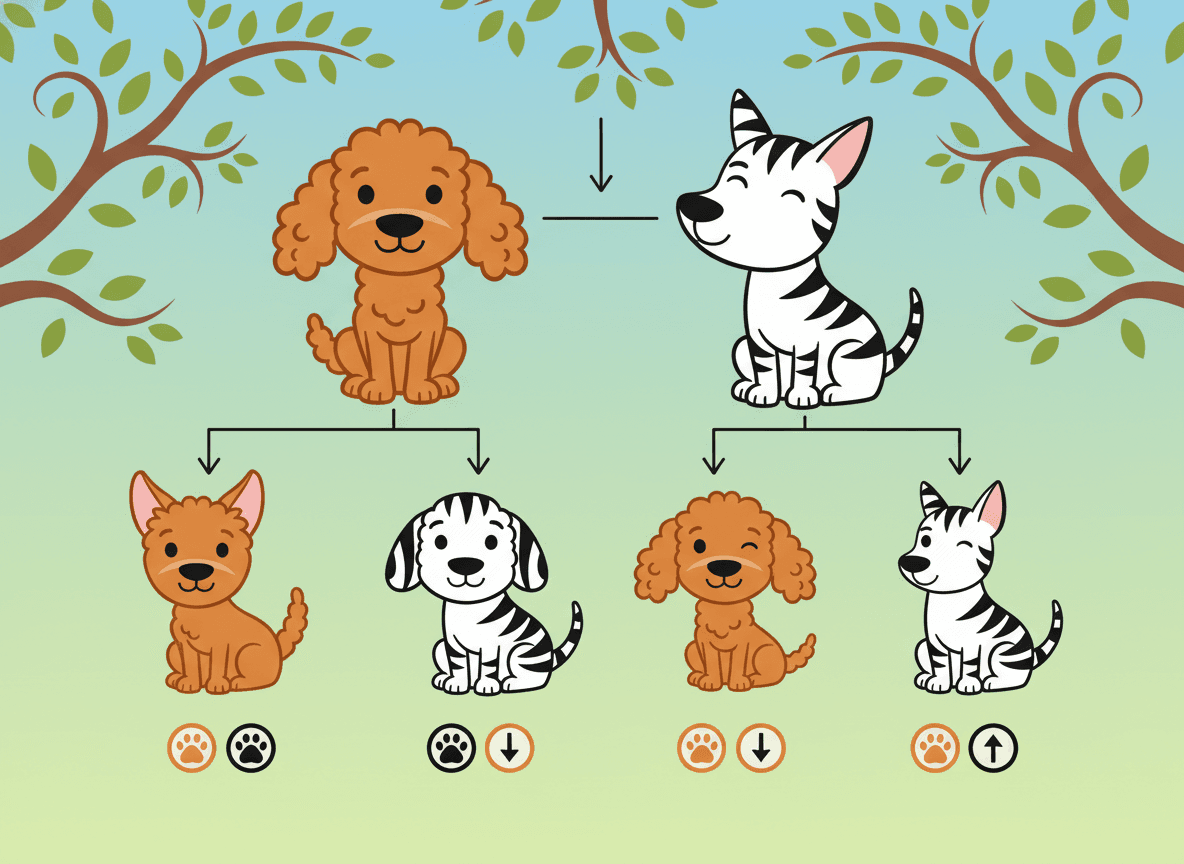
Offspring inherit traits from both parents, which means they are similar to both parents but not identical to either. This creates variation - differences among individuals of the same species.
Example: Two brown-haired parents can have children with slightly different hair shades, curl patterns, and hair thickness - because the exact combination of genes each child inherits differs.
Variation is important for species survival. When environments change, individuals with certain traits may be better suited to survive and reproduce - passing those advantageous traits to the next generation. This is the foundation of natural selection.
Dominant and Recessive Traits (Simplified)
Some traits are dominant - they appear whenever that version of the gene is present. Others are recessive - they only appear when both copies of the gene are the recessive version.
Classic example: Brown eyes are typically dominant over blue eyes, which is why two brown-eyed parents can have a blue-eyed child (if both parents carry a recessive blue-eye gene).
At the elementary level, students learn that offspring resemble parents but can also show traits that seem to skip a generation - a starting point for understanding heredity.
Practice Activities
- Create a family traits survey: students ask family members about their eye color, hair color, and other traits to look for patterns of inheritance.
- Sort a set of cards into inherited vs. acquired traits and discuss any tricky cases with the class.
- Compare photos of animals (dogs, horses, cats) with their offspring and list traits that were clearly passed down.
- Grow two types of bean plants from seeds of the same parent plant and compare the offspring - do they all look identical?
- Read a nonfiction passage about a species (like Arctic wolves or monarch butterflies) and identify which of their traits help them survive.
Frequently Asked Questions
What is a gene?
A gene is a small segment of DNA that carries instructions for a specific trait. Every cell in an organism's body contains the same set of genes, inherited from both parents. Genes determine traits like eye color, hair texture, and blood type.
What is the difference between an inherited trait and an acquired trait?
An inherited trait is passed from parents through genes before birth - you are born with it. An acquired trait is something you develop through experience, training, or the environment, such as learning to ride a bike or developing a scar.
Can a dog's training be passed to its puppies?
No. A dog that is trained to sit, roll over, or herd sheep passes only its genetic traits (body size, coat color, temperament tendencies) to its puppies - not the learned behaviors. The puppies must be trained separately.
Free Inherited Traits Worksheets
Curriculum-aligned printable worksheets for 3rd – 4th Grade. Download free.


