What Is Making Predictions in Reading?
Taught in US schools
Key Takeaways
- Predicting means using text clues and background knowledge to think ahead about what will happen.
- Good predictions are supported by evidence - they are not random guesses.
- Returning to check, revise, or confirm predictions keeps readers actively engaged throughout a text.
- Predicting develops inference skills and overall reading comprehension.
What Is Making Predictions?
Making predictions is a reading comprehension strategy in which readers use clues from the text and their own background knowledge to anticipate what will happen next. Good predictions are not guesses - they are evidence-based inferences about the future direction of the text.
Predicting is one of the seven core reading comprehension strategies (along with visualizing, connecting, questioning, inferring, summarizing, and monitoring understanding).
What Good Predictors Do
Active readers make predictions throughout reading - not just at the beginning:
Before reading: Use the cover, title, author, and blurb to predict genre, topic, and tone.
During reading: Update predictions as new information is revealed. Revise when surprised.
After reading: Reflect on which predictions were accurate and why, and which were wrong and what that reveals about the text.
Types of Prediction Clues
Text-based clues:
- Title and headings
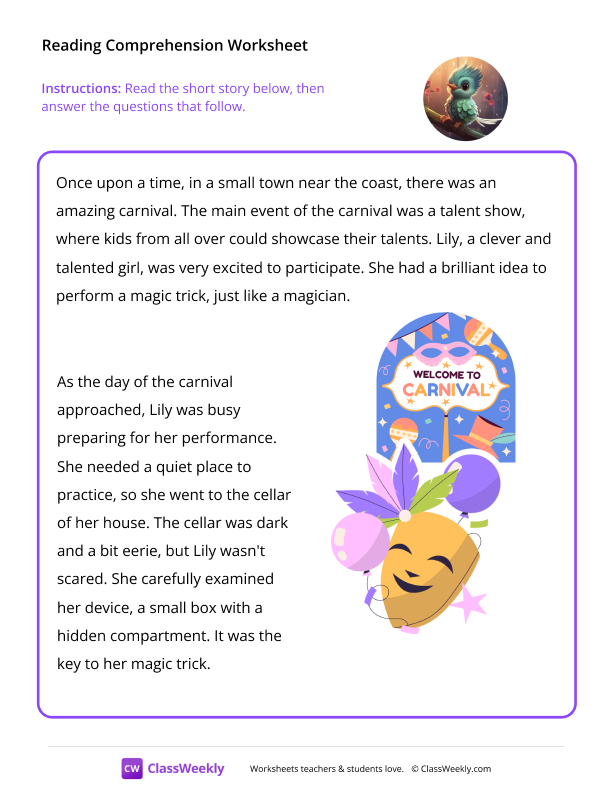
- Illustrations and photographs
- Character behavior and traits
- Events and patterns already established
- Genre and text structure conventions
Knowledge-based clues:
- Prior knowledge of similar topics
- Real-world experience with similar situations
- Understanding of how narrative genres typically resolve
Sentence Frames for Prediction
Giving students language to structure their predictions builds both comprehension and academic vocabulary:
- "I predict _____ because the text says _____."
- "Based on _____, I think _____ will happen."
- "I was surprised that _____. Now I think _____ because _____."
What Grade Do Kids Learn Predictions?
Kindergarten–1st grade: Students use pictures and text clues to predict outcomes.
2nd–3rd grade: Students make evidence-based predictions with increasing precision and revisit them during reading.
4th–5th grade: Predictions shift to more complex inferences about character motivation, theme, and author intent, not just "what happens next."
Common Misconceptions
Predictions must be correct to be valuable: Wrong predictions teach students just as much as correct ones. Discussing "Why was I wrong? What did the author do to surprise me?" builds analytical thinking.
Predict once at the beginning: Effective prediction is ongoing. Students should re-predict at chapter breaks, after significant events, and any time something surprising happens.
Prediction is only for fiction: Readers of nonfiction can also predict: "I think this article will explain how volcanoes form because the title says 'Inside Volcanoes.'"
Practice Activities
-
Prediction journal: Students record predictions and evidence at 3-4 stopping points throughout a text.
-
Sticky note stopping: Readers place sticky notes at chapter breaks recording new predictions.
-
Cover prediction: Before opening a book, students predict genre, mood, and major character challenge from the cover.
-
Prediction vs. actual chart: Two columns - what I predicted, what actually happened.
-
Read-aloud pause: Teacher reads aloud and stops at tense moments: "What do you predict happens next? What's your evidence?"
Frequently Asked Questions
What does 'making predictions' mean in reading?
Making predictions means using clues from the text - the title, pictures, events so far, character behavior - plus your own background knowledge to anticipate what might happen next. Predictions keep readers actively thinking and engaged. A good prediction is based on evidence, not just a wish for how the story will go.
How is a prediction different from a guess?
A guess is random. A prediction is an educated inference based on evidence. When students make predictions in reading, they cite specific text evidence or prior knowledge that supports their thinking. 'I predict she will fail the test because the text says she was daydreaming all week' is a prediction. 'I think something bad will happen' is a guess.
What are good sources of prediction evidence?
Sources include: the title and cover illustration, chapter headings, illustrations within the text, character traits and past behavior, events and patterns that have already occurred, genre conventions (fairy tales typically have happy endings), and personal knowledge of how similar situations resolve in real life.
Should predictions always be correct?
No - predictions don't need to be right. What matters is that they are evidence-based and that students return to check them. Revising predictions when new information is revealed is actually a higher-level skill than simply making them. Authors sometimes surprise readers deliberately. Discussing why a prediction was wrong deepens comprehension.
How does predicting help comprehension?
Predicting keeps readers mentally active and motivated. Readers who predict naturally pay closer attention to the text to see if they were right. Making and checking predictions also builds inference skills (reading between the lines) and trains students to attend to text details that might otherwise be overlooked.
Free Making Predictions Worksheets
Curriculum-aligned printable worksheets for Kindergarten – 5th Grade. Download free.
Common Core Standards