What Are the Phases of the Moon?
Taught in US schools
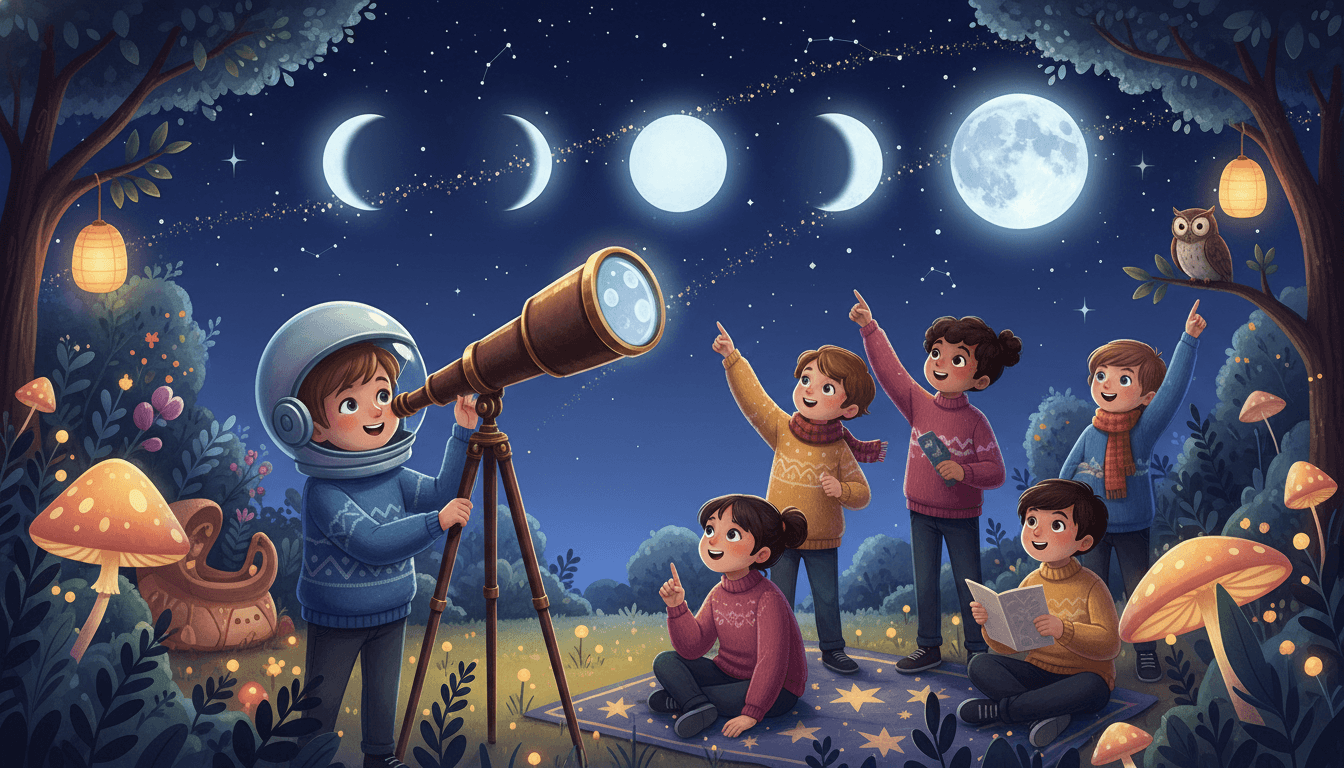
Key Takeaways
- The Moon goes through 8 phases in approximately 29.5 days as it orbits Earth - this is called a lunar month.
- The Moon does not produce its own light; it reflects sunlight. The phase we see depends on the Moon's position relative to Earth and the Sun.
- We always see the same side of the Moon because the Moon rotates at the same rate it orbits Earth, a phenomenon called synchronous rotation.
What Are the Phases of the Moon?
The phases of the Moon are the different shapes the Moon appears to have when viewed from Earth throughout the month. The Moon itself doesn't change shape - what changes is how much of its sunlit side we can see as it travels around Earth.
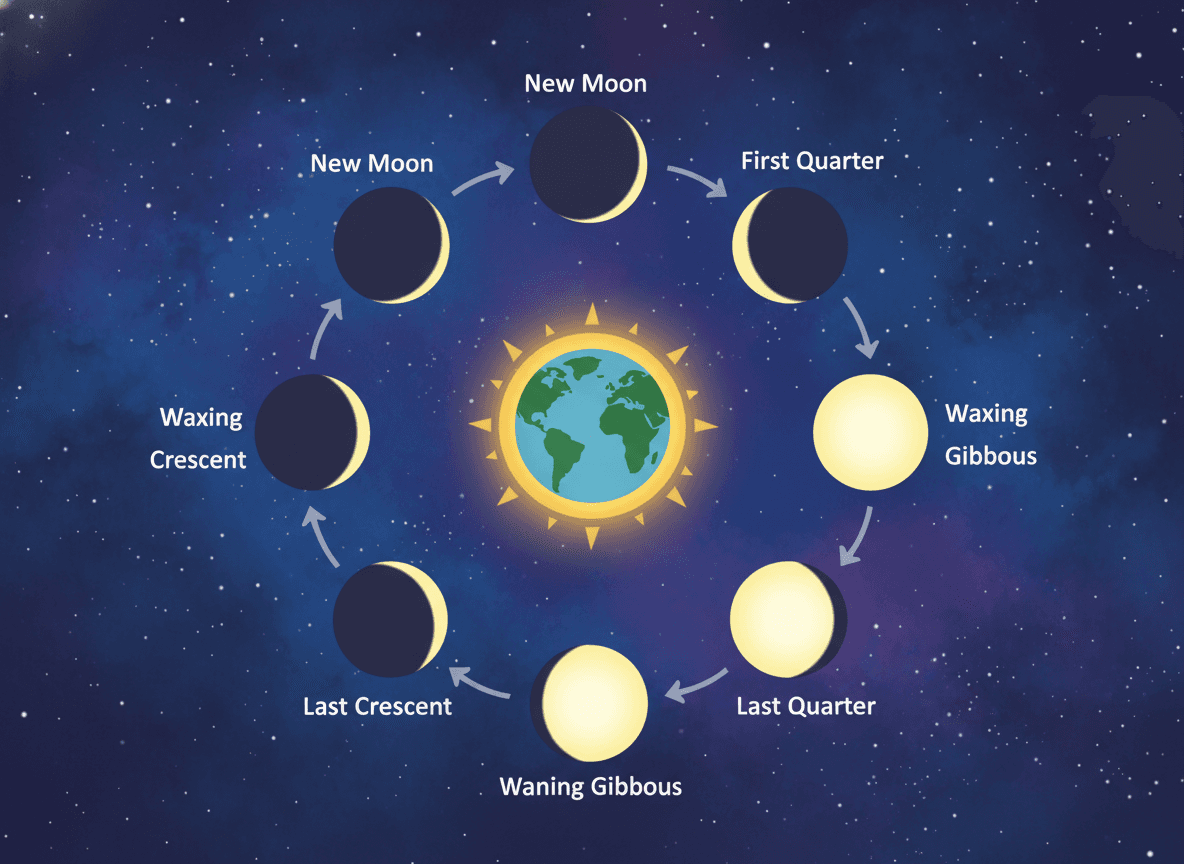
The complete cycle of all eight phases takes approximately 29.5 days - this is called a lunar month.
Why the Moon Shines
The Moon does not produce its own light. Instead, it reflects sunlight - like a mirror in space. The Sun always illuminates half the Moon, but depending on the Moon's position in its orbit, we see different amounts of that lit half from Earth.
The Eight Phases in Order
New Moon: Nothing (dark) - The Moon is between Earth and the Sun - the lit side faces away from us
Waxing Crescent: Thin sliver on right - A small, growing sliver of the lit side becomes visible
First Quarter: Half Moon (right half lit) - One quarter of the orbit complete - right half is bright
Waxing Gibbous: More than half lit - More than half is visible; still growing
Full Moon: Full circle - The Moon is on the opposite side of Earth from the Sun - fully lit side faces us
Waning Gibbous: More than half lit (shrinking) - The lit portion begins to shrink after the full moon
Third Quarter: Half Moon (left half lit) - Three quarters of the orbit complete - left half is bright
Waning Crescent: Thin sliver on left - A small, shrinking sliver remains before the new moon
Memory trick: During waxing, the lit portion is on the right (like the letter D). During waning, the lit portion is on the left (like the letter C).
Synchronous Rotation: Why We Always See the Same Face
The Moon rotates on its axis at almost exactly the same rate that it orbits Earth. This means the same side of the Moon always faces Earth. The far side (sometimes called the "dark side") is never visible from Earth's surface. Astronauts and spacecraft have photographed it, but we never see it with the naked eye.
The Moon's Effect on Earth
-
Tides: The Moon's gravity pulls on Earth's oceans, creating high and low tides roughly twice per day.
-
Calendars: Many ancient calendars were based on the lunar month. The word month comes from moon.
-
Light at night: A full moon provides enough reflected light to see outdoors at night.
Practice Activities
- Keep a Moon journal for one month - go outside each night and sketch the Moon's shape, then compare sketches over time.
- Make a Moon phase wheel using paper plates - students cut and fold to show all eight phases.
- Use an Oreo cookie to model the phases by scraping away frosting to show new moon, crescent, quarter, gibbous, and full.
- Watch a time-lapse video of an entire lunar cycle and pause to name each phase.
- Use a flashlight and ball in a darkened room to demonstrate why the Moon has phases based on its position.
Frequently Asked Questions
Why does the Moon appear to change shape?
The Moon does not actually change shape. What changes is how much of the sunlit side of the Moon we can see from Earth. As the Moon orbits Earth, our viewing angle of the lit side shifts, creating the appearance of different shapes.
What is the difference between waxing and waning?
Waxing means the visible lit portion of the Moon is growing larger each night. Waning means the visible lit portion is shrinking. The full moon is in between - it is the peak before the lit portion begins to shrink.
What causes ocean tides?
The Moon's gravitational pull on Earth's oceans causes tides. When the Moon is overhead, its gravity pulls ocean water toward it, creating a high tide. On the opposite side of Earth, another high tide occurs. Low tides happen in the areas between.
Free Moon Phases Worksheets
Curriculum-aligned printable worksheets for Kindergarten – 4th Grade. Download free.


