What Are Nonfiction Text Features?
Taught in US schools

Key Takeaways
- Nonfiction text features help readers navigate, locate, and understand information in nonfiction texts.
- Common text features include headings, subheadings, captions, bold words, diagrams, tables of contents, glossaries, and indexes.
- Text features are not decoration - each one serves a specific purpose for the reader.
- Teaching students to use text features before, during, and after reading improves comprehension of informational texts.
What Are Nonfiction Text Features?
Nonfiction text features are special elements added to informational texts to help readers find, understand, and organize information. Unlike in fiction, where readers follow a story from beginning to end, nonfiction readers often need to navigate, skim, and locate specific information - and text features make that possible.
Text features are found in textbooks, articles, encyclopedias, how-to guides, and online informational content.
Categories of Text Features
Print Features
-
Title: The name of the book or article; signals the topic
-
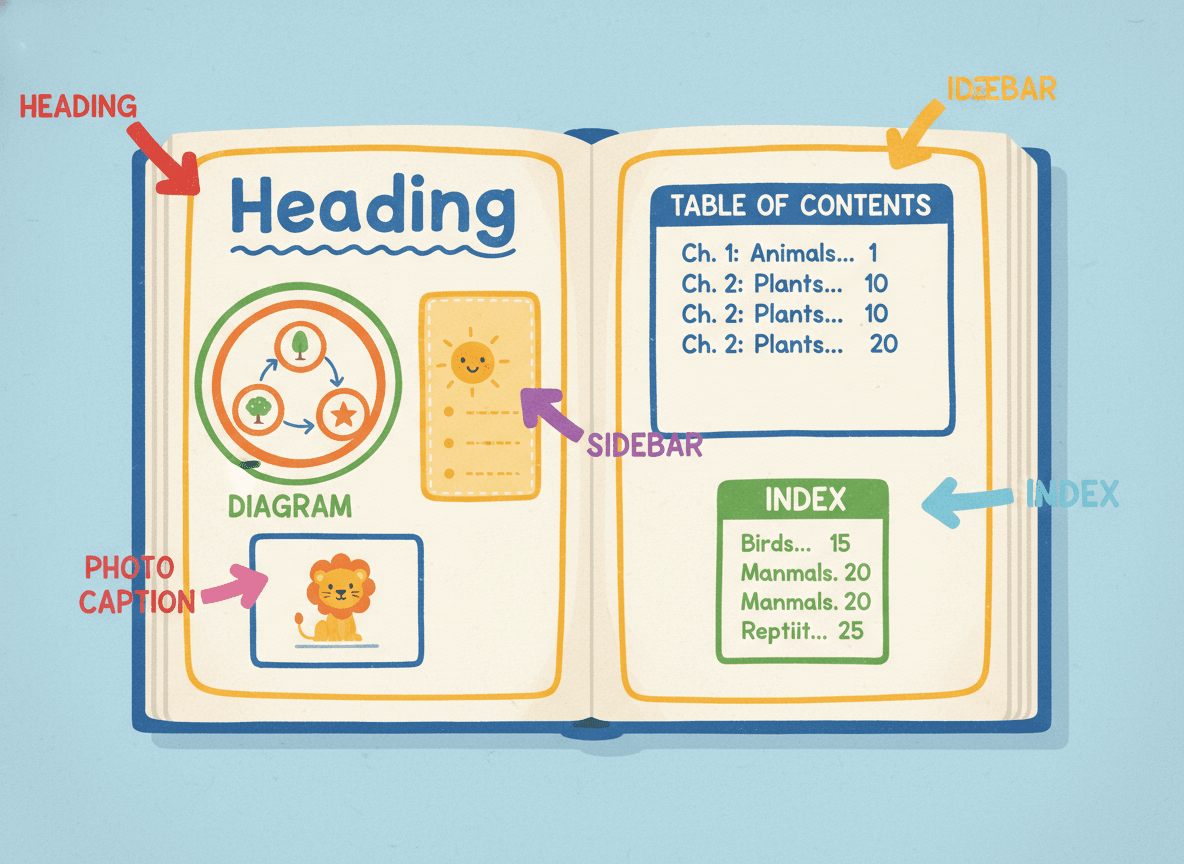
Headings and Subheadings: Break the text into organized sections; help readers find topics quickly
-
Bold / Italic words: Signal important vocabulary
-
Captions: Text under photos or illustrations that explains what is shown
Graphic Features
-
Photographs: Show real images of the topic
-
Illustrations / Diagrams: Labeled drawings that show how something works or is structured
-
Maps: Show geographical information or location
-
Charts and Tables: Organize data for comparison
-
Graphs: Show data visually (bar graph, pie chart, line graph)
-
Timelines: Show events in chronological order
Organizational Features
-
Table of Contents: Organized list of sections at the front of a book
-
Index: Alphabetical list of topics with page numbers at the back
-
Glossary: Definitions of key vocabulary at the back
-
Sidebar / Call-out box: Extra related information beside the main text
What Grade Do Kids Learn Text Features?
2nd grade (RI.2.5): Students know and use text features to locate key facts efficiently.
3rd grade (RI.3.5): Students use text features and search tools to locate information relevant to a question.
4th–5th grade (RI.4.5, RI.5.5): Students describe the overall structure of events, ideas, or information in a text and explain how text features contribute to the author's purpose.
Common Misconceptions
Text features are optional extras: Every text feature has a purpose. Skipping captions, diagrams, or sidebars means missing information the author deliberately included.
The glossary is just a dictionary: The glossary defines terms specifically as they are used in this text, which may differ from their everyday meaning. It's text-specific.
Text features contain less important information: This is false. Diagrams may convey information not stated anywhere in the prose. Maps show spatial relationships that words alone can't communicate as clearly.
Practice Activities
-
Text feature scavenger hunt: Give students a nonfiction text and a checklist; they find and identify each type of text feature.
-
Text feature purpose cards: Students explain in writing why each feature appears: "The author included this map because..."
-
Text walk preview: Before reading, pairs do a text feature walk and predict what they'll learn.
-
Create a text feature: Students add a diagram, caption, or glossary to a text that lacks one.
-
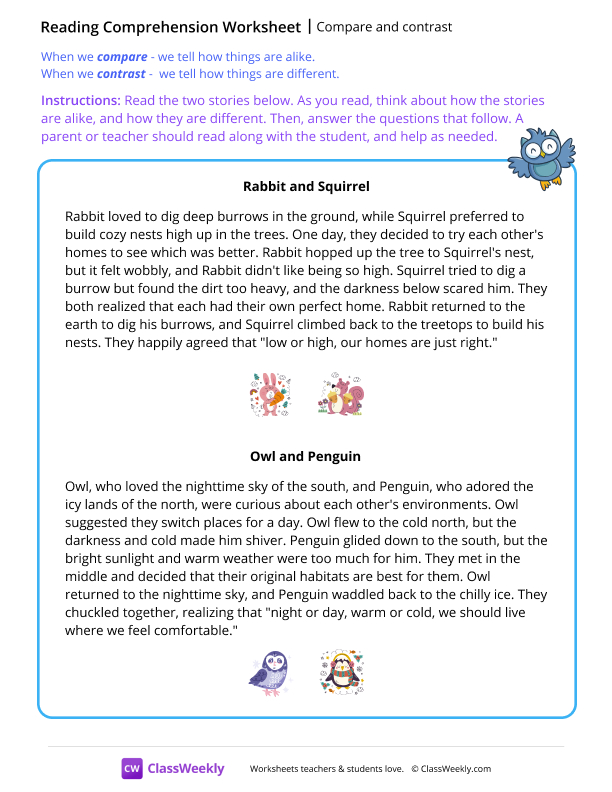
Compare two texts: Compare the text features used in two books on the same topic and discuss why they differ.
Frequently Asked Questions
What are nonfiction text features?
Nonfiction text features are elements added to informational texts to help readers organize, navigate, and understand the content. They include print features (bold words, italics, headings), graphic features (photographs, diagrams, maps, charts), and organizational features (table of contents, index, glossary, sidebars). They work alongside the main text to convey information.
Why do nonfiction books have so many visual features?
Nonfiction text features serve readers in ways that continuous prose cannot. A diagram of a food web shows relationships that would take paragraphs to describe. A table of contents lets readers jump directly to the section they need. A glossary defines technical terms. Bold words signal important vocabulary. Each feature reduces the cognitive load of navigating complex informational texts.
What is the difference between a table of contents and an index?
A table of contents appears at the front of a book and lists major sections and chapters in order by page number - it shows the book's overall organization. An index appears at the back and lists specific topics alphabetically with page numbers - it helps readers find mentions of a specific topic anywhere in the book. Both are navigation tools, but they serve different purposes.
How should students use text features before reading?
Before reading, students should preview text features to activate prior knowledge and set purpose. They scan the title, headings, photographs and captions, bold words, and any sidebars or call-out boxes. This pre-reading strategy (often called a 'text walk' or 'text feature walk') primes students for the content and vocabulary they're about to encounter.
What text features do students need to know for standardized tests?
Most elementary standardized tests (including those aligned to CCSS) ask students to identify and explain text features including headings, subheadings, sidebars, captions, diagrams, maps, charts, glossaries, and indexes. Students are asked both to name features and to explain what purpose each serves within the text.
Free Nonfiction Text Features Worksheets
Curriculum-aligned printable worksheets for 2nd – 5th Grade. Download free.