What Is a Relative Pronoun?
Taught in US schools
Key Takeaways
- The five relative pronouns are who, whom, whose, which, and that - they introduce relative clauses that describe or identify a noun.
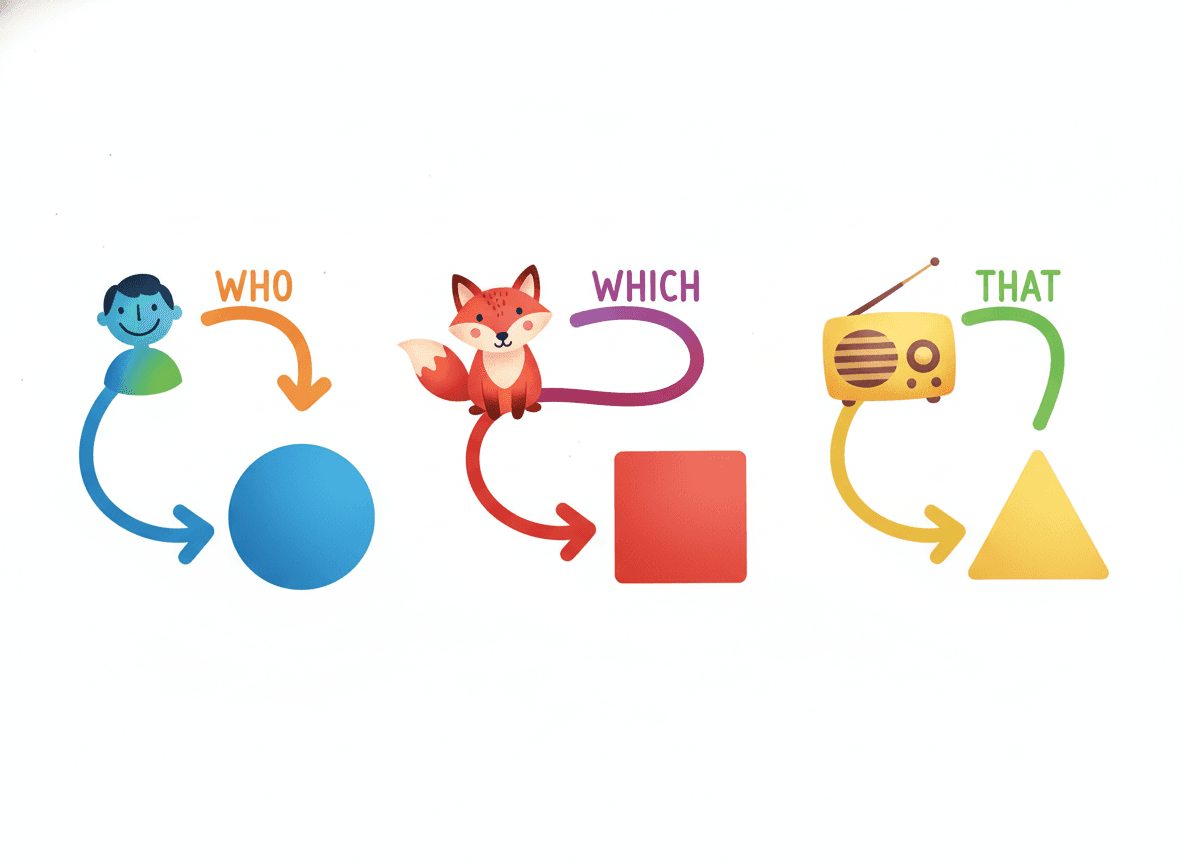
- Who and whom refer to people; which refers to things and animals; that can refer to people or things; whose shows possession.
- A relative clause is a type of dependent clause - it cannot stand alone and must be attached to the noun it modifies.
What Is a Relative Pronoun?
A relative pronoun introduces a relative clause - a dependent clause that modifies (describes or gives more information about) a noun in the sentence.
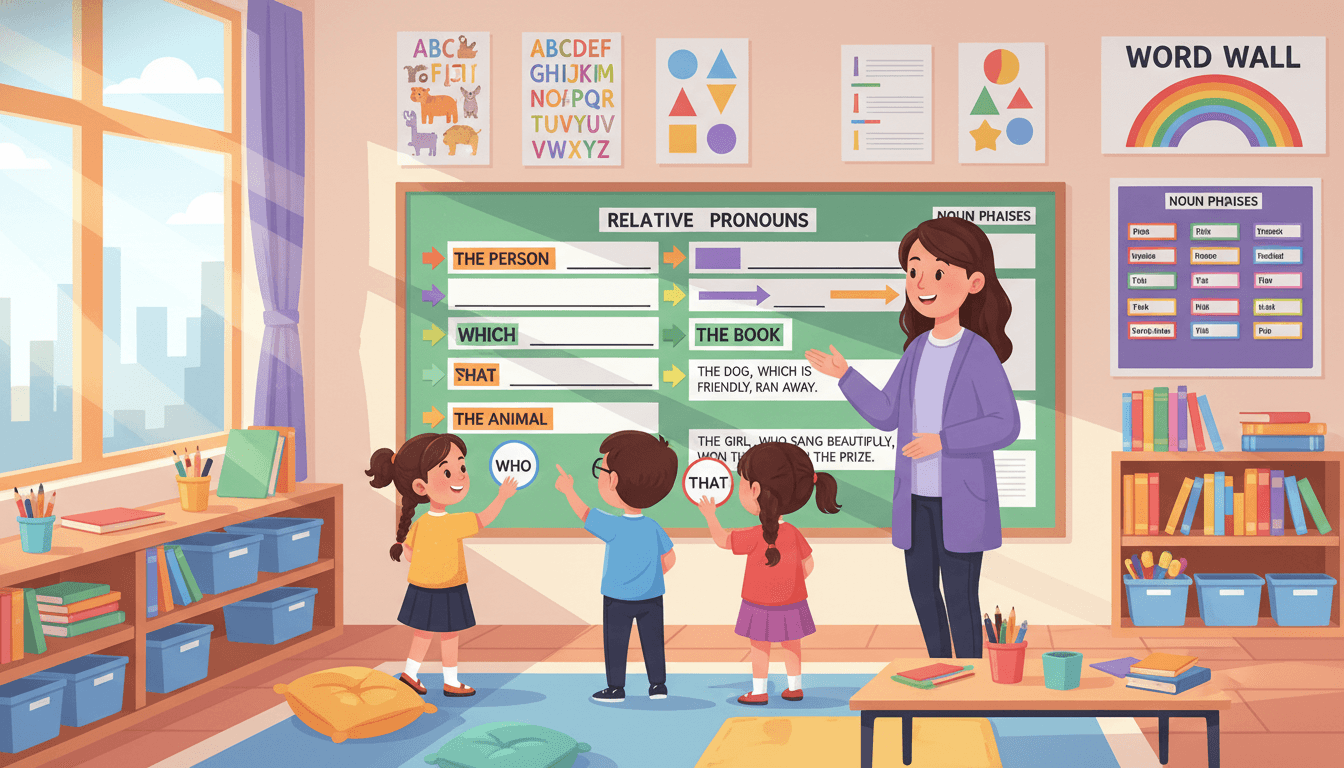
The five relative pronouns in English are:
who: People (subject of the clause) - "The boy who won the race..."
whom: People (object of the clause) - "The girl whom I helped..."
whose: Possession (people or things) - "The student whose project won..."
which: Things, animals (extra information) - "The park, which we visit often, is beautiful."
that: People or things (essential info) - "The book that I chose is long."
What Is a Relative Clause?
A relative clause is a dependent clause that begins with a relative pronoun. It answers the question "Which one?" or "What kind?" about the noun it follows.
"The teacher who helped me was very patient."
The relative clause who helped me tells us which teacher. Without it, we only know "The teacher was very patient" - we lose the identifying information.
Key rule: A relative clause always comes immediately after the noun it modifies.
Who vs. Whom
The most commonly confused relative pronouns for elementary students:
-
Who = subject of the relative clause (performing the action)
-
Whom = object of the relative clause (receiving the action)
"The boy who finished first got a prize." → He finished first → subject → who "The coach whom they admired moved away." → They admired him → object → whom
Trick: Replace the relative pronoun with he/she (subject) or him/her (object).
- "He finished first" → who
- "They admired him" → whom
Which vs. That: Restrictive and Nonrestrictive Clauses
This distinction is introduced in upper elementary:
Restrictive clause (that): Essential information - removes ambiguity about which noun. No commas.
"The cup that is cracked should be thrown away." (Not all cups - specifically the cracked one.)
Nonrestrictive clause (which): Extra information - could be removed without changing the core meaning. Use commas.
"My favorite cup, which is red, is in the dishwasher." (The comma signals this is bonus information.)
Elementary simplification: That identifies; which adds extra info.
Relative Clauses and Sentence Variety
Using relative clauses allows writers to combine two short sentences into one more sophisticated sentence:
"I have a dog. The dog is named Rex.": "I have a dog that is named Rex."
"We visited a museum. The museum was built in 1905.": "We visited a museum that was built in 1905." This is one of the key sentence-combining strategies taught in 4th–5th grade writing.
Practice Activities
- Give students pairs of simple sentences and have them combine them using who, whom, whose, which, or that.
- Underline hunt: students find all relative clauses in a paragraph and draw an arrow back to the noun each one modifies.
- "Who or Whom?" quick check: display sentences with blanks; students hold up WHO or WHOM cards.
- Error correction: provide sentences where which and that are switched; students correct and explain why.
- Creative writing: have students describe a mysterious character or object using two relative clauses (e.g., "It was a creature that glowed in the dark and whose eyes were silver.").
Frequently Asked Questions
When do you use 'who' versus 'whom'?
Use 'who' when the relative pronoun is the subject of the clause (doing the action): 'The teacher who helped me was very kind.' Use 'whom' when it is the object (receiving the action): 'The student whom the teacher praised felt proud.' A helpful test: if you can replace it with 'he/she,' use who; if you can replace it with 'him/her,' use whom.
What is the difference between 'which' and 'that' in a relative clause?
In formal grammar, 'that' introduces a restrictive relative clause - one that is essential to identify which noun is being discussed (no commas): 'The book that I borrowed is on the table.' 'Which' introduces a nonrestrictive clause - one that adds extra information but isn't essential (use commas): 'The book, which I borrowed from the library, is on the table.' For elementary students, a simplified rule is: use 'that' for things essential to meaning; use 'which' for extra information.
What is a relative clause?
A relative clause is a dependent clause that begins with a relative pronoun and modifies (describes or identifies) a noun. It tells us more about the noun it follows. Example: 'The dog that barked all night kept us awake.' The relative clause 'that barked all night' tells us which dog. Relative clauses always come right after the noun they modify.
Free Relative Pronoun Worksheets
Curriculum-aligned printable worksheets for 4th – 5th Grade. Download free.
Common Core Standards