Who Was Rosa Parks?
Taught in US schools
Key Takeaways
- On December 1, 1955, Rosa Parks refused to give up her seat on a Montgomery, Alabama bus to a white passenger, leading to her arrest.
- Her arrest sparked the Montgomery Bus Boycott - a 381-day protest during which African Americans refused to ride the city buses.
- Rosa Parks is called the 'Mother of the Civil Rights Movement' and received the Presidential Medal of Freedom (1996) and the Congressional Gold Medal (1999).
Who Was Rosa Parks?
Rosa Parks (1913–2005) was an African American civil rights activist whose single act of courage on a city bus helped ignite one of the most significant movements in American history. She is often called the "Mother of the Civil Rights Movement."
Early Life
Rosa Louise McCauley was born on February 4, 1913, in Tuskegee, Alabama. She grew up in the racially segregated South, where laws and customs enforced the separation of Black and white people in nearly every aspect of daily life - schools, restaurants, transportation, and more.
She married Raymond Parks in 1932, a barber and civil rights activist. Rosa became an active member of the NAACP (National Association for the Advancement of Colored People) and served as its Montgomery chapter secretary.
December 1, 1955: The Bus Ride
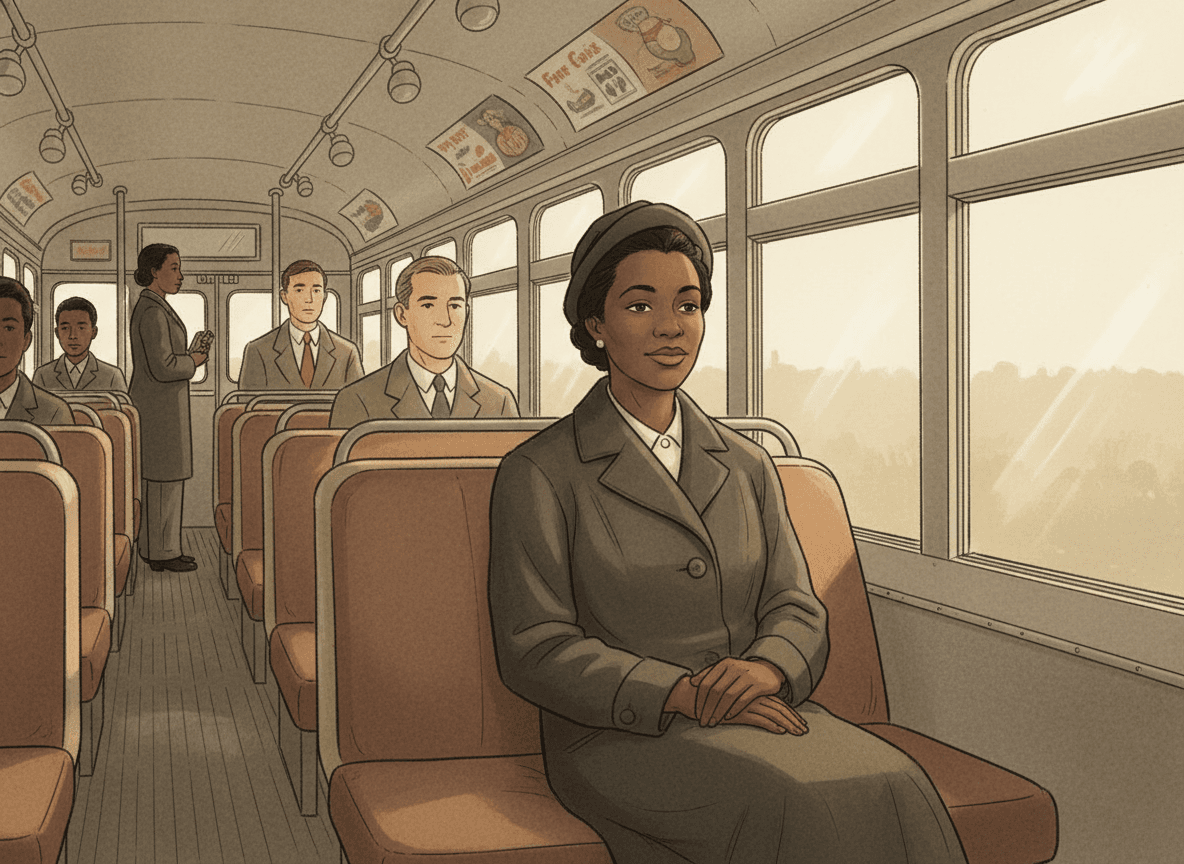
On the evening of December 1, 1955, Rosa Parks boarded a city bus in Montgomery, Alabama after a long day of work as a seamstress. When the bus filled up, the driver ordered Parks and other Black passengers to give up their seats for white passengers - as was required by the city's segregation laws.
Rosa Parks refused.
She was arrested and charged with violating segregation laws. Her quiet, dignified act of defiance became a spark.
The Montgomery Bus Boycott
The African American community of Montgomery responded to Parks's arrest with remarkable unity. Led by the Montgomery Improvement Association and a young minister named Dr. Martin Luther King Jr., they organized a boycott of the city bus system.
For 381 days, from December 5, 1955 to December 20, 1956, African American residents walked, carpooled, and found other ways to get around rather than ride the segregated buses. The boycott caused serious financial harm to the bus company.
The boycott ended when the U.S. Supreme Court ruled that bus segregation was unconstitutional.
Later Life and Legacy
Rosa Parks continued her civil rights work for decades. She moved to Detroit, Michigan, where she worked for Congressman John Conyers. In later years, she cofounded the Rosa and Raymond Parks Institute for Self-Development.
Presidential Medal of Freedom: 1996
Congressional Gold Medal: 1999
Lying in honor at the U.S. Capitol: 2005 Rosa Parks died on October 24, 2005, at age 92. She was the first woman and second African American to lie in honor at the U.S. Capitol Rotunda.
Why Rosa Parks Matters
Rosa Parks showed that one person's courageous choice - to stand up (or stay seated) for what is right - can change the world. Her story teaches students that justice requires action, that ordinary people can make a difference, and that laws must be challenged when they are unfair.
Practice Activities
- Read a picture book biography of Rosa Parks (e.g., Rosa by Nikki Giovanni) and discuss: what made her brave? What would you have done?
- Create a timeline showing the events from December 1, 1955 through December 20, 1956.
- Compare Rosa Parks's act of civil disobedience to other acts of peaceful protest in history - what do they have in common?
- Research the Montgomery Bus Boycott logistics: how did 40,000+ people get to work for 381 days without riding buses?
- Write from the perspective of a Montgomery resident during the boycott - what would your daily life be like?
Frequently Asked Questions
Why did Rosa Parks refuse to give up her seat?
At the time, Montgomery, Alabama had a law requiring Black passengers to give up their seats for white passengers when the bus was full. Rosa Parks refused because she believed the law was unjust and discriminatory. She later said she was not simply tired from a long day's work - she was tired of giving in to an unjust system. Her action was deliberate and courageous.
What was the Montgomery Bus Boycott?
The Montgomery Bus Boycott was a 381-day protest (December 5, 1955 to December 20, 1956) during which African American residents of Montgomery, Alabama refused to ride the city's buses. The boycott was organized by the Montgomery Improvement Association, led by Dr. Martin Luther King Jr. It ended when the U.S. Supreme Court ruled that bus segregation was unconstitutional.
Was Rosa Parks a trained activist before the bus incident?
Yes. Rosa Parks was not just a tired seamstress who spontaneously refused to move. She was the secretary of the Montgomery chapter of the NAACP (National Association for the Advancement of Colored People) and had attended the Highlander Folk School, where activists were trained in nonviolent resistance. Her act was a courageous decision by a committed, experienced civil rights worker.
Free Rosa Parks Worksheets
Curriculum-aligned printable worksheets for 1st – 5th Grade. Download free.