What Are Synonyms and Antonyms?
Taught in US schools
Key Takeaways
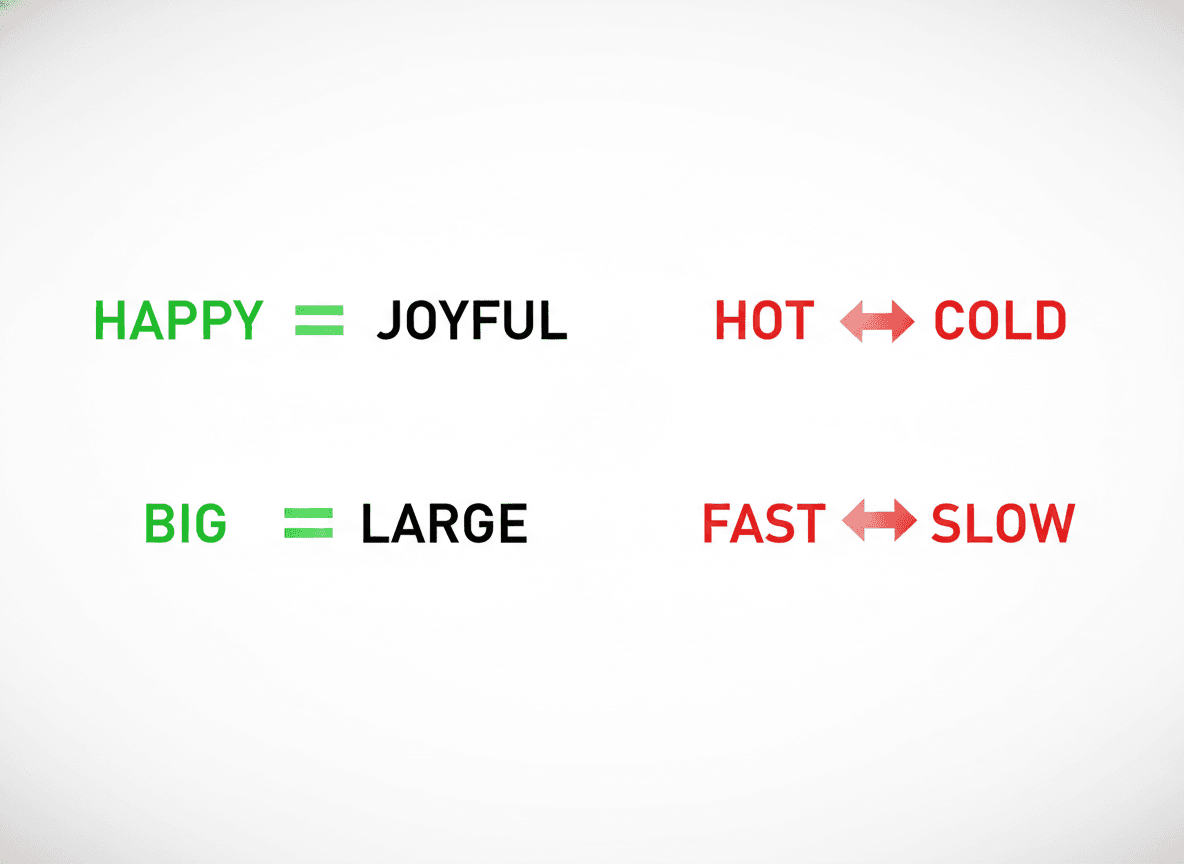
- Synonyms are words that have the same or similar meanings: happy/joyful, big/large.
- Antonyms are words with opposite meanings: hot/cold, always/never, kind/cruel.
- True synonyms are rare - most synonyms have subtle differences in degree or connotation.
- Building synonym and antonym knowledge strengthens vocabulary, improves writing word choice, and supports reading comprehension.
What Are Synonyms and Antonyms?
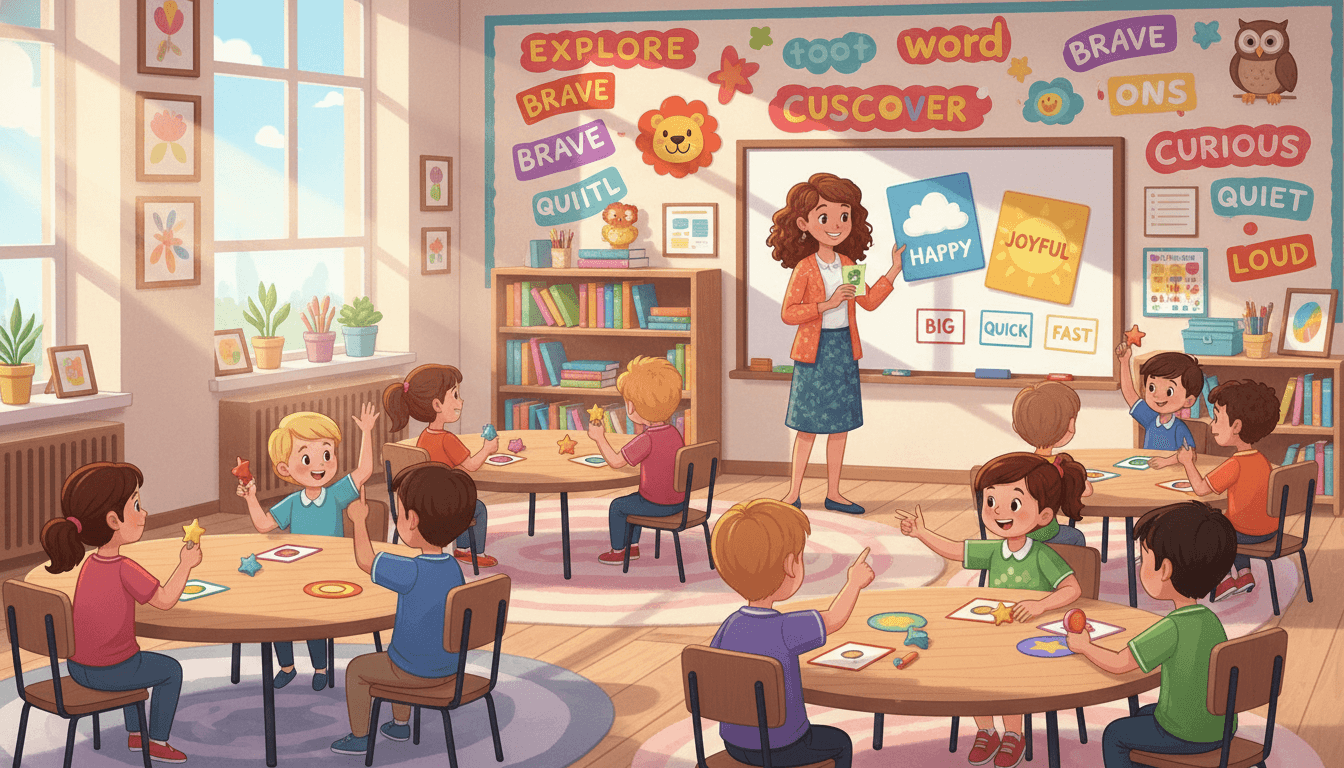
Synonyms are words with the same or similar meanings. Antonyms are words with opposite meanings. Together, they form one of the most fundamental vocabulary concepts in elementary English Language Arts.
Synonym examples:
- happy → joyful, content, pleased, delighted
- fast → quick, swift, rapid, speedy
Antonym examples:
- hot ↔ cold
- bright ↔ dim
- brave ↔ cowardly
The Spectrum of Synonyms
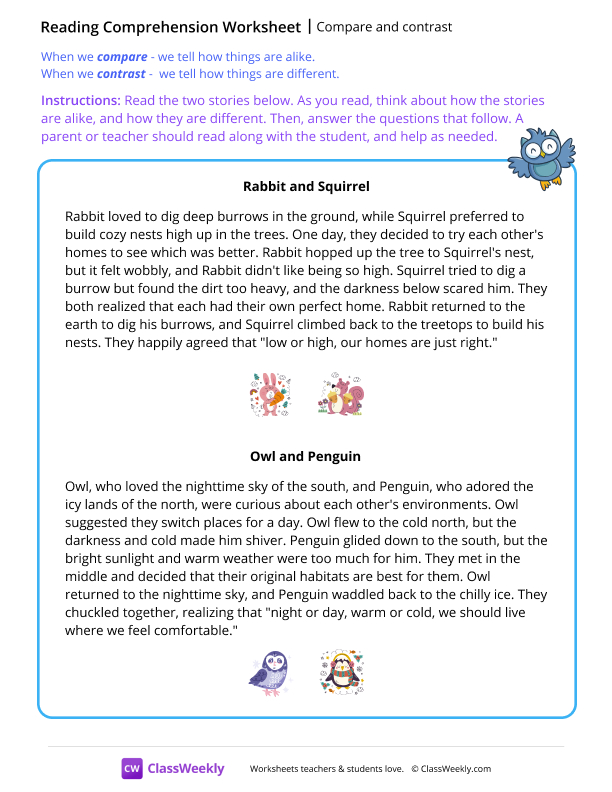
Most synonyms are not interchangeable - they differ in degree, formality, or exact meaning. Teaching this nuance helps students move beyond surface-level word awareness.
Angry → annoyed → mad → furious → livid (a scale of intensity)
Large → big → enormous → gigantic → colossal (a scale of size)
Mapping synonyms on a scale or spectrum is more powerful than simply listing them as equals.
Antonyms: Types
Gradable antonyms: Exist on a spectrum (hot/cold - there is warm and cool in between).
Complementary antonyms: Absolute opposites, no middle ground (alive/dead, present/absent).
Relational antonyms: Express a relationship (buy/sell, teacher/student, parent/child).
Why Synonyms and Antonyms Matter
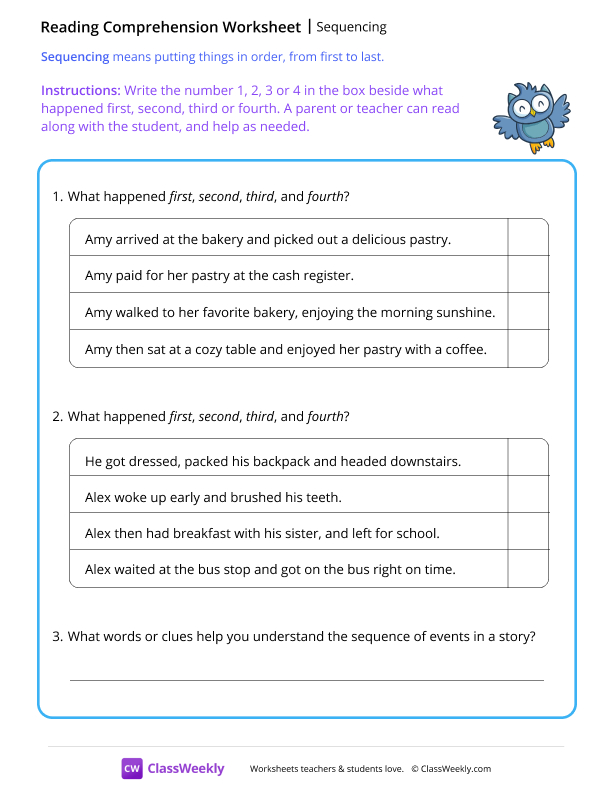
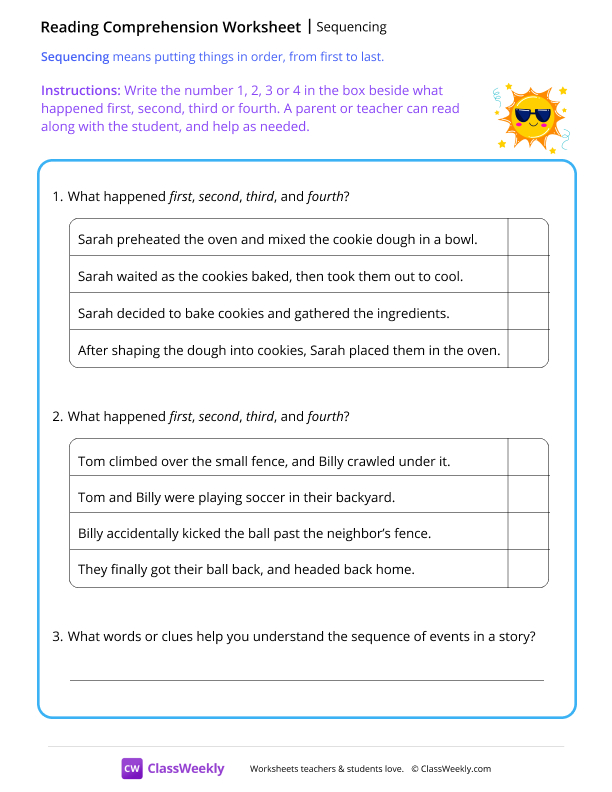
For reading: Recognizing synonyms helps students understand text when an author avoids repeating the same word. Recognizing antonyms helps with context clue strategies - "although she was usually shy, today she was _______" suggests the answer is an antonym of shy.
For writing: A strong vocabulary of synonyms gives students the tools for precise word choice, vivid description, and varied sentence style.
What Grade Do Kids Learn Synonyms and Antonyms?
2nd grade (L.2.5a): Students identify real-life connections and distinguish shades of meaning among related words.
3rd grade (L.3.5a): Students distinguish the literal and nonliteral meanings of words and phrases.
4th grade (L.4.5c): Students distinguish between the connotations of words with similar denotations (e.g., stingy vs. thrifty).
Common Misconceptions
All synonyms mean exactly the same thing: Very few words are perfect synonyms. Students should learn to distinguish nuance - "home" and "house" are similar but not identical in meaning and emotional weight.
Antonyms are just adding "not": While "unkind" is an antonym of "kind," the richer antonym might be "cruel" or "harsh." Push students to think beyond simple negation.
Any word can be replaced by its synonym: Context determines which synonym is best. "The horse galloped" cannot always become "the horse hustled."
Practice Activities
-
Synonym spectrum: Arrange synonym cards on a line from mild to intense.
-
Antonym pairs: Match word cards into antonym pairs with justification.
-
Synonym swap: Improve a paragraph by replacing overused words with more precise synonyms.
-
Antonym context clues: Fill in the blank using context (antonym clue) in a sentence.
-
Thesaurus exploration: Choose one word, find 5 synonyms, and discuss how each would work differently in the same sentence.
Frequently Asked Questions
What are synonyms?
Synonyms are words that have the same or very similar meanings. For example, happy, joyful, content, pleased, and delighted are all synonyms - they all describe a positive emotional state. However, true synonyms are rare: most near-synonyms differ in intensity, formality, or specific nuance. 'Furious' and 'annoyed' are both synonyms of 'angry' but differ greatly in intensity.
What are antonyms?
Antonyms are words with opposite or contrasting meanings. Hot and cold, day and night, give and take, brave and cowardly are antonym pairs. Antonyms can be exact opposites or just contrasting. Learning antonyms alongside synonyms helps students understand the full range of meaning around a word and use language more precisely.
Why is learning synonyms important for writing?
Synonyms help writers avoid repetition and choose the most precise word for the situation. Using 'sprinted' instead of 'ran' is more vivid. 'Whispered' instead of 'said' creates a different effect. A strong vocabulary of synonyms allows students to calibrate their word choice to the exact meaning and tone they want to convey.
How is a thesaurus used with synonyms?
A thesaurus is a reference tool that lists synonyms (and sometimes antonyms) for words. Unlike a dictionary, it doesn't define words - it groups related words by meaning. Students use a thesaurus to find alternatives when a word feels too plain or too repeated. However, they should always verify in a dictionary that the synonym fits their intended meaning.
What is the difference between a synonym and a homophone?
A synonym is a word with a similar meaning to another word. A homophone is a word that sounds the same as another word but has a different meaning and spelling (there/their/they're). These are completely different concepts. Students sometimes confuse them because both involve pairs of words - but the relationship is entirely different.
Free Synonyms and Antonyms Worksheets
Curriculum-aligned printable worksheets for 2nd – 4th Grade. Download free.