What Is Telling Time?
Taught in US schools
Key Takeaways
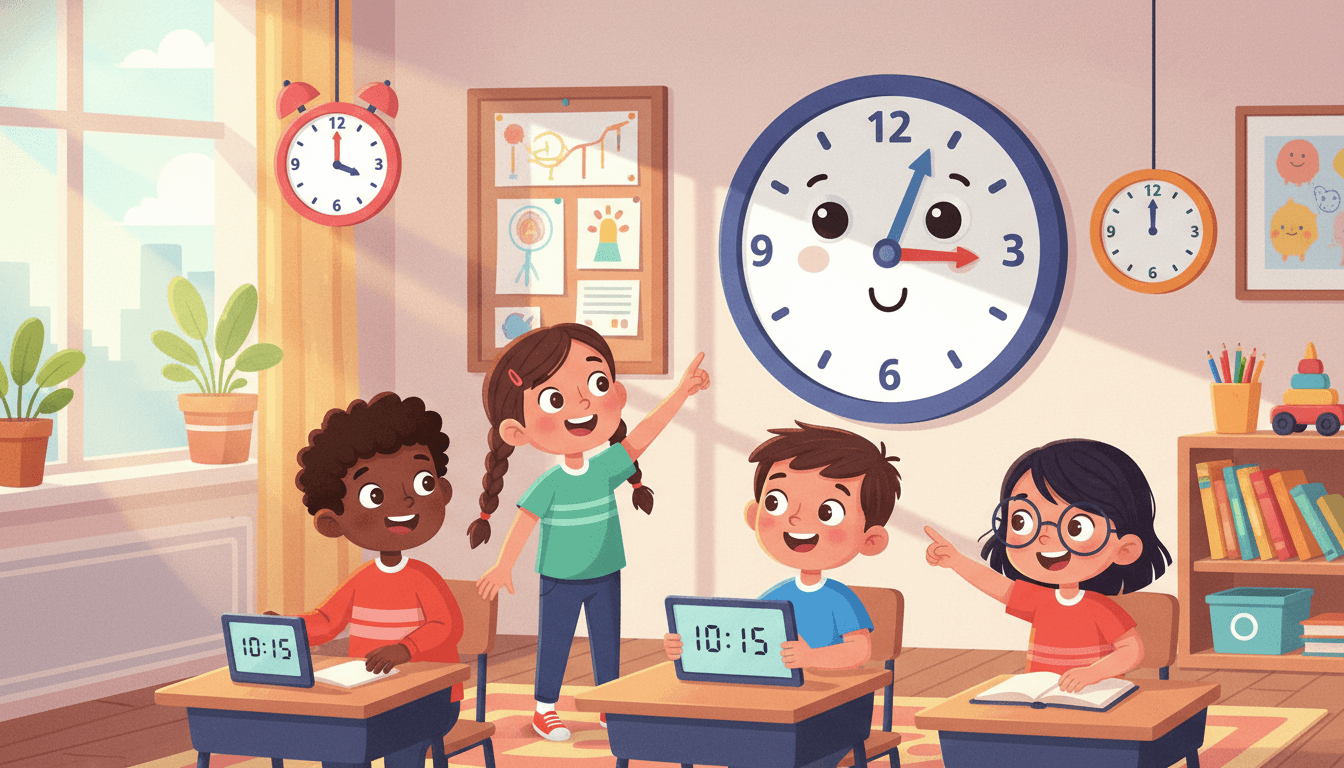
- Analog clocks: hour hand (shorter) tells the hour, minute hand (longer) tells the minutes.
- 1st grade: tell time to the hour and half-hour. 2nd grade: to the nearest 5 minutes. 3rd grade: to the minute + elapsed time.
- A.M. = after midnight to noon; P.M. = noon to midnight.
- Elapsed time = end time − start time. Use a number line or clock jumps to calculate it.
What Is Telling Time?
Telling time is the ability to read a clock and understand how time is measured. It includes:
- Reading analog (clock face) and digital clocks
- Understanding minutes, hours, A.M., and P.M.
- Calculating elapsed time - how long something takes
The Analog Clock
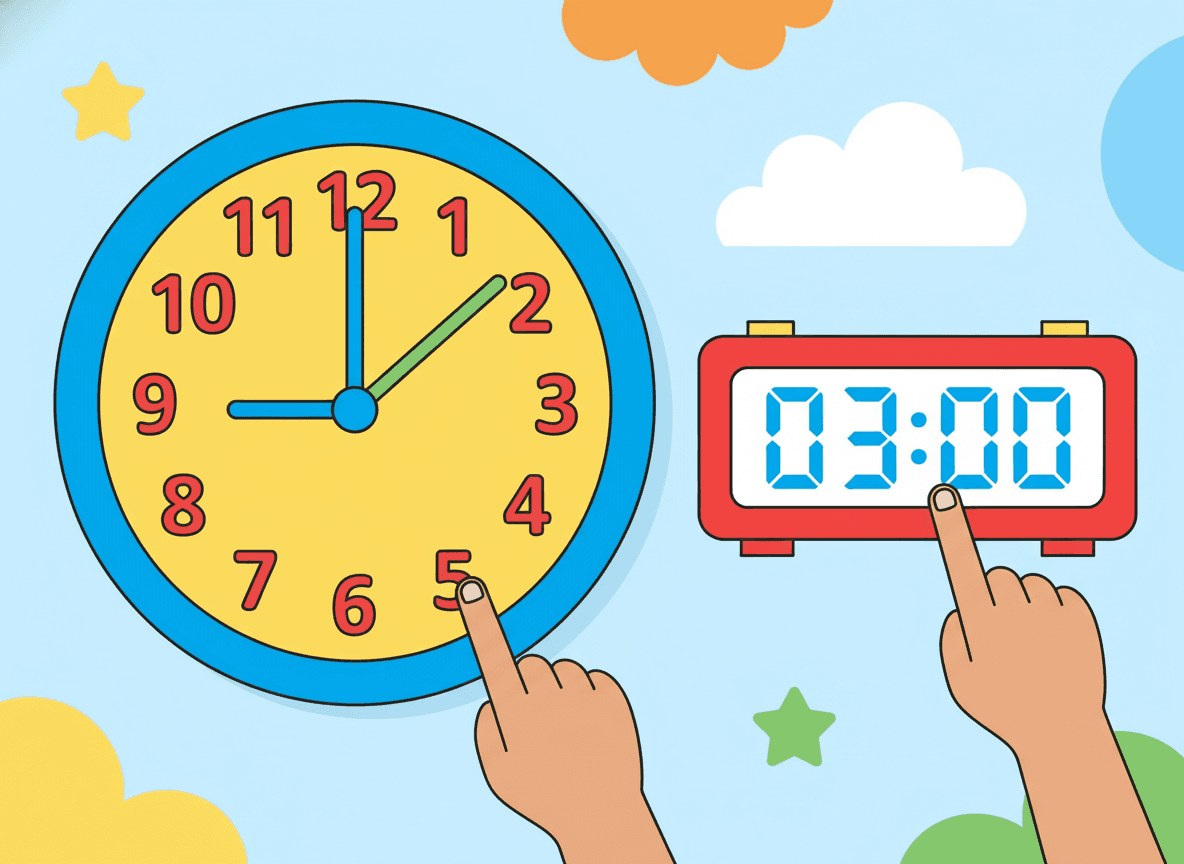
An analog clock face has:
-
Hour hand (shorter) - moves slowly, points to the current hour
-
Minute hand (longer) - makes a full rotation every hour, counts minutes
-
60 equal divisions around the face - the 12 numbers mark 5-minute intervals
Reading the clock:
- Find the hour: the shorter hand points to (or just past) the current hour
- Count the minutes: multiply the number the minute hand points to by 5
- Add any additional tick marks
Hour hand just past 3, minute hand on 4 (= 20 min) → 3:20
Anchor points to memorize:
- Minute hand at 12 = :00 (on the hour)
- Minute hand at 3 = :15 (quarter past)
- Minute hand at 6 = :30 (half past)
- Minute hand at 9 = :45 (quarter to)
A.M. and P.M.
After midnight to noon: Noon to midnight
12:00 A.M. = midnight: 12:00 P.M. = noon
School morning, breakfast: Afternoon, evening
Elapsed Time
Elapsed time is how much time passes between a start and end time.
Example: Start: 2:15 P.M. End: 4:00 P.M.
Open number line strategy:
2:15 → (+1 hour) → 3:15 → (+45 min) → 4:00
Total: 1 hour 45 minutes
Break the problem into jumps of hours, then minutes.
What Grade Do Kids Learn Time?
1st Grade: Tell and write time to the hour and half-hour using analog and digital clocks (1.MD.B.3).
2nd Grade: Tell and write time from analog and digital clocks to the nearest five minutes; use A.M. and P.M. (2.MD.C.7).
3rd Grade: Tell and write time to the nearest minute; measure time intervals; solve elapsed time problems using a number line diagram (3.MD.A.1).
Common Misconceptions
"The big hand is the hour." The minute hand is the longer (bigger) hand - this is counterintuitive because students expect "bigger = more important." Teach by function: the minute hand moves the most because it covers more distance in a day.
"3:15 is 'three fifteen'" - but also a quarter past three, or 15 minutes after 3. Multiple representations of the same time build flexibility.
"12 A.M. is noon." Many adults make this error. 12:00 A.M. is midnight. 12:00 P.M. is noon. Remember: noon comes first in the P.M. half.
Practice Activities
-
Geared analog clock manipulative: Practice moving hands to set specific times and reading displayed times.
-
Daily schedule: Record daily events on a timeline with clock faces and written times.
-
Elapsed time number line: Practice drawing number lines with time jumps from start to end times.
-
A.M./P.M. sort: Cards with activities; students sort into A.M. or P.M. categories.
-
Clock around the room: Clocks at different times placed around the room; students record each time on a worksheet.
Frequently Asked Questions
How do you read an analog clock?
An analog clock has two main hands: the hour hand (shorter, moves slowly) and the minute hand (longer, moves faster). To read the time: (1) Look at the hour hand - it points to (or just past) the current hour. (2) Look at the minute hand - count by fives for each number it passes, then by ones for additional minute marks. The 12 = 0 or 60 minutes. The 3 = 15 minutes. The 6 = 30 minutes. The 9 = 45 minutes. Example: hour hand past 2, minute hand at 3 (the 15-minute mark) → 2:15.
What is elapsed time and how do students calculate it?
Elapsed time is how much time passes between a start time and an end time. 'Sam started homework at 3:30 and finished at 5:00. How long did he work?' Elapsed time = 1 hour 30 minutes. Strategies: Open number line (mark start time, jump in hours, then minutes to end time). Clock model (move the minute hand and count). Starting time + elapsed time formula. The open number line is the most widely taught strategy because it makes the jumps visible. 3rd grade introduces elapsed time formally (3.MD.A.1) and students work with problems to the minute.
What is the difference between A.M. and P.M.?
A.M. (from Latin ante meridiem = before midday) covers the 12 hours from midnight to noon: 12:00 A.M. (midnight) to 11:59 A.M. P.M. (post meridiem = after midday) covers the 12 hours from noon to midnight: 12:00 P.M. (noon) to 11:59 P.M. A common confusion: 12:00 A.M. is midnight (start of the day), not noon. Relating A.M. and P.M. to daily routines (wake up at 7 A.M., dinner at 6 P.M.) makes the concept concrete for early elementary students.
Why is the analog clock still taught when digital clocks are everywhere?
Analog clock reading develops spatial and proportional reasoning - the clock face is a circle divided into 60 equal parts, and reading it requires understanding fractions of a whole (quarter past, half past). This connects directly to fractions and circle geometry. Additionally, analog clocks are still used in many schools, doctors' offices, and public spaces. More importantly, research on early math development suggests that the mental models built through analog clock reading (visualizing time intervals, understanding relative duration) support number sense in ways that reading a digital display does not.
How do students learn to count minutes on an analog clock?
The key insight: count by fives for each number on the clock (5, 10, 15, 20... 60), then count individual tick marks for additional minutes. Teaching sequence: (1) Hours only - the minute hand is on the 12. (2) Half hours - minute hand on 6. (3) Quarter hours - minute hand on 3 and 9. (4) Five-minute intervals - minute hand on each number. (5) Minute precision - minute marks between numbers. Connecting 'skip-counting by 5' to the clock face is a natural bridge from skip-counting to time-telling.
Free Telling Time Worksheets
Curriculum-aligned printable worksheets for 1st – 3rd Grade. Download free.