What Is a Timeline?
Taught in US schools
Key Takeaways
- A timeline is a graphic tool that displays events in chronological (time) order, with earlier events on the left and later events on the right.
- Timelines have a starting point, an ending point, and evenly spaced intervals - each interval represents the same amount of time.
- Timelines are used in social studies (historical events), science (life cycles, Earth history), reading (story sequencing), and personal biography.
What Is a Timeline?
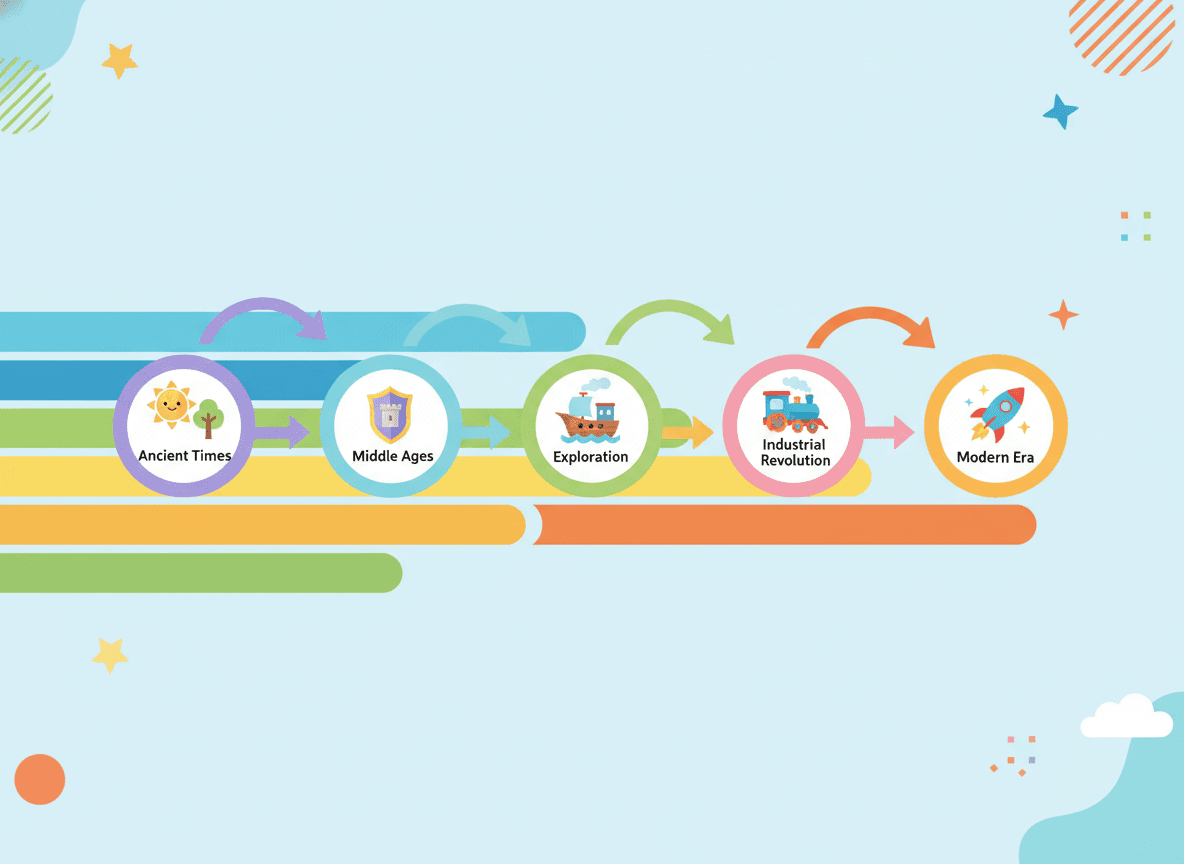
A timeline is a visual graphic that shows events in chronological order - arranged from earliest to latest along a horizontal (or sometimes vertical) line. Timelines help readers understand the sequence of events, recognize patterns in history, and see how one event leads to another.
Timelines are one of the most versatile tools in elementary school - used in social studies, reading, science, and personal writing.
Parts of a Timeline
Every timeline has these essential components:
Start point: The earliest event or date shown
End point: The latest event or date shown
Intervals: Evenly spaced markers showing equal periods of time
Events/Labels: Descriptions of what happened at each point
Dates: The specific time each event occurred
Title: What the timeline is about
Key rule: Intervals must be equally spaced - if each inch on the line represents 10 years, every 10 years must be the same distance apart.
Types of Timelines
Personal Timeline
Shows events from a person's own life in order: birth, learning to walk, starting school, a special trip, current day.
Historical Timeline
Shows significant events over a period of history:
- Events leading to American independence
- The Civil Rights Movement (1950s–1960s)
- World explorers from 1400–1600
Biographical Timeline
Shows key events in the life of one person: Rosa Parks, Benjamin Franklin, a famous scientist.
Science Timeline
Shows a sequence of events in a natural process: the stages of a butterfly's life cycle, the formation of a fossil, the history of Earth's geological eras.
Story Timeline (Sequencing)
Shows the sequence of events in a story - beginning, middle, end - which connects to reading comprehension and story structure.
Reading a Timeline
To read a timeline:
- Read the title - what topic or person does it cover?
- Find the start and end points to understand the full time span.
- Check the intervals - what period does each unit represent?
- Read events left to right in order.
- Look for patterns: How much time passed between events? Which events happened close together? Which had a long gap?
Creating a Timeline
Steps for students:
- List all events and their dates.
- Sort them from earliest to latest.
- Choose an appropriate scale (intervals of 1 year, 10 years, 100 years).
- Draw a horizontal line and mark the intervals.
- Place each event at the correct point on the line.
- Label each event with a brief description.
- Add a title.
Timelines vs. Sequence Charts
Both show order, but they are different:
Shows: Specific dates and durations
Uses: Actual time scale
Best for: History, biography
Practice Activities
- Students create a personal timeline of their own life (birth to present) using drawings and captions.
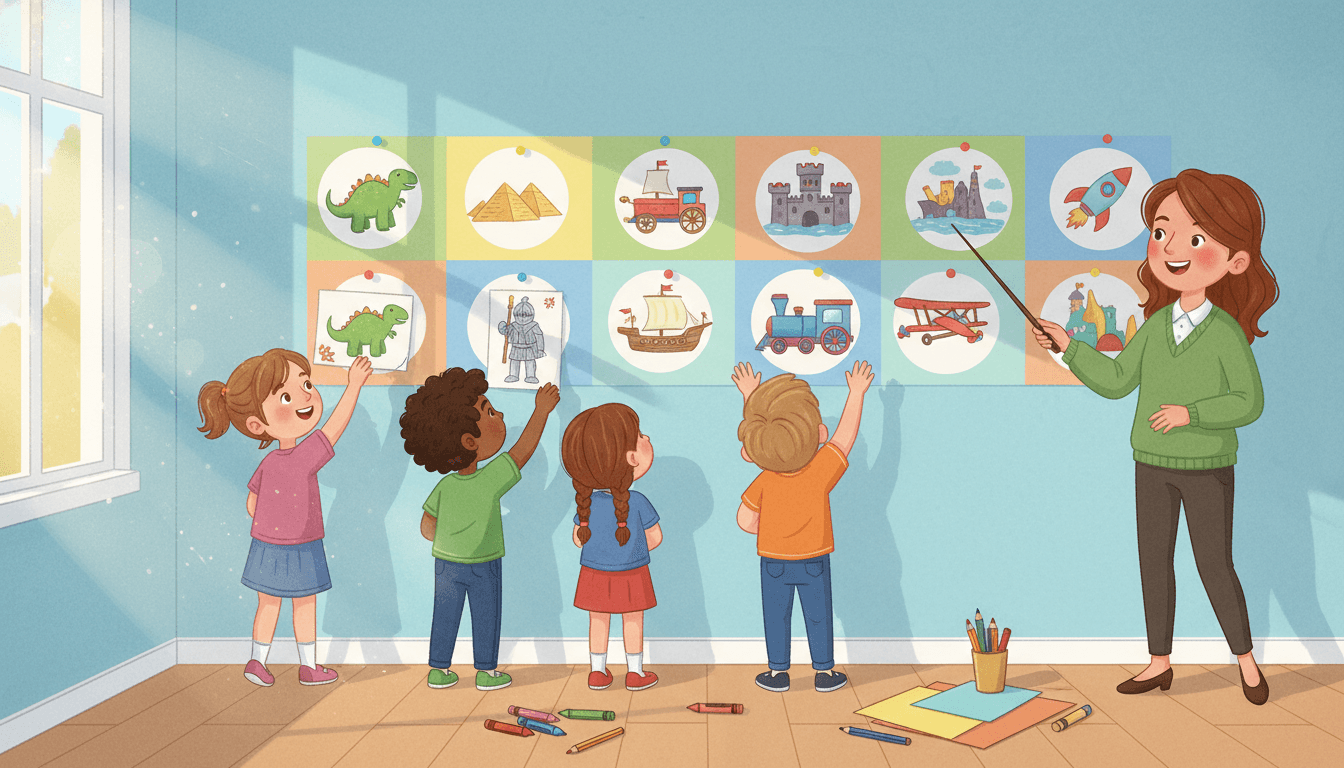
- Provide a set of event cards from a historical period (e.g., the American Revolution) and have students arrange them in chronological order, then place them on a class timeline.
- After reading a biography, students build a biographical timeline of the subject's key life events.
- Compare two timelines of the same period from different sources - do they agree? Are different events highlighted?
- Science connection: create a timeline of the life cycle of a monarch butterfly, from egg to adult.
Frequently Asked Questions
What does 'chronological order' mean?
Chronological order means arranged by time - from the earliest event to the most recent. 'Chrono' comes from the Greek word for time (chronos). Placing events in chronological order helps us understand the sequence of how things happened and how one event led to the next.
What is the difference between a personal timeline and a historical timeline?
A personal timeline shows events from one person's life in order (birthdate, first day of school, a special trip, a birthday). A historical timeline shows events from history over a specific time period (events leading to the American Revolution, milestones of the Civil Rights Movement). Both use the same structure - chronological order with labeled events and dates.
How do you choose the intervals on a timeline?
Intervals should be equal in size and appropriate for the time span being shown. For a personal timeline covering a few years, intervals of one year work well. For a historical timeline covering centuries, intervals of 10, 25, 50, or 100 years may be more appropriate. The key rule: every interval must represent the same amount of time.
Free Timeline Worksheets
Curriculum-aligned printable worksheets for Kindergarten – 4th Grade. Download free.