What Are the Four Types of Sentences?
Taught in US schools

Key Takeaways
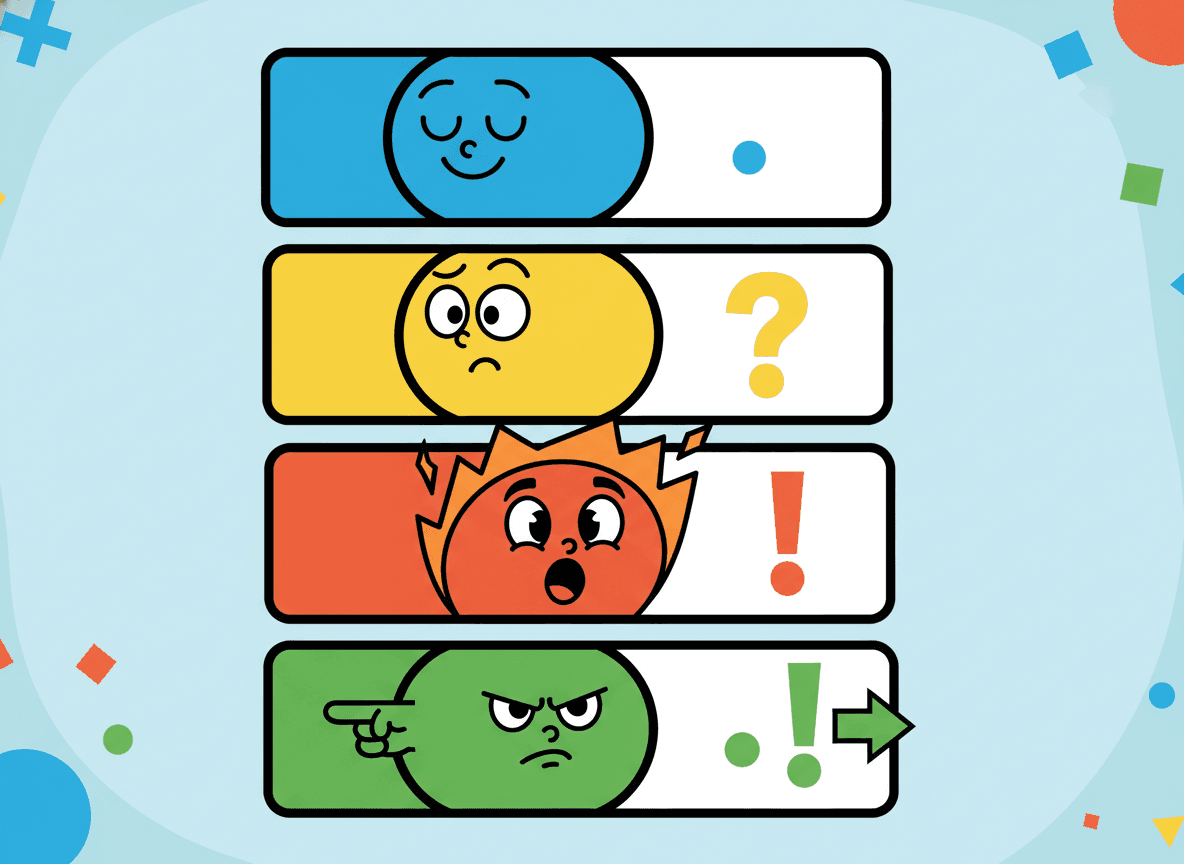
- Declarative sentences make statements and end with a period; interrogative sentences ask questions and end with a question mark.
- Exclamatory sentences express strong emotion and end with an exclamation point; imperative sentences give commands and end with a period or exclamation point.
- In imperative sentences, the subject 'you' is implied but not written - the sentence commands the reader directly.
What Are the Four Types of Sentences?
Every sentence we write or say has a purpose - to share information, ask a question, show strong feeling, or give a command. English has four sentence types, each with its own purpose and end punctuation.
The Four Types at a Glance
Declarative: Makes a statement - Period (.) - The dog is sleeping on the porch.
Interrogative: Asks a question - Question mark (?) - Did you finish your homework?
Exclamatory: Shows strong emotion - Exclamation point (!) - I can't believe we won the game!
Imperative: Gives a command or request - Period (.) or ! - Please close the door.
1. Declarative Sentences
A declarative sentence makes a statement - it tells, explains, or describes something. It is the most common type of sentence.
Examples:
- My favorite color is blue.
- The library opens at nine o'clock.
- Frogs are amphibians.
Declarative sentences always end with a period.
2. Interrogative Sentences
An interrogative sentence asks a question. It always ends with a question mark (?). Many interrogative sentences begin with question words: who, what, where, when, why, how, did, is, are, can, will.
Examples:
- Where is the nearest water fountain?
- Can penguins fly?
- What time does school start?
3. Exclamatory Sentences
An exclamatory sentence expresses strong emotion - excitement, surprise, anger, joy, or fear. It ends with an exclamation point (!).
Examples:
- I got a puppy for my birthday!
- That was the scariest movie ever!
- Watch out for the bee!
Be careful not to overuse exclamation points - they lose their impact when every sentence has one.
4. Imperative Sentences
An imperative sentence gives a command, direction, or request. The subject of an imperative sentence is always "you" (implied) - it is not written in the sentence because the speaker is addressing the reader or listener directly.
Examples:
- Turn left at the stop sign.
- Please hand in your papers.
- Don't touch the hot stove!
Imperative sentences end with a period for polite requests and an exclamation point for urgent commands.
Grade-by-Grade Progression
Kindergarten – 1st: Declarative and interrogative sentences; capital letters and periods vs. question marks
2nd Grade: Adds exclamatory and imperative; matching punctuation to sentence type
3rd – 5th: Writing all four types with variety; identifying and correcting punctuation errors
Practice Activities
- Sort a set of sentence strips by type - students hold them up to show declarative, interrogative, exclamatory, or imperative.
- Rewrite the same idea as all four sentence types (e.g., "It is raining." → "Is it raining?" → "It's pouring out there!" → "Grab your umbrella.").
- Punctuation repair: give students a paragraph where all end marks are removed and ask them to put the correct punctuation back.
- Write a dialogue between two characters that uses all four sentence types naturally.
- Play "What kind am I?" - teacher reads a sentence aloud and students hold up a card (D, I, E, or Imp) to identify the type.
Frequently Asked Questions
What is a declarative sentence?
A declarative sentence makes a statement or shares information. It ends with a period. Example: The sun rises in the east.
How is an imperative sentence different from the others?
An imperative sentence gives a command or makes a request. The subject is the implied 'you,' so it does not appear in the sentence. Examples: Close the door. Please sit down.
Can an imperative sentence end with an exclamation point?
Yes. An imperative sentence ends with a period for a calm request (Please pass the salt.) but ends with an exclamation point when the command is urgent or forceful (Stop right now!).
Free Types of Sentences Worksheets
Curriculum-aligned printable worksheets for Kindergarten – 5th Grade. Download free.