What Is Sentence Variety?
Taught in US schools

Key Takeaways
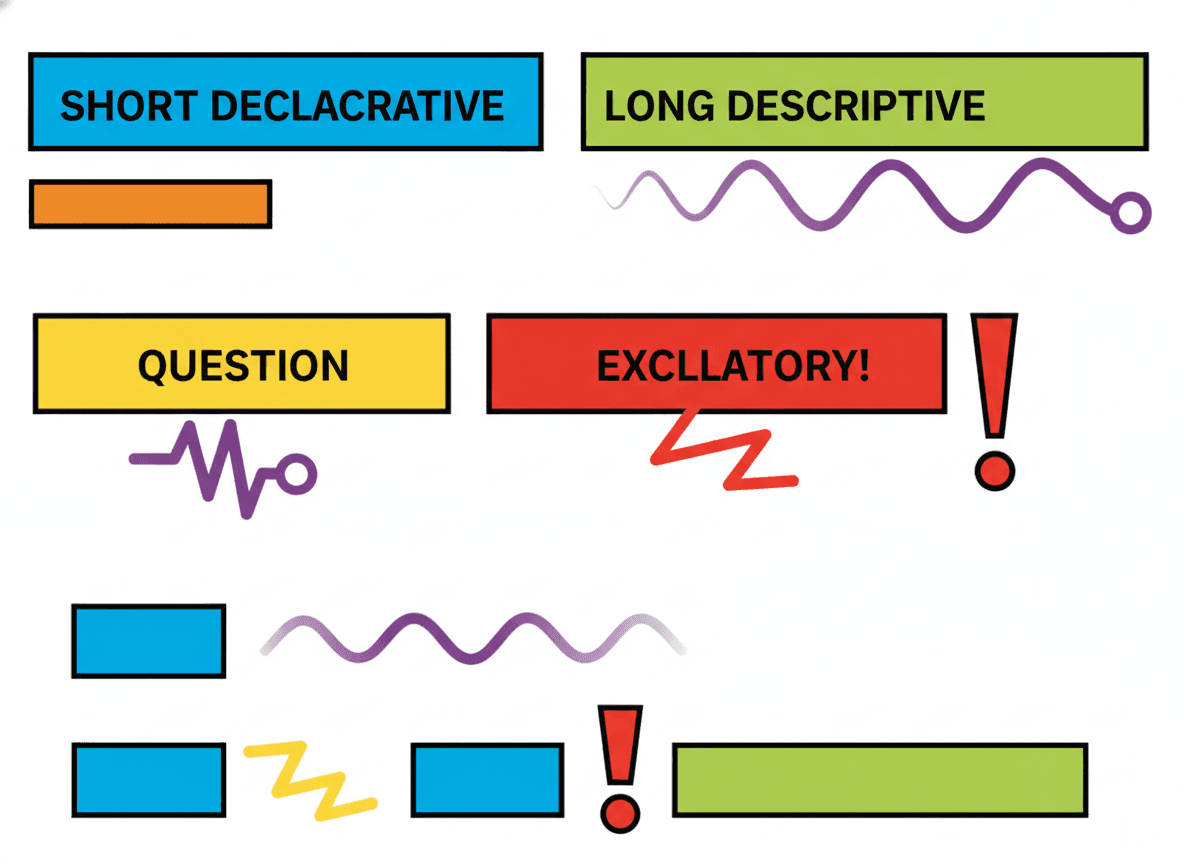
- Sentence variety uses different lengths and types of sentences to create rhythm and avoid monotony.
- A mix of simple, compound, and complex sentences creates writing that flows naturally.
- Short sentences create punch and emphasis; long sentences develop ideas and create flow.
- Sentence variety is a key marker of mature, fluent writing in upper elementary grades.
What Is Sentence Variety?
Sentence variety is the intentional use of different sentence lengths, structures, and beginnings to create writing that flows naturally and keeps readers engaged. Writing without variety sounds robotic - like a series of identical beats with no rhythm.
Compare: No variety: "The dog ran. The dog was fast. The dog jumped the fence. The dog disappeared."
With variety: "The dog ran. Fast and low to the ground, it cleared the fence in a single leap - and then it was gone."
The second version uses different sentence lengths and structures to create rhythm and momentum.
The Three Basic Sentence Structures
Simple sentence: One independent clause - one subject, one predicate. "The storm arrived."
Compound sentence: Two independent clauses joined by a coordinating conjunction (FANBOYS: for, and, nor, but, or, yet, so) or semicolon. "The storm arrived, but we were ready."
Complex sentence: One independent clause + one dependent clause. "When the storm arrived, we were already inside."
Compound-complex: Two independent clauses + at least one dependent clause. "When the storm arrived, we were ready, and we had planned for weeks."
Varying Sentence Beginnings
The most common sentence-variety problem: every sentence begins the same way. Alternatives to opening with a subject:
Adverb: "Suddenly, the lights failed."
Prepositional phrase: "In the corner of the room, the clock ticked."
Subordinating clause: "After the storm passed, we surveyed the damage."
Participial phrase: "Shivering in the cold, she knocked again."
Transition: "Meanwhile, the tide was rising."
Adjective/description: "Quiet and efficient, she completed the task."
What Grade Do Kids Learn Sentence Variety?
4th grade (L.4.3b): Students choose words and phrases to convey ideas precisely; vary sentence patterns for meaning, interest, and style.
5th grade (L.5.3a): Students expand, combine, and reduce sentences for meaning, reader interest, and style.
Common Misconceptions
Longer is always better: Long, complex sentences are not automatically more sophisticated. Short sentences, used strategically, carry enormous power. "She was gone." Three words. Maximum impact.
Compound sentences are always correct: Joining every pair of sentences with "and" creates run-on-feeling writing. "I went to the store and I bought milk and I came home and I put it away" needs to be broken up and restructured.
Sentence variety is only about length: Varying beginnings, structures, and lengths all contribute. Students who only vary length but start every sentence the same way still have limited variety.
Practice Activities
-
Read-aloud rhythm check: Students read their draft aloud and mark where they get bored or where it sounds flat.
-
Sentence combining: Take 5 short simple sentences and combine them into 2-3 varied sentences.
-
Sentence expansion: Take a simple sentence and expand it into a complex sentence by adding a dependent clause.
-
Beginning variety: Rewrite a paragraph so no two sentences begin the same way.
-
Long-short alternation: Deliberately write a paragraph alternating between a long sentence and a short one.
Frequently Asked Questions
What is sentence variety?
Sentence variety means intentionally using different sentence structures, lengths, and beginnings to create writing that reads smoothly and holds the reader's attention. Writing that uses the same sentence pattern repeatedly feels monotonous and robotic. Varying sentence structure creates a natural rhythm that keeps readers engaged.
What are the three basic sentence structures?
Simple sentences: One independent clause ('The dog ran.'). Compound sentences: Two or more independent clauses joined by a conjunction or semicolon ('The dog ran, and the cat watched.'). Complex sentences: One independent clause and one or more dependent clauses ('When the bell rang, the students rushed outside.'). Mixing all three creates natural, varied writing.
How does sentence length affect writing?
Short sentences create emphasis and impact. They stop the reader. They demand attention. Longer sentences flow more smoothly, allowing ideas to build upon each other and creating a sense of movement and momentum through the text. The most effective writing uses both: a series of longer sentences building tension, then a short one that lands with force.
What are some ways to vary sentence beginnings?
Students often begin every sentence with a noun subject ('The dog... The girl... The storm...'). Alternatives: Start with an adverb ('Suddenly, the lights went out.'), a prepositional phrase ('In the hallway, she waited.'), a participial phrase ('Running as fast as she could, she made it just in time.'), a transition word ('However, no one noticed.'), or a dependent clause ('When the storm hit, everything changed.').
How do you recognize a lack of sentence variety?
Signs of low variety: Every sentence starts with a noun subject, every sentence is about the same length, sentences all follow the same structure, the writing feels choppy (all short) or drone-like (all long). Reading aloud is the best diagnostic - monotonous writing will be noticeably flat, while varied writing creates a natural rise and fall of rhythm.
Free Sentence Variety Worksheets
Curriculum-aligned printable worksheets for 4th – 5th Grade. Download free.