What Are Transition Words?
Taught in US schools
Key Takeaways
- Transition words connect ideas within sentences and between paragraphs, guiding the reader through writing.
- Different transitions signal different relationships: sequence, contrast, cause-effect, addition, examples.
- Overusing 'first, then, next, finally' is a sign that students need exposure to richer transitional language.
- Strong use of transitions is a marker of developed, organized writing in upper elementary grades.
What Are Transition Words?
Transition words are words and phrases that connect ideas within sentences, between sentences, and between paragraphs. They act as signposts, guiding the reader through the writer's thinking by signaling the relationship between ideas.
Without transitions, writing can feel choppy and disconnected - like a list of unrelated facts. With transitions, ideas flow together into a coherent, readable whole.
Example without transitions: "I woke up late. My alarm didn't go off. I missed the bus. I had to walk to school. I was late for my first class."
Example with transitions: "I woke up late because my alarm didn't go off. As a result, I missed the bus and had to walk to school. Consequently, I arrived late to my first class."
Categories of Transition Words
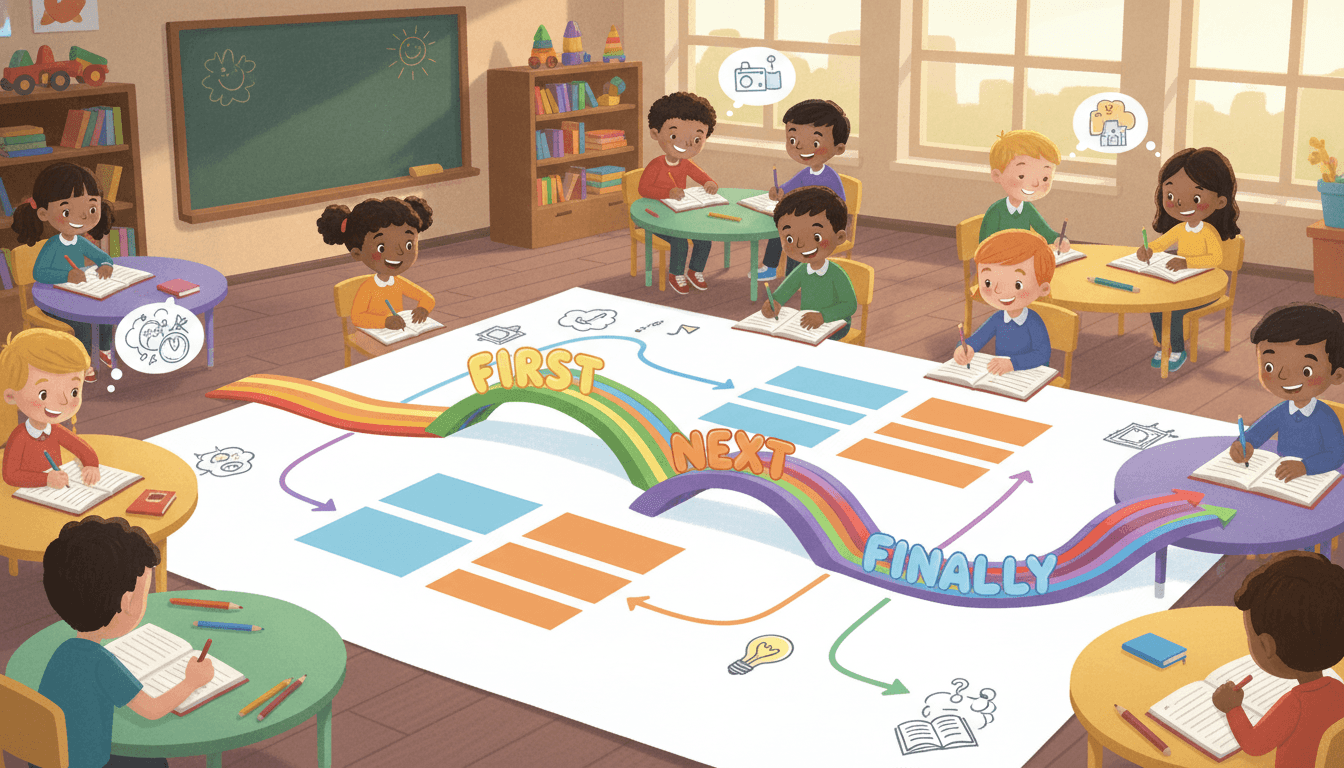
Sequence/Time (showing order): First, second, third, next, then, after that, meanwhile, soon, eventually, finally, later, before, during, when
Addition (adding more information): Also, in addition, furthermore, moreover, another, additionally, besides
Contrast (showing difference): However, but, on the other hand, although, yet, despite, even though, while, in contrast, unlike
Cause/Effect (showing consequence): Because, since, so, therefore, as a result, consequently, due to, for this reason
Example (illustrating a point): For example, for instance, such as, specifically, in particular, to illustrate
Summary/Conclusion: In conclusion, overall, in summary, to sum up, finally, in the end, therefore
Transitions in Different Types of Writing
Narrative: Sequence transitions (then, next, suddenly, the next day) carry the story forward.
Informational: Addition and example transitions (furthermore, for example, in addition) expand and support ideas.
Opinion/Persuasive: Addition, contrast, and conclusion transitions (most importantly, on the other hand, in conclusion) structure arguments.
What Grade Do Kids Learn Transition Words?
3rd grade (W.3.2c, L.3.6): Students use temporal words and phrases to signal event order and add variety in writing.
4th grade (W.4.2c): Students link ideas within categories of information using words and phrases.
5th grade (W.5.2c): Students use words, phrases, and clauses to link sections of informational writing; use increasingly varied transitional language.
Common Misconceptions
"First, then, next, finally" is enough: These are the most basic sequence transitions. Students who rely solely on these four are writing at a 2nd-grade level. Upper elementary students need contrast, cause-effect, addition, and example transitions.
Transitions always begin sentences: Transitions can appear at the beginning, middle, or end of sentences. "She worked hard. She succeeded, however" uses "however" in the middle.
More transitions = better writing: Over-use of transitions can feel mechanical and formulaic. Transitions should flow naturally and serve a purpose, not appear at the start of every sentence.
Practice Activities
-
Transition sorting: Sort transition word cards into categories (sequence, contrast, cause-effect, etc.).
-
Revision with transitions: Take a choppy paragraph and add 3–4 transitions to improve flow.
-
Transition treasure hunt: Highlight all transitions in a well-written informational passage.
-
Category writing: Write a paragraph using at least one transition from each of three categories.
-
Transition word wall: Class creates an anchor chart of transitions organized by category.
Frequently Asked Questions
What are transition words?
Transition words and phrases connect ideas within a sentence, between sentences, and between paragraphs. They signal to the reader how ideas relate to each other - whether one idea follows another in time, contrasts with another, gives an example, shows cause and effect, or summarizes. Without transitions, writing can feel choppy and disconnected.
What are the main types of transitional language?
Categories: (1) Sequence/Time: first, next, then, after, finally, meanwhile, soon, later. (2) Addition: also, furthermore, in addition, moreover, another. (3) Contrast: however, but, on the other hand, although, yet, despite. (4) Cause/Effect: because, therefore, as a result, so, consequently. (5) Examples: for example, for instance, such as. (6) Summary/Conclusion: in conclusion, overall, finally, to sum up.
How do transitions improve paragraph writing?
Transitions smooth the flow between ideas and signal the reader about how each new sentence or paragraph relates to what came before. A paragraph that begins with 'However' immediately signals a shift or contrast. One beginning with 'For example' signals an illustration coming. Without these signals, readers must figure out the relationship on their own - transitions do this work for them.
How are transition words different from conjunctions?
Conjunctions (and, but, because, although) join clauses within a sentence. Transition words often appear at the beginning of a new sentence or paragraph and link it to the previous one. Both connect ideas, but conjunctions work within sentences, while transitions work between sentences and paragraphs. Some transitions double as conjunctions (however, although, because).
What transition words are appropriate for different types of writing?
Opinion/persuasive writing: first, furthermore, in addition, most importantly, on the other hand, in conclusion. Narrative writing: first, then, next, meanwhile, suddenly, eventually, finally, the next day. Informational writing: for example, another reason, in contrast, as a result, in conclusion, similarly. Each writing type has transitions that match its structure and purpose.
Free Transition Words Worksheets
Curriculum-aligned printable worksheets for 3rd – 5th Grade. Download free.
Common Core Standards