
Nouns for Kindergarten: How to Teach Them (10 Activities)
Get 30 days of free worksheet downloads
Key Takeaways
- Nouns are the ideal first grammar concept for kindergartners because most are concrete objects children can point to and name.
- Start instruction with the people-places-things framework and anchor it in a familiar picture book before moving to worksheets.
- Proper nouns should be introduced gently in kindergarten, with the capital letter as the primary hook rather than deep categorical understanding.
- Plural nouns are highly accessible at this age; begin with the simple -s rule, then introduce -es endings, and save irregular plurals like feet and children for last.
- Noun hunts, sorting activities, and movement-based games are more effective than definitions alone for building lasting noun intuition.
A little one raises their hand during morning meeting and says, very seriously, "Teacher, 'happy' is a noun. It's a thing. I feel it."
You pause. You consider it. You say, "That's really interesting thinking. Let's talk about that."
That conversation, right there, is grammar instruction in kindergarten. It's messy, it's full of genuine questions, and it is absolutely the right kind of mess. Teaching nouns to five-year-olds isn't about memorizing definitions. It's about building an intuition for how language works, through games, movement, sorting, and lots of real examples.
Table of Contents
- Why Nouns Are the Perfect Grammar Starting Point
- Introducing the Concept: People, Places, and Things
- Teaching Common Nouns
- Concrete Nouns: What You Can Touch and See
- Introducing Proper Nouns (Gently)
- Plural Nouns: From One to Many
- Noun Sorts That Kids Love
- Noun Hunts Around the Classroom
- Reinforcing Nouns With Hands-On Practice
- What Comes After Nouns
Why Nouns Are the Perfect Grammar Starting Point
Nouns are everywhere.
Every sentence has at least one. Every story, every instruction, every question is built around them. And unlike some grammar concepts that feel abstract to young children, nouns have a wonderful concrete quality: most of them you can point to.
Honestly, there's no single right way to do this.
That's what makes nouns the ideal entry point for kindergarten grammar. You're not asking children to feel the difference between an adverb and an adjective. You're asking them to look around the room and name what they see. Dog. Chair. Teacher. Sun. They already know nouns. They've been using them since they were one year old. You're just giving the concept a name.
Free Nouns Worksheets for Kindergarten


Introducing the Concept: People, Places, and Things
The classic definition kids learn first: a noun is a person, place, or thing.
This is intentionally simplified, and that's fine. Kindergartners don't need to know about abstract nouns yet. The people-places-things framework gives them three clear categories they can apply immediately.
How to introduce it: Start with a book. Almost any picture book works, because picture books are full of nouns. Read a page or two aloud, then go back and start asking: "Is 'dog' a person, place, or thing?" "What about 'park'?" "What about 'Grandma'?"
Once they get the idea, make it physical.
Introduction activities:
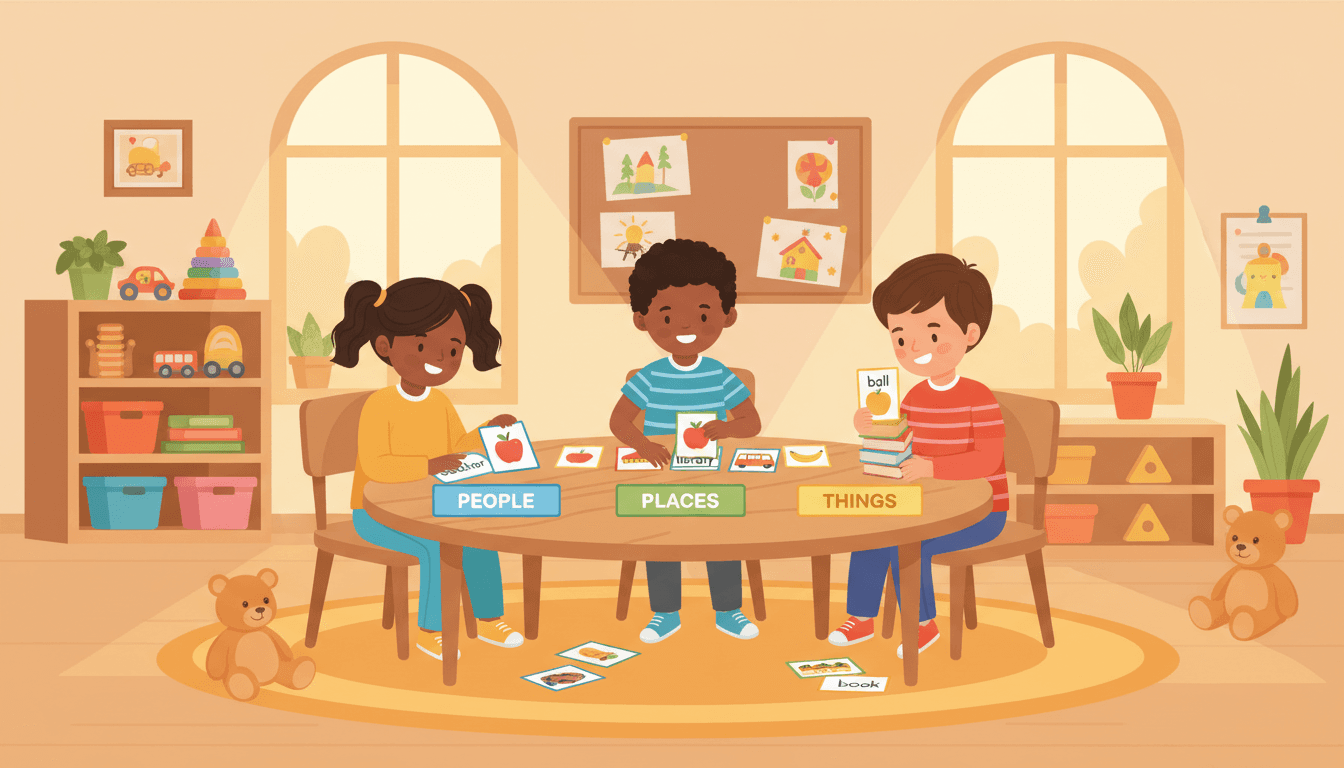
- Three-column anchor chart. Draw a person, a house, and a toy. Label each column: People, Places, Things. Add examples together as a class.
- Noun museum. Bring in (or ask kids to bring in) small objects from home. Place them on a table. Walk around the "museum" naming each object and identifying what kind of noun it is.
- Point and name. Walk around the classroom pointing at objects. Each child names one noun they see. Go around the circle until you've collected 20 nouns from the room alone.
- Book scavenger hunt. Choose a familiar picture book. Read it together. Then flip back through and mark the nouns with sticky notes.
- Noun collage. Cut pictures from magazines. Sort them onto a three-column page: people, places, things. Glue and label.
Teaching Common Nouns
Common nouns are general names for people, places, and things. "Teacher" is a common noun. "City" is a common noun. "Dog" is a common noun. They don't name a specific person or specific place, just the category.
This is the main focus of kindergarten noun instruction. Keep it concrete, keep it visual, and give children tons of examples before asking them to identify nouns on their own.
Common noun activities:
- Noun of the day. Introduce one noun each morning. Write it on the board, draw a picture, use it in a sentence. By end of week, you have five nouns to review.
- Classroom label hunt. Your classroom probably has labels on furniture and materials already. Read each label together and confirm: is it a noun?
- Category sort. Give children a pile of picture cards. Sort into people (firefighter, teacher, baby), places (school, park, library), and things (apple, book, car).
- "I see a noun" game. One child picks an object in the room without pointing to it and gives a clue: "I see a noun. It holds water." Class guesses.
- Noun sentence frames. "A _____ is a noun. It is a person/place/thing." Kids complete the frame with their own examples.
Concrete Nouns: What You Can Touch and See
At kindergarten level, virtually all the nouns you'll teach are concrete nouns: things that exist in the physical world and can be perceived by the senses.
This is a natural fit for five-year-olds, who are very much in the concrete operational stage of thinking. Abstract nouns like "love," "freedom," or "bravery" can come later. For now, if you can touch it, see it, smell it, hear it, or taste it, it can go in the noun category.
Concrete noun activities:
- Sensory noun bags. Put 3-4 small objects in a bag. Kids reach in, touch one without looking, name it, and confirm: "Yes, that's a noun. It's a thing."
- Draw your nouns. Ask children to draw five nouns from their morning walk to school or bus ride. Share and discuss.
- Noun nature walk. Go outside for 10 minutes. Collect or observe 10 nouns. Tree. Stick. Bird. Cloud. Rock. Fence. Gate. Bus. Flower. Sky.
- Noun photo wall. Kids bring in printed photos from home. Each photo is labeled with the nouns it contains.
Introducing Proper Nouns (Gently)
I'll be honest: proper nouns are a stretch for many kindergartners, and that's okay.
You don't need deep mastery here. What you do want is for children to notice that some nouns are specific names and those specific names start with capital letters.
"Dog" is a common noun. "Max" is a proper noun (the name of a specific dog). "City" is a common noun. "New York" is a proper noun. "Teacher" is a common noun. "Ms. Chen" is a proper noun.
The capital letter is the most memorable hook.
Proper noun activities:
- Our names are proper nouns. Write every child's name on the board. "These are all proper nouns. They are the specific names of specific people. Notice anything about how they start?" (Capital letters.)
- Common vs. proper match. Pairs of cards: "girl" and "Sofia," "dog" and "Buddy," "city" and "Chicago." Match the common noun to its proper noun partner.
- Class pet or classroom stuffed animal. Name them together. "His common noun name is 'bear.' His proper noun name is 'Mr. Buttons.' See how Mr. Buttons has capital letters?"
- Name that place. Show photos of landmarks. "This is a bridge. That's a common noun. This specific bridge is called the Golden Gate Bridge. That's a proper noun."
Plural Nouns: From One to Many
Plural nouns are one of the most accessible grammar concepts for kindergartners because children encounter them constantly and the basic rule is intuitive.
One cat, two cats. One box, two boxes. One child, two children.
Start with the easy rule: add -s to make most nouns plural. Then, once that's solid, introduce the -es rule (words ending in s, x, ch, sh get -es). Save irregular plurals (child/children, mouse/mice, foot/feet) for last. They're fascinating to kids, and they generate great conversations.
Plural noun activities:
- One and many. Draw a single object, then two or more. Write the noun in both forms. "One cup, two cups."
- Plural parade. Walk around the room. Every object you touch, say it in singular form, then plural. "Book, books. Chair, chairs. Window, windows."
- Silly sentences. Build sentences with obviously wrong plurals: "I see two mouses." Let kids catch the error and correct it.
- Sort by plural rule. Pile of word cards: some add -s, some add -es. Sort into two groups. (Keep it simple: only regular plurals at this stage.)
- Irregular plural spotlight. Choose one per week. "This week's special plural: one tooth, two teeth." Write it, illustrate it, repeat it all week.
Noun Sorts That Kids Love
Sorting is one of the best learning tools in kindergarten because it combines thinking, movement, and collaboration. Noun sorts let children apply what they've learned in a hands-on, low-stakes way.
Noun sort ideas:
- People, places, things sort. Classic. Can be done with picture cards, objects, or word cards (for kids who are reading).
- Noun or not a noun sort. Mix noun cards with verb and adjective cards. Kids sort them: noun or not a noun? This builds category awareness.
- Living vs. nonliving noun sort. Dog, tree, rock, car, bird, pencil. Which are living nouns? Which are things?
- Big vs. small noun sort. Elephant, ant, whale, mouse, mountain, pebble. Great for vocabulary building alongside grammar.
- My world nouns. Each child sorts nouns into "at school" and "at home." Personalization increases engagement every time.
Noun Hunts Around the Classroom
Noun hunts are simple, effective, and endlessly adaptable.
The basic version: give each child a clipboard and a recording sheet. Set a timer. They walk around the room, find nouns, and record them (drawing or writing, depending on skill level). Share at the end.
Variations:
- Category noun hunt. Find only "place" nouns. Or only "people" nouns.
- Color noun hunt. Find nouns that are blue. (They have to name the noun, not just the color.)
- Partner noun hunt. Two kids hunt together, take turns recording.
- Nature noun hunt. Take the hunt outside.
- Book noun hunt. Each child gets a book and hunts for nouns in the text.
The noun hunt works as a center activity, a transition filler, or a quick formative assessment. It's one of those activities that feels like a game while being genuinely instructional.
Reinforcing Nouns With Hands-On Practice
Once children have experienced nouns through sorting, hunting, singing, and discussion, worksheets become a useful consolidation tool.
Our kindergarten noun worksheets cover all the major kindergarten noun concepts: identifying nouns in sentences, sorting by category, matching singular and plural forms, and distinguishing common from proper nouns. They're designed to pair with instruction, not replace it.
How to use them well:
- Use as a center activity after whole-group instruction
- Pair with a verbal component: have children say each word before writing or circling
- Use the singular/plural sheets as a quick whole-class check: project on screen, answer together
What Comes After Nouns
Once children have a solid grasp of nouns, you've laid the foundation for all the grammar that follows.
Nouns connect naturally to verbs (what does the noun do?), to adjectives (what does the noun look like?), and to sentence building (a noun plus a verb makes a sentence). Every grammar concept you introduce from here builds on this one.
You've also done something more important than grammar instruction. You've taught children to pay attention to language. To notice words. To ask "what kind of word is that?" That habit of linguistic curiosity is the foundation of everything. ✨
Grab the full collection of kindergarten noun worksheets and keep the momentum going.
Keep Reading
- How to Teach Adjectives to Kindergartners: Activities, Tips, and What Actually Works
- How to Teach Grammar to Kindergartners: Skills, Activities, and What Actually Works
- How to Teach Prepositions to Kindergartners: Activities, Tips, and What Actually Works
Frequently Asked Questions
Should kindergartners learn the formal definition of a noun? A simplified definition works well: "a noun is a person, place, or thing." Formal definitions with abstract nouns and gerunds are appropriate for older grades. At this age, examples and sorting matter more than memorizing a definition.
When should I introduce proper nouns? Most kindergarten programs introduce proper nouns in the second half of the year, once children are comfortable with common nouns. The capital letter rule is the most accessible way in.
My student keeps calling adjectives nouns. What do I do? This is very common early on. Adjectives describe nouns, and kids often confuse the two. Return to the concrete: "Can you point to it? Can you touch it? Then it's a noun. Does it describe what something looks like or feels like? Then it's not a noun."
Are there picture books specifically good for teaching nouns? Yes. "A Mink, A Fink, A Skating Rink: What Is a Noun?" by Brian Cleary is a classic. "Many Luscious Lollipops" touches on adjectives but is good for comparison. Really, any picture book works: just read a page and ask "what nouns did we hear?"

Adi Ackerman
Head Teacher
Adi is the Head Teacher at ClassWeekly, with years of experience teaching elementary students. She designs our curriculum-aligned worksheets and writes practical guides for teachers and parents.
Keep Reading
Ready to download? Try ClassWeekly free for 30 days.
Unlimited worksheets for PreK through 5th grade. Cancel anytime.