
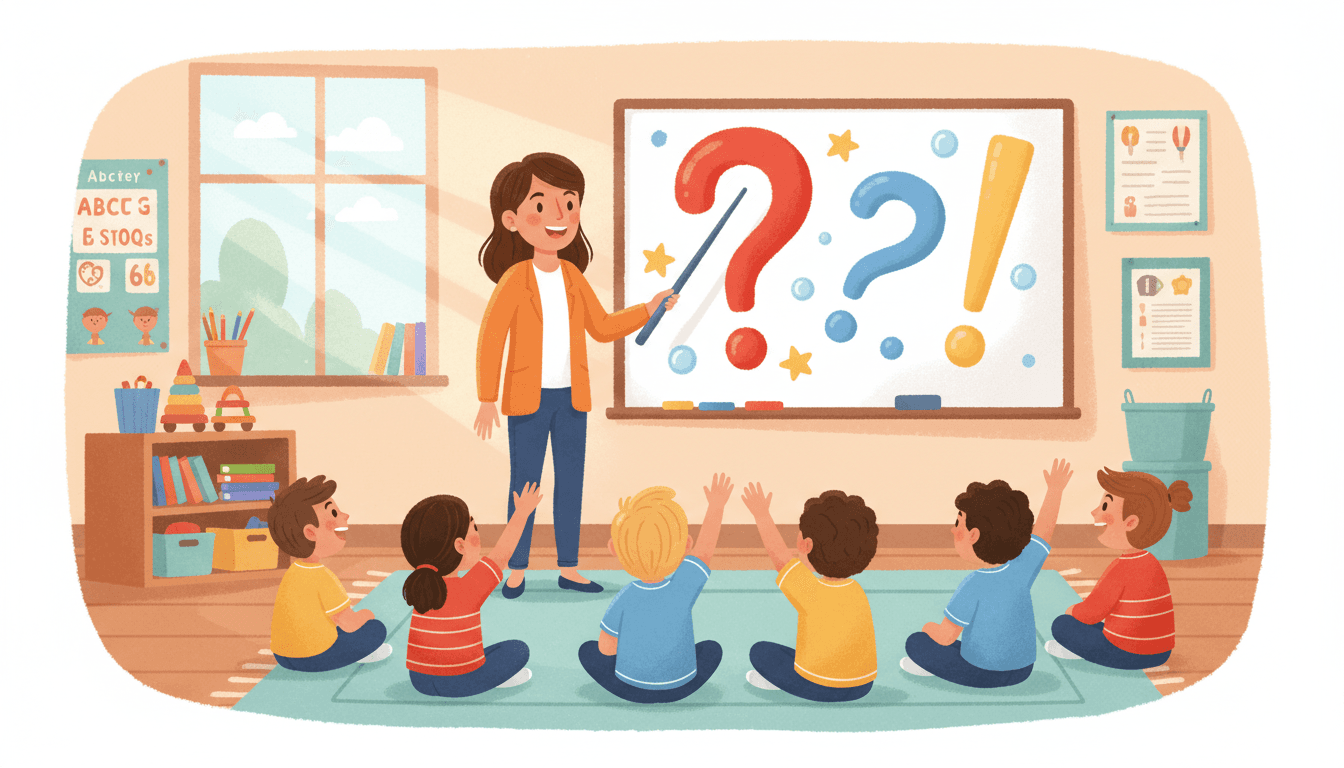
Punctuation for Kindergarten: How to Teach the Basics
Get 30 days of free worksheet downloads
Key Takeaways
- Kindergartners are more ready for punctuation than teachers assume because they already intuitively understand questions, statements, and excitement before any formal instruction.
- Teaching punctuation as a voice skill first - using physical gestures and vocal delivery - helps children internalize periods, question marks, and exclamation marks faster than drill-and-practice alone.
- Starting with capital letters before introducing end punctuation gives kindergartners an anchor concept they already know from their own names.
- Shared writing is the most effective daily context for punctuation instruction because children see the teacher make real-time punctuation decisions and can participate in them.
- Reading with expression and punctuation awareness is a comprehension skill, not just a mechanics skill - a child who voices a question mark correctly is demonstrating understanding of the text.

You're reading aloud and you reach a question mark at the end of a sentence. You read it flat, like a statement. Then you reread it with the voice going up at the end and say, "Did you hear the difference? That little squiggle changes everything."
Three children immediately want to know where the squiggle lives. One child says her name has a squiggle. Another announces that squiggles are his favorite shape.
And somehow, by the end of the lesson, most of the class knows what a question mark is.
That's punctuation in kindergarten. You work with the chaos. You follow the curiosity. And you teach these little marks on the page in a way that connects to the voice, the body, and the moment.
Table of Contents
- Why Punctuation in Kindergarten Matters More Than You Think
- Starting With Capital Letters
- Teaching the Period
- Teaching the Question Mark
- Teaching the Exclamation Mark
- Reading With Expression: The Voice-Punctuation Connection
- Punctuation in Shared Writing
- Games and Activities for Every Punctuation Mark
- Practice Pages That Build Punctuation Skills
- What Comes Next
Why Punctuation in Kindergarten Matters More Than You Think
Punctuation isn't just a writing skill. It's a reading skill.
When children learn to recognize a period, they learn to pause. When they learn a question mark, they learn to raise their voice. When they see an exclamation mark, they feel the energy. These marks are instructions for how language sounds, and teaching them early makes children better readers before they can even write fluently.
Here's what I find most true about teaching punctuation to kindergartners: they are much more ready for it than we sometimes assume. Five-year-olds already understand questions. They already feel the difference between a statement and an excited announcement. Punctuation just puts marks on the page for what they already feel in their voice.
Your job is to build the bridge between the feeling and the symbol.
Free Kindergarten Punctuation Worksheets


Starting With Capital Letters
Before periods, question marks, and exclamation marks, start with capital letters at the beginning of sentences.
This is the first punctuation concept most kindergarten programs introduce, and it connects naturally to something children already know: their own name starts with a capital letter.
The concept is simple: every sentence starts fresh, and fresh starts get a capital letter.
Capital letter activities:
- Name wall. Every child's name is on the wall. Point to the capital at the start. "Your name starts with a capital because names are important. Sentences start with a capital too, because every sentence is a new idea."
- Fix it sentences. Write sentences on chart paper with the first letter lowercase. Class identifies the mistake and corrects it.
- Capital letter hunt. Open a familiar big book. How many capital letters can we find? Which ones start sentences? Which ones are names?
- Morning message edit. Write the morning message with intentional capitalization errors. Children catch and correct them.
- My sentence starts with... Each child writes one sentence and must start with a capital. Illustrate and share.
Teaching the Period
The period is the most foundational punctuation mark, and the concept behind it is something children already intuitively understand: everything stops somewhere.
The teacher-friendly explanation: "A period is a stop sign for sentences. When you see a period, it means the idea is finished. Take a breath and get ready for the next one."
Connect it to their voice immediately. Say a sentence that trails off without ending. Then say it with a clear, definite stop. Kids can hear the difference.
Period activities:
- Stop sign game. Write a run-on sentence on the board. Walk along the words with your finger. When you get to where a period should go, a child holds up a mini stop sign. Discuss: why does the idea end here?
- Add the period. Write three sentences, each missing its period. Children take turns coming up and adding the period in red marker.
- Read and stop. Reading a text together, every time you reach a period, everyone stops and takes a breath. Dramatic, fun, and it builds the habit of attending to punctuation while reading.
- Sentence sorting. Is this a complete thought? "The cat ran." (Yes, add a period.) "The cat" (No, not a complete sentence yet.) This is harder and works better in spring.
- Period writing practice. In shared writing, pause before each period: "Is this idea finished? Thumbs up or down?" Add the period together.
Teaching the Question Mark
The question mark might be the easiest punctuation mark to teach because kids love asking questions.
In fact, they never stop asking questions. Use that.
"A question mark is the mark you put at the end when you're asking something. It means your voice goes up. You're waiting for an answer."
The best way to cement this concept: contrast. Say the same words as a statement and as a question. "You have a dog." vs. "You have a dog?" Kids hear the difference. Now they see the mark that tells them how to read it.
Question mark activities:
- Question or statement? Call out sentences. Kids hold thumbs up for a question, thumbs flat for a statement. Vary your vocal delivery deliberately.
- Question mark voice. Ask children to say a sentence with a "question voice" (voice rising at the end) and a "telling voice" (voice level). Practice until they can switch on command.
- Question of the day. Write the daily question with an exaggerated question mark. "What is your favorite color?" Read it together with questioning voice every morning.
- Ask the stuffed animal. Each child asks the class stuffed animal one question and must write it with the correct punctuation. (The stuffed animal answers if you're feeling theatrical.)
- Question mark hunt in books. Find every question mark in a familiar book. Read those sentences in a questioning voice.
Teaching the Exclamation Mark
Children are born knowing how to use exclamation marks. They just don't know the name yet.
"You did it!" "Watch out!" "That's so cool!" Their natural exuberance is the raw material for this lesson.
The concept: an exclamation mark means big feeling. Surprise, excitement, warning, joy. When you see one, your voice wakes up.
Exclamation mark activities:
- Feeling scale. Draw a face meter: calm face on one end, extremely excited face on the other. A period is calm. An exclamation mark is excited. Where would you put your voice?
- Boring vs. exciting read. Read the same sentence twice: once flat, once with a big exclamation mark delivery. "I found a frog." vs. "I found a frog!" Kids decide which one needed the exclamation mark.
- Exclamation moment writing. Ask: "What's something that would make you yell?" Kids dictate or write that sentence and add an exclamation mark. "My birthday is tomorrow! I love pizza! We got a puppy!"
- Punctuation performance. Three children each hold a card: period, question mark, exclamation mark. A fourth child reads a sentence. The correct card holder jumps up and the reader must deliver the sentence with that energy.
- Exclamation hunt. Find every exclamation mark in a Mo Willems book. (There are a lot. The Pigeon is practically made of them.)
Reading With Expression: The Voice-Punctuation Connection
The reason punctuation matters for kindergartners isn't just writing mechanics. It's that it makes reading come alive.
When a child reads a question mark with their voice going up, they are comprehending. They understand that the character is asking something. When they boom out an exclamation, they're inside the emotional moment of the text. That's not just punctuation. That's reading for meaning.
Expression-building activities:
- Echo reading. Read a sentence with full expression. Kids echo it back with the same expression and punctuation.
- Reader's theater. Short scripts (even 3-4 lines per character) let children practice reading with punctuation in context.
- Punctuation conductor. One child is the "conductor" of a group read-aloud. They hold up a symbol for period (flat hand), question mark (finger up), or exclamation (both hands up). Readers adjust their voice to the conductor's signal.
- Whisper, regular, loud. Assign voices to different punctuation: period is whisper voice, question mark is regular voice, exclamation mark is outdoor voice. Read the passage together.
- Dramatic rereading. Take a text the class has read before and reread it purely for expression. Pause before each punctuation mark and ask: "What does my voice do here?"
Punctuation in Shared Writing
The most natural place to teach punctuation is during shared writing, when you're composing a sentence together and children can see you making decisions about marks in real time.
Narrate your thinking: "We said everything we wanted to say about the field trip. The idea is finished. I need a..." Let children fill in the blank. "Period! Right."
Shared writing punctuation moves:
- Think-aloud. "Is this a question or a telling sentence? How do I know? What should I put at the end?"
- Turn and talk before punctuating. "I'm about to end this sentence. Turn to a partner: what punctuation comes next and why?"
- Deliberate errors. Put a question mark after a statement. Read it with questioning voice. "Does that sound right? What's wrong?"
- Daily morning message. Write one sentence per punctuation type over the course of a week. Monday is a statement (period). Wednesday is a question (question mark). Friday is an exciting announcement (exclamation mark).
- Student scribes. When the sentence is ready, invite a child to add the punctuation mark themselves. They own it.
Games and Activities for Every Punctuation Mark
The more variety you bring to punctuation practice, the more angles children have to internalize the concept.
Quick games that work:
- Punctuation bingo. Sentences read aloud, children mark whether it ends with a period, question mark, or exclamation mark.
- Punctuation relay. Three stations, each labeled with a punctuation mark. Teacher calls out a sentence. Children run to the correct station.
- Punctuation puppets. Each punctuation mark is a puppet character with a personality. Period Pam always stops and takes a breath. Question Quinn always wants to know more. Exclamation Eddie is VERY excited about everything.
- Sentence building with punctuation choice. Children write or dictate a sentence and choose the punctuation. "Why did you choose that mark?" is the most important question.
- Text message format. Write "text messages" between storybook characters. Each message needs correct punctuation. "Are you coming to the party?" "Yes! I will bring cake." "What kind?"
Practice Pages That Build Punctuation Skills
After children have experienced punctuation through games, shared writing, and voice work, worksheets give them structured practice with the mechanics.
Our kindergarten punctuation worksheets cover adding periods, question marks, and exclamation marks to sentences, capitalizing the first word, and reading sentences with correct expression cues. They pair well with the activities above as a center activity or a quick check.
Worksheet tips:
- Before students work independently, read each sentence aloud and ask: "What is the feeling? What is the punctuation?"
- Use the "add the punctuation" sheets after the class has practiced with group chart paper activities
- Celebrate accuracy: "You knew exactly when to use the exclamation mark there. How did you decide?"
What Comes Next
Punctuation in kindergarten is about planting seeds.
Your little ones don't need to produce perfectly punctuated writing by the end of the year. What they need is the awareness that marks matter, that they change how we read and how we understand. A child who reads a question mark with their voice going up, who pauses at a period, who feels the energy of an exclamation mark: that child is reading with comprehension. That child is a writer who knows their tools.
You built that. Through stop sign games and question voice practice and Pigeon books with too many exclamation marks. Through every morning message and every shared sentence and every time you narrated your own punctuation decisions out loud.
That's how the small marks become big understanding. 🌟
Grab the full collection of kindergarten punctuation worksheets and give your kiddos the practice that makes it permanent.
Keep Reading
- How to Teach Adjectives to Kindergartners: Activities, Tips, and What Actually Works
- How to Teach Grammar to Kindergartners: Skills, Activities, and What Actually Works
- How to Teach Nouns to Kindergartners
Frequently Asked Questions
Is kindergarten too early to teach punctuation? Not at all. Kindergartners encounter punctuation in every book they read, and they can understand the concept of stopping, asking, and expressing big feelings. Formal mastery isn't the goal; awareness and exposure are.
My students use exclamation marks on everything. How do I address that? This is very common and honestly shows they've understood that exclamation marks mean strong feeling. Help them develop discrimination by asking: "Is this an exciting moment or a calm moment? Does the character feel big feelings here, or are they just telling us a fact?" Compare examples side by side.
Should kindergartners be using quotation marks? Most kindergarten standards don't include quotation marks. They may encounter them in read-alouds and you can name them, but instruction in quotation marks is generally a first or second grade goal.
How do I handle the capital letter rule when students are writing names vs. starting sentences? Use the distinction intentionally. "We capitalize names because they're special. We capitalize the first word of a sentence because every new idea gets a fresh start." Both rules have reasons, and kids this age respond well to the "why." Once they understand that capitalization means "this matters," applying it in two contexts becomes more intuitive.

Adi Ackerman
Head Teacher
Adi is the Head Teacher at ClassWeekly, with years of experience teaching elementary students. She designs our curriculum-aligned worksheets and writes practical guides for teachers and parents.
Keep Reading
Ready to download? Try ClassWeekly free for 30 days.
Unlimited worksheets for PreK through 5th grade. Cancel anytime.