What Is a Collective Noun?
Taught in US schools

Key Takeaways
- A collective noun names a group of people, animals, or things as one unit: team, flock, herd, class.
- In American English, collective nouns are treated as singular: 'The team is ready.'
- Many animal groups have unique collective nouns that are fun and worth exploring: a pride of lions, a murder of crows.
- Collective nouns are grammatically singular but conceptually plural - this distinction matters for subject-verb agreement.
What Is a Collective Noun?
A collective noun is a noun that names a group of people, animals, or things as a single unit. Even though the group contains many members, the collective noun refers to it as one.
Examples:
- a team of players
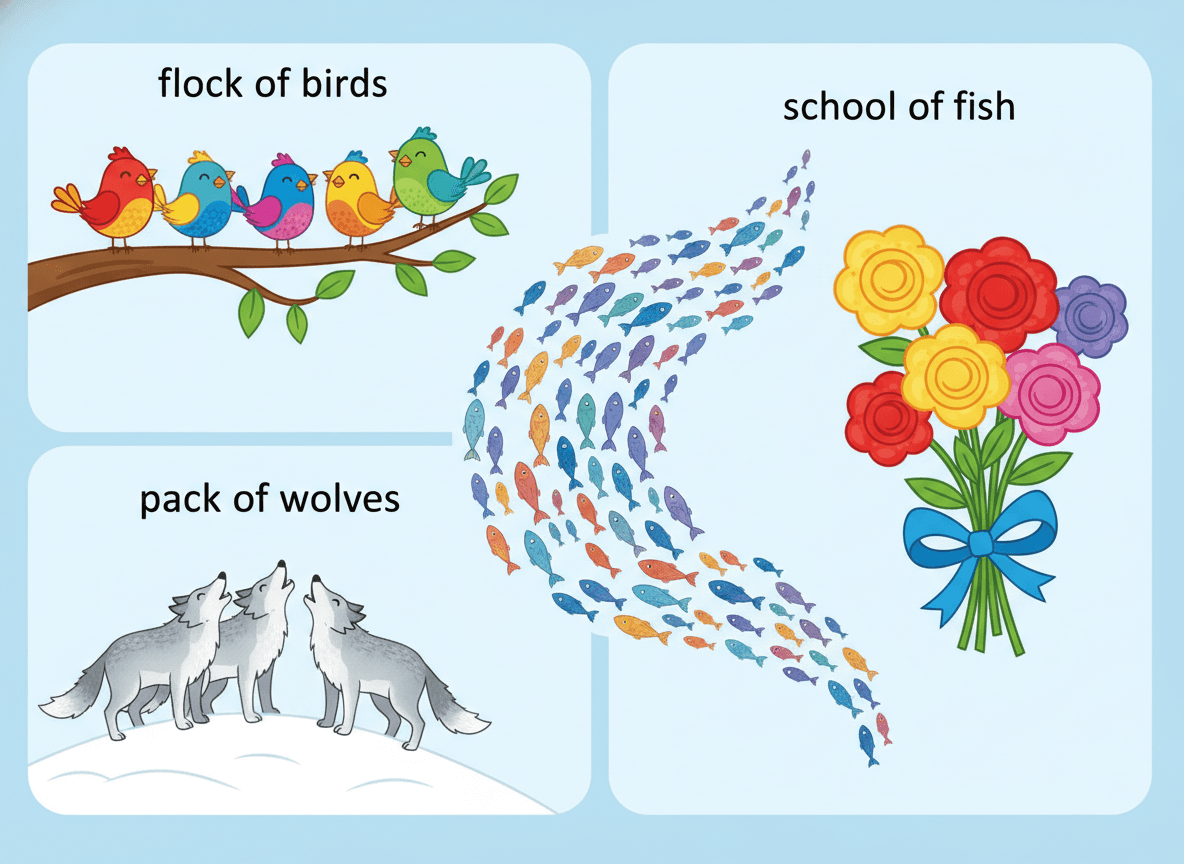
- a flock of birds
- a class of students
- a herd of cattle
- a pack of wolves
- a bouquet of flowers
Collective nouns allow speakers to discuss groups efficiently and often carry specific meaning about the type or nature of the group.
Common Collective Nouns
For people: team, class, crew, crowd, staff, committee, jury, audience, choir, band, troop, council, faculty
For animals: flock (birds), herd (cattle, elephants), pack (wolves, dogs), school (fish), pride (lions), pod (whales/dolphins), swarm (bees), colony (ants), gaggle (geese on the ground), murder (crows)
For things: bunch (grapes, bananas), fleet (ships, cars), pile (leaves), collection (stamps), cluster (stars), bouquet (flowers), library (books)
Collective Nouns and Subject-Verb Agreement
In American English, collective nouns are treated as singular:
- "The team is practicing." (not "are")
- "The class was quiet." (not "were")
- "The flock has migrated south." (not "have")
This can feel counterintuitive - "the team" involves many players, yet the verb is singular. The key: you're talking about the group as one unit, not individual members separately.
When to use plural: If you're emphasizing individual members rather than the group as a unit, American English sometimes allows plural: "The jury are divided in their opinions" (each member has a separate opinion). This usage is more common in British English and in careful formal writing.
What Grade Do Kids Learn Collective Nouns?
2nd grade: Students encounter collective nouns in reading and informally learn common examples.
3rd grade (L.3.1): Students identify and form collective nouns as part of noun instruction.
4th grade (L.4.1): Students apply collective noun knowledge in subject-verb agreement; use collective nouns in writing.
Common Misconceptions
Collective nouns are plural: A collective noun is grammatically singular. "The team is" not "the team are" (in American English).
All group words are collective nouns: "They" is a plural pronoun, not a collective noun. "People" is a plural noun, not collective. A collective noun specifically names the group as one unit.
The unusual animal group names are required vocabulary: Fun collective nouns (a murder of crows, a parliament of owls) are wonderful to know but are not required for everyday communication. They're tools for enriching vocabulary and building enthusiasm for language.
Practice Activities
-
Match the group: Match collective nouns to the animals or people they describe (flock → birds).
-
Fill in the blank: "A ___ of lions is called a pride."
-
Agreement sentences: Write sentences using collective nouns with the correct singular verb.
-
Create a collective noun: Invent collective nouns for groups of things in the classroom ("a pile of pencils," "a stack of books").
-
Animal collective noun research: Research unusual collective nouns for 5 animals and share with the class.
Frequently Asked Questions
What is a collective noun?
A collective noun names a group of people, animals, or things as a single unit. Instead of saying 'a group of wolves,' we say 'a pack of wolves.' Instead of 'a group of students,' we say 'a class of students.' Collective nouns package many individual members into one grammatical unit, treated in American English as a singular noun.
How do collective nouns work with verbs in American English?
In American English, collective nouns are treated as singular and take singular verbs. 'The team is practicing' (not 'are practicing'). 'The class was quiet' (not 'were quiet'). This differs from British English, where collective nouns often take plural verbs ('The team are playing well'). US students should use singular verbs with collective nouns.
What are some unusual collective nouns for animals?
English has many unusual collective nouns for animal groups: a pride of lions, a murder of crows, a school of fish, a gaggle of geese, a pod of whales, a colony of ants, a parliament of owls, a crash of rhinos, an army of ants, a bloat of hippos, a flamboyance of flamingos, a prickle of porcupines. These specific terms are mostly used in biology and literature.
What are some collective nouns for people?
Common collective nouns for people: a class of students, a team of players, a crew of workers, a crowd of people, a committee of members, a staff of teachers, a board of directors, a troupe of actors, a choir of singers, a jury of jurors, a band of musicians, a faculty of professors, an audience of viewers.
Can collective nouns be pluralized?
Yes - the plural refers to multiple groups. 'One team is ready' (one group). 'Both teams are ready' (two groups, plural). The plural of team = teams; flock = flocks; class = classes. Pluralizing a collective noun creates a plural noun - which then takes a plural verb. 'The teams are competing this week.'
Free Collective Noun Worksheets
Curriculum-aligned printable worksheets for 2nd – 4th Grade. Download free.