What Is Subject-Verb Agreement?
Taught in US schools

Key Takeaways
- The verb in a sentence must match its subject in number: singular subject → singular verb; plural subject → plural verb.
- The key to agreement is correctly identifying the subject - especially when phrases come between subject and verb.
- Collective nouns, indefinite pronouns, and compound subjects have special agreement rules.
- Subject-verb agreement errors are among the most noticeable grammar mistakes in student writing.
What Is Subject-Verb Agreement?
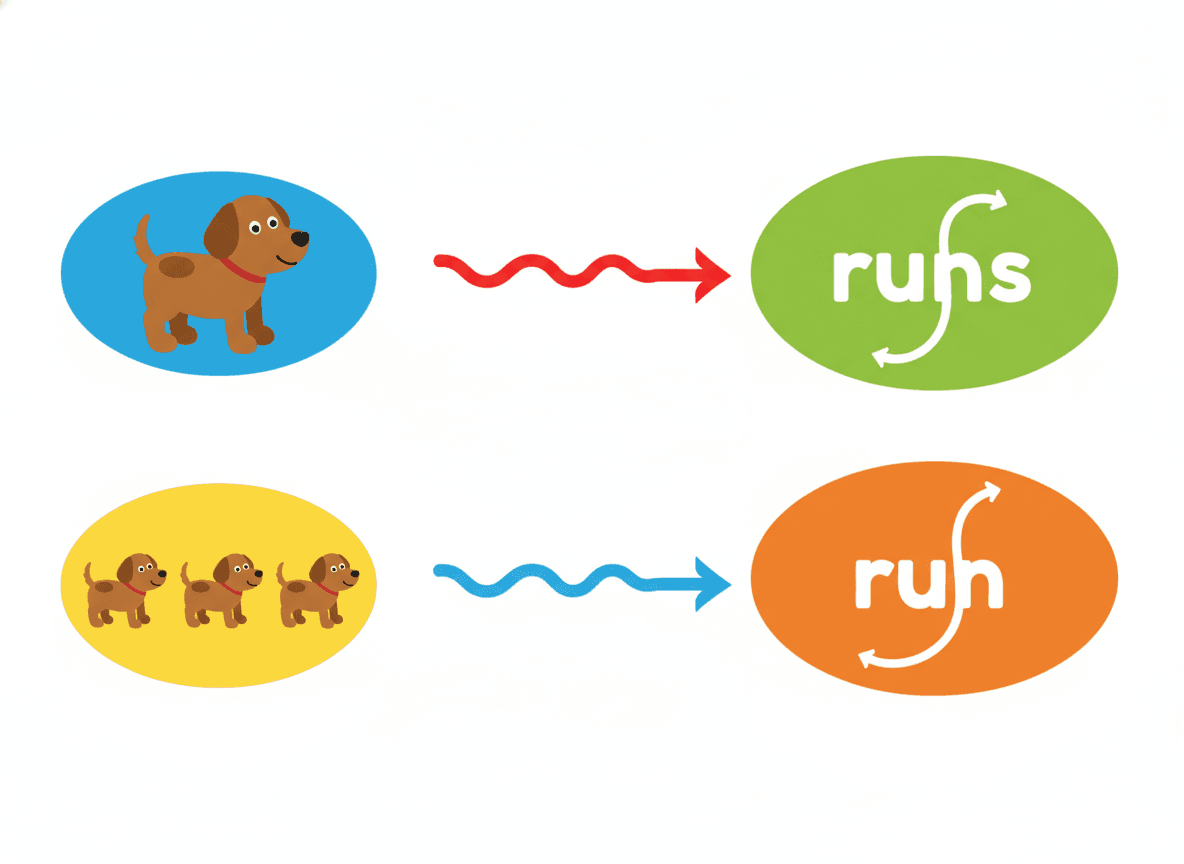
Subject-verb agreement is the grammar rule requiring the subject and verb of a sentence to match in number. Singular subjects take singular verbs; plural subjects take plural verbs.
Examples:
- Singular: "The cat sleeps on the mat." (cat = singular; sleeps = singular verb form)
- Plural: "The cats sleep on the mat." (cats = plural; sleep = plural verb form)
In English, verbs in present tense add -s for singular subjects (he/she/it), while plural subjects use the base form.
The Basic Pattern
Singular noun: Add -s to verb - "The bird sings."
Plural noun: Base form - "The birds sing."
I: Base form (special) - "I sing."
You: Base form - "You sing."
He/She/It: Add -s - "She sings."
We/They: Base form - "They sing."
Common Agreement Traps
Prepositional phrase interruption: "The stack of books [is/are] on the table." → Subject is "stack" (singular) → is (not "books")
Collective nouns: "The class [is/are] ready." → In American English: is
Indefinite pronoun subjects: "Everyone [is/are] invited." → Everyone is always singular: is
Compound subjects: "Tom and Maya [is/are] here." → Joined by "and" = plural → are "Neither Tom nor Maya [is/are] here." → Verb agrees with closer subject → is
What Grade Do Kids Learn Subject-Verb Agreement?
3rd grade (L.3.1f): Students ensure subject-verb agreement in simple sentences.
4th grade (L.4.1c): Students use modal auxiliaries (can, may, must, should, will) correctly.
5th grade (L.5.1a): Students explain the function of conjunctions, prepositions, and interjections; apply agreement in more complex sentence structures.
Common Misconceptions
The word closest to the verb is always the subject: Prepositional phrases between subject and verb fool many students. "The bowl of strawberries is ready" - "strawberries" is part of a prepositional phrase, not the subject.
Collective nouns are plural: In American English, collective nouns are singular. "The team is practicing" (not "are practicing").
Compound subjects joined by 'and' are always plural: True - unless the two parts refer to the same thing: "Peanut butter and jelly is my favorite sandwich." (Treated as one thing = singular.)
Practice Activities
-
Subject-verb sort: Cards with subjects and verbs; students pair correctly.
-
Error identification: Give sentences with agreement errors; students underline and correct.
-
Agreement sentences: For each subject given, students write a sentence with the correct verb form.
-
Find the real subject: Sentences with prepositional phrases; students identify the real subject before choosing the verb.
-
Quiz show: Rapid-fire practice - teacher reads a sentence frame, students call out the correct verb form.
Frequently Asked Questions
What is subject-verb agreement?
Subject-verb agreement means the verb must match its subject in number. If the subject is singular (one thing), the verb must be in its singular form. If the subject is plural (more than one), the verb must be in its plural form. For example: 'The dog barks' (singular) vs. 'The dogs bark' (plural). In English, the difference is usually just one letter: barks vs. bark.
How do you identify the subject of a sentence?
The subject is who or what the sentence is about - usually the noun or pronoun that performs the action. To find it: (1) Find the verb. (2) Ask 'who or what [verb]?' The answer is the subject. Common traps: prepositional phrases between subject and verb can confuse students ('The bag of apples is heavy' - subject is 'bag,' not 'apples').
How does agreement work with collective nouns?
Collective nouns (team, class, family, crowd, crew) name groups as single units. In American English, collective nouns are treated as singular: 'The team is ready' (not 'are ready'). The plural form (teams, classes) is used when there are multiple groups: 'The teams are practicing.'
What are indefinite pronouns and how do they affect agreement?
Indefinite pronouns refer to unspecified people or things. Some are always singular: everyone, someone, anyone, nobody, each, either, neither, everything. Always use a singular verb: 'Everyone is excited.' Some are always plural: both, few, many, several. Some depend on context: some, all, most, none.
What are compound subjects and how do they affect agreement?
Compound subjects joined by 'and' are usually plural: 'Jack and Jill are coming.' Compound subjects joined by 'or' or 'nor': the verb agrees with the subject closest to it. 'Neither the students nor the teacher is ready.' 'Either the teacher or the students are responsible.' This 'closest subject' rule (proximity rule) is taught in upper elementary.
Free Subject-Verb Agreement Worksheets
Curriculum-aligned printable worksheets for 3rd – 5th Grade. Download free.