What Is an Abstract Noun?
Taught in US schools

Key Takeaways
- Abstract nouns name ideas, emotions, qualities, or states that cannot be seen, touched, smelled, heard, or tasted.
- Examples: love, courage, freedom, justice, happiness, wisdom, friendship, democracy, childhood.
- Contrast with concrete nouns: a table (concrete) vs. justice (abstract).
- Abstract nouns often appear in themes, discussions of values, and academic writing.
What Is an Abstract Noun?
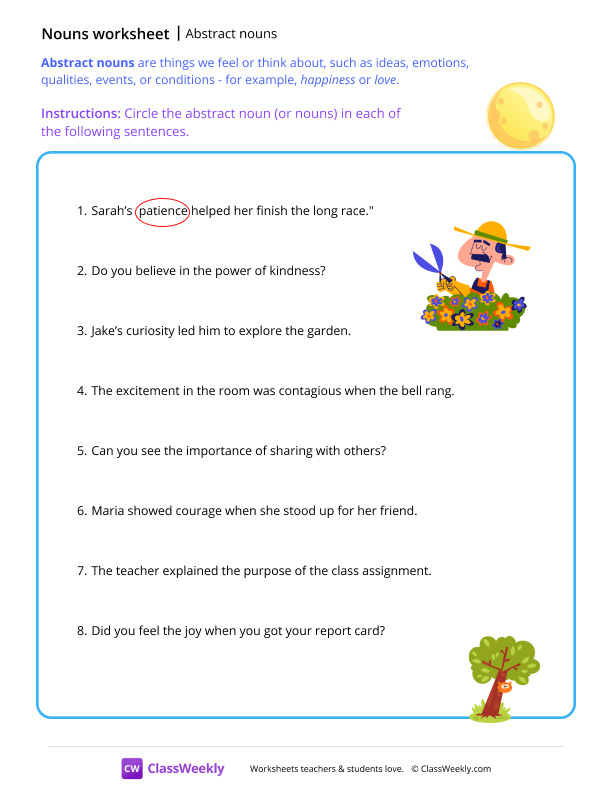
An abstract noun is a noun that names an idea, quality, emotion, concept, or state - something that exists in the world of thoughts and feelings rather than the physical world. You cannot see, touch, hear, smell, or taste an abstract noun.
Abstract nouns: love, courage, freedom, happiness, justice, friendship, wisdom, beauty, fear, democracy, childhood, loyalty, honesty, pride, peace
Contrast with concrete nouns (you can perceive with the senses): dog, rain, music, pizza, tree
The Concrete vs. Abstract Test
Ask: Can I perceive this with my five senses?
table (can touch): freedom (cannot touch)
thunder (can hear): fear (cannot hear)
flower (can smell): beauty (cannot smell)
ice cream (can taste): happiness (cannot taste)
sunset (can see): hope (cannot see)
How Abstract Nouns Are Formed
Many abstract nouns are created from adjectives and verbs using suffixes:
happy: -ness - happiness
brave: -ry - bravery
kind: -ness - kindness
free: -dom - freedom
just: -ice - justice
friend: -ship - friendship
child: -hood - childhood
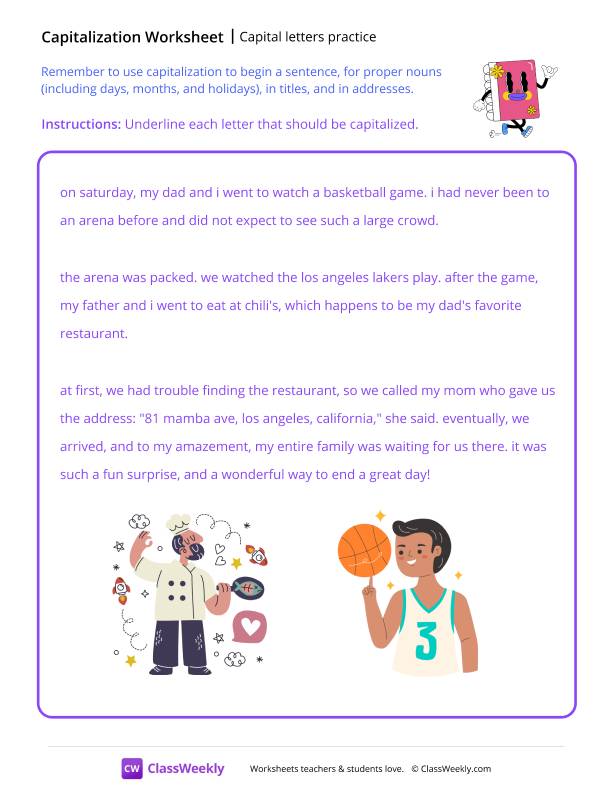
inform: -ation - information Recognizing these suffixes helps students decode and generate abstract nouns.
Abstract Nouns in Writing and Discussion
Abstract nouns are the language of themes, values, and ideas:
- Literary analysis: "The theme of courage runs through the entire novel."
- Persuasive writing: "Every student deserves fairness and equality."
- Discussion of history: "The colonists fought for freedom and self-determination."
Without abstract nouns, students are limited to describing only what can be seen - they can't discuss meaning, values, or ideas.
What Grade Do Kids Learn Abstract Nouns?
3rd grade (L.3.1): Students identify and use abstract nouns in the context of broader noun instruction.
4th–5th grade: Students use abstract nouns in persuasive and literary writing; analyze how authors use concrete details to illustrate abstract concepts.
Common Misconceptions
All nouns are things you can see: Abstract nouns challenge this intuition. Expanding students' definition of "noun" from "a person, place, or thing" to "a person, place, thing, OR idea" is the key conceptual shift.
Feelings are not nouns: Emotions like happiness, fear, and grief are abstract nouns. Students sometimes think feelings are only expressed through adjectives (sad, happy) - but the noun forms (sadness, happiness, grief) are equally valid and often more precise in writing.
Abstract nouns can't be specific: Abstract nouns can be made specific through concrete details. "Her courage was like a small, stubborn flame that wouldn't go out" illustrates the abstract noun "courage" with a concrete image.
Practice Activities
-
Abstract or concrete sort: Sort noun cards into two categories; justify each choice.
-
Suffix creation: Take 10 adjectives or verbs and form abstract nouns by adding suffixes.
-
Illustration of the abstract: Draw a concrete image that represents an abstract noun (e.g., two hands clasped = friendship).
-
Theme identification: Identify the abstract nouns that name the themes of a class novel.
-
Definition sentences: Write a sentence for each of 5 abstract nouns, explaining what it means to you.

Frequently Asked Questions
What is an abstract noun?
An abstract noun is a noun that names something that cannot be experienced through the five senses - it cannot be seen, heard, touched, tasted, or smelled. Abstract nouns name ideas, concepts, emotions, qualities, and states: love, courage, freedom, knowledge, beauty, fear, democracy, childhood, success. They represent things that exist in the mind and the world of ideas rather than the physical world.
What is the difference between concrete and abstract nouns?
Concrete nouns name things you can perceive with your senses: dog, pizza, music, storm, flower. Abstract nouns name things you cannot directly perceive: justice, hope, anger, loyalty, peace. A dog you can see and touch; justice is an idea. Music you can hear; freedom is a concept. The test: 'Can I touch/see/hear/taste/smell this?' If yes: concrete. If no: abstract.
How are abstract nouns formed?
Many abstract nouns are formed by adding suffixes to other words: happy (adjective) → happiness (abstract noun); kind → kindness; free → freedom; brave → bravery; just → justice; friend → friendship; child → childhood. Recognizing these suffixes helps students identify and form abstract nouns in their own writing.
Can abstract nouns be made plural?
Some can: freedoms, joys, fears, hopes. Others are typically uncountable and don't take a plural: honesty, courage, knowledge, beauty. Whether an abstract noun can be pluralized often depends on whether it refers to specific instances: 'the joys of childhood' (specific experiences, plural) vs. 'joy' (general concept, typically singular).
Why do students need to understand abstract nouns?
Abstract nouns are the language of ideas, values, and discussion - essential for literary analysis ('the theme of justice'), persuasive writing ('the importance of fairness'), and academic discourse. Without abstract nouns, students can only write about what they can see and touch. The ability to discuss ideas requires abstract noun vocabulary.
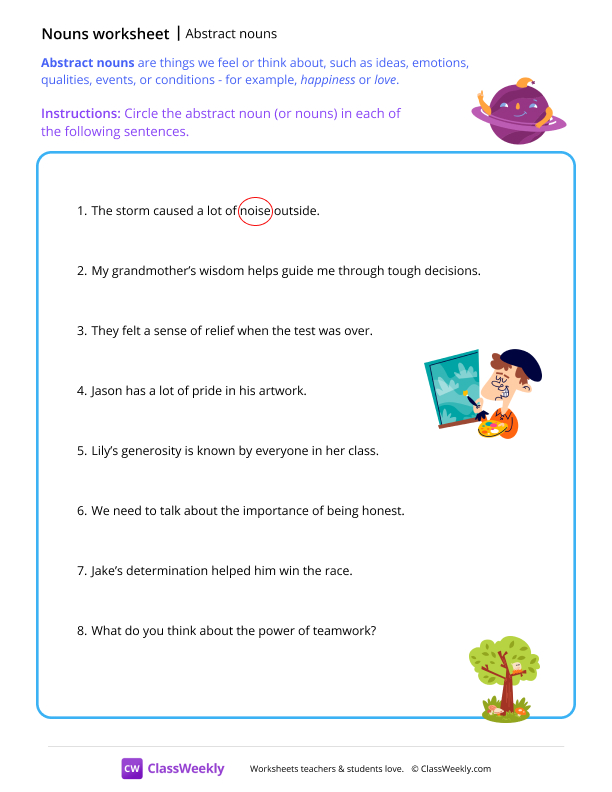
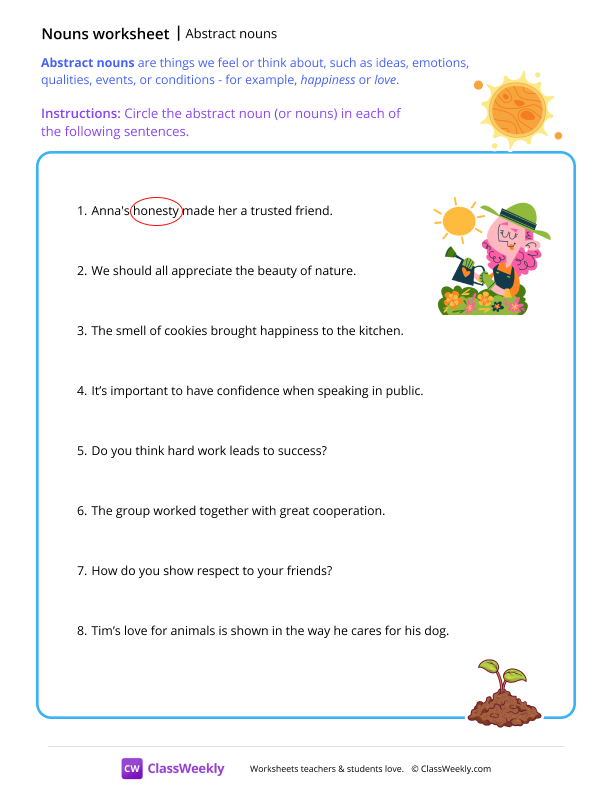
Free Abstract Noun Worksheets
Curriculum-aligned printable worksheets for 3rd – 5th Grade. Download free.