What Is Critical Thinking?
Taught in US schools
Key Takeaways
- Critical thinking means analyzing, evaluating, and reasoning - not just remembering.
- It can be taught and practiced from kindergarten through explicit questioning and discussion.
- Bloom's Taxonomy levels 4-6 (analysis, evaluation, creation) describe higher-order critical thinking.
- The best critical thinking tasks involve real decisions, ambiguous problems, or evaluating conflicting sources.
What Is Critical Thinking?
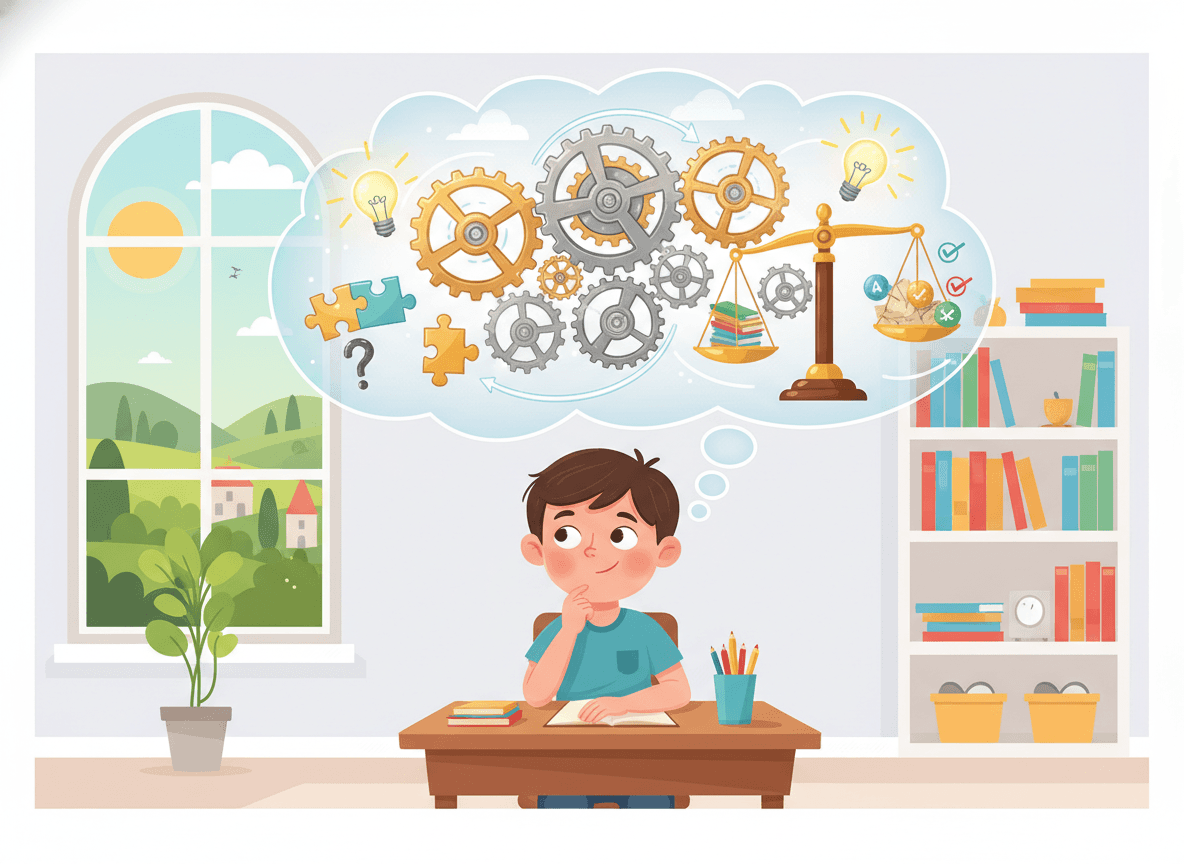
Critical thinking is the ability to analyze information carefully, question assumptions, evaluate evidence, and draw reasoned conclusions. It is the opposite of accepting information at face value - critical thinkers ask why, how do we know, and what else could this mean.
Critical thinking is not a single skill but a set of habits and abilities that develop over time with practice. Even kindergartners can practice early forms of critical thinking when asked to explain their reasoning or compare two options.
What Critical Thinking Looks Like in the Classroom
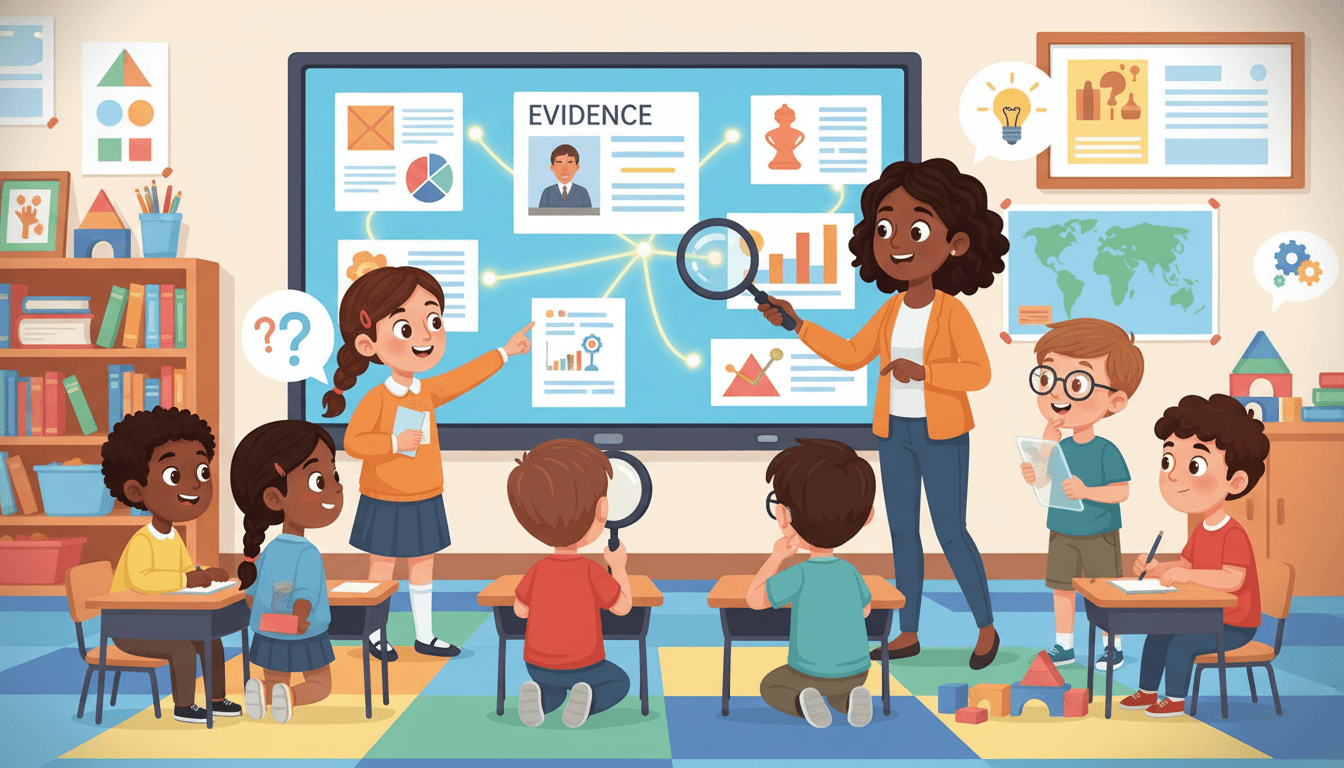
Critical thinking shows up in many forms across subjects:
In reading: "The author says the colonists were brave. Is that the only way to see it? What might British citizens think?"
In math: "Is there another way to solve this problem? How do you know your answer makes sense?"
In science: "What evidence do we have for this conclusion? Could there be another explanation?"
In social studies: "Who wrote this source? Why might they have described events this way?"
In any subject: "What assumptions are we making? What would change our mind?"
Connection to Bloom's Taxonomy
Benjamin Bloom's taxonomy of learning describes six levels of thinking, from simple to complex. Critical thinking primarily lives at the upper three levels:
-
Level 4 - Analysis: Breaking information into parts and examining relationships
-
Level 5 - Evaluation: Making judgments about the quality, validity, or usefulness of information
-
Level 6 - Creation: Combining information in new ways to generate original ideas or products
Questions that push students to these levels include: Compare... / Evaluate... / What would happen if... / Design a... / Judge whether... / Argue for or against...
Strategies for Developing Critical Thinking
-
Wait time - After asking a question, wait 5-10 seconds before accepting an answer. Longer wait time produces more thoughtful responses.
-
Socratic questioning - Follow every answer with a follow-up: "Why do you think that?" "What's your evidence?" "Does anyone see it differently?"
-
Two-sided tasks - Give students problems with multiple valid solutions and ask them to defend their choice.
-
Compare and evaluate - Place two sources, solutions, or examples side by side and ask students to evaluate which is better and why.
-
"Devil's advocate" discussions - Ask students to argue for the position they personally disagree with.
Practice Activities
- Give students two conflicting sources on the same event and ask: "Which do you trust more? Why?"
- Present a math word problem with an error in the "solution" - can students find and explain the mistake?
- After a read-aloud, ask: "Was the main character's decision the right one? What would you have done differently?"
- Use "Philosophical Chairs" - students physically move to opposing sides of the room based on their position on a debatable question, then discuss.
Frequently Asked Questions
What is critical thinking in education?
Critical thinking is the disciplined process of actively analyzing, evaluating, and forming judgments about information. In school, it means going beyond memorizing facts to asking: Is this true? How do we know? What evidence supports this? What are other explanations? What assumptions are being made? Critical thinking is not a subject - it is a way of engaging with any subject.
How do you teach critical thinking to elementary students?
Critical thinking develops through practice with good questions. Use open-ended questions with no single right answer. Ask students to compare, evaluate, and justify. Use Socratic discussion. Present conflicting sources and ask students to decide what to believe. Give problems with multiple valid solutions. Regularly ask 'How do you know?' and 'What evidence supports that?'
What is the difference between critical thinking and higher-order thinking?
Higher-order thinking (from Bloom's Taxonomy) refers to the upper levels of the taxonomy: analysis, evaluation, and creation. Critical thinking overlaps with these levels but is slightly broader - it also includes dispositions like intellectual humility, curiosity, and the habit of questioning assumptions. In practice, the terms are often used interchangeably in K-5 settings.
Free Critical Thinking Worksheets
Curriculum-aligned printable worksheets for Kindergarten – 5th Grade. Download free.