What Is Inquiry-Based Learning?
Taught in US schools

Key Takeaways
- In inquiry-based learning, student questions drive the investigation - not teacher content delivery.
- It develops curiosity, research skills, persistence, and deeper conceptual understanding.
- There are different levels: structured (teacher-guided), guided, and open inquiry.
- Inquiry is central to the Next Generation Science Standards (NGSS) and good history teaching.
What Is Inquiry-Based Learning?
Inquiry-based learning is an instructional approach in which student questions drive the learning process. Rather than receiving information through direct instruction, students investigate, discover, and construct understanding through exploration and questioning.
The name comes from "inquiry" - the act of asking and investigating. In inquiry-based classrooms, curiosity is the engine. Students don't just learn answers; they learn how to find answers.
The Inquiry Process
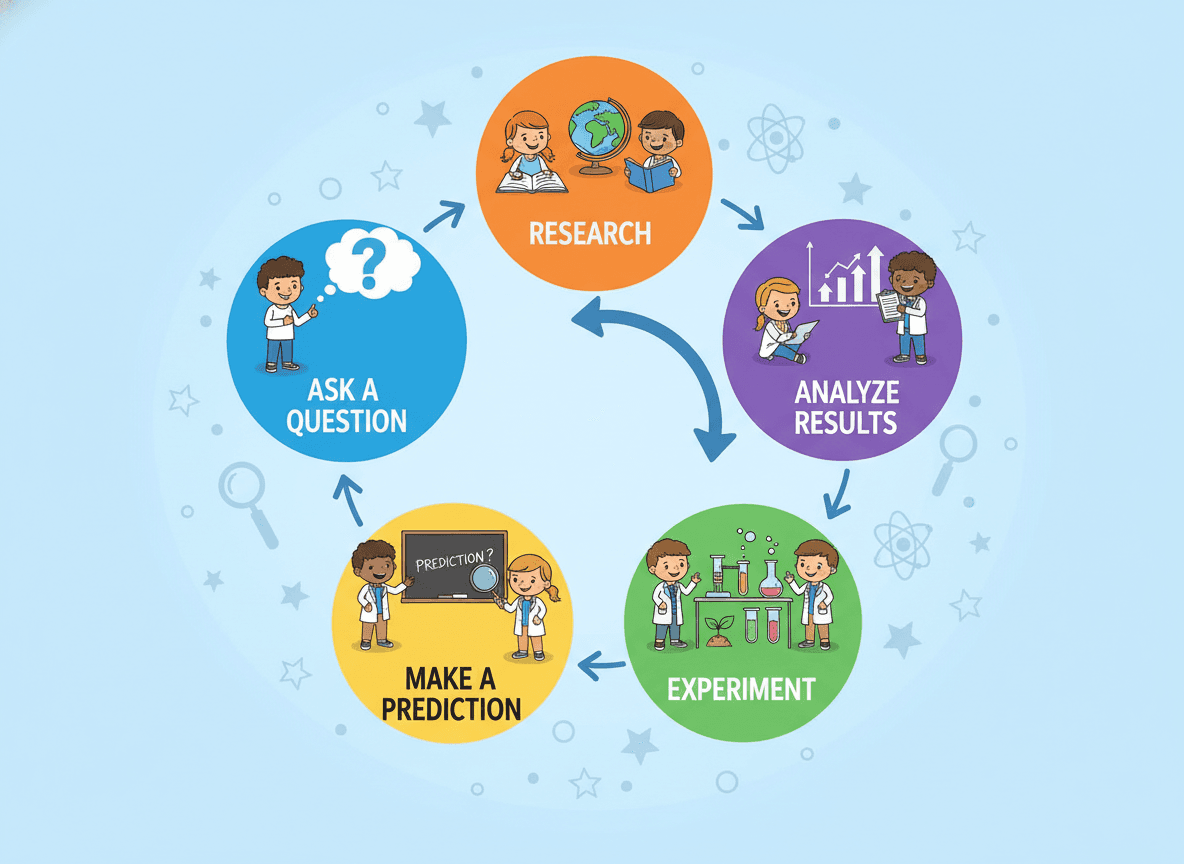
Whether in science, social studies, or any subject, inquiry typically follows a cycle:
- Question - Students observe something and generate a question worth investigating
- Research / Plan - Gather background information, design an investigation
- Investigate - Conduct experiments, research, or observations
- Analyze - Look at the data or evidence; identify patterns
- Conclude - Draw conclusions; connect findings to the original question
- Communicate - Share findings with others
This process mirrors how scientists, historians, and researchers actually work - which is why inquiry-based learning is considered authentic, meaningful work.
Levels of Inquiry
Not all inquiry looks the same. Teachers can adjust the level of student independence:
Structured Inquiry: Teacher provides the question and the procedure. Students collect and analyze data.
"Follow these steps to investigate how ramp height affects speed. Record your data and tell me what you found."
Guided Inquiry: Teacher provides the question. Students design their investigation.
"Does ramp height affect the speed of a rolling ball? Design an experiment to find out."
Open Inquiry: Students generate their own question and design their own investigation.
"What question do you have about motion? How could you test it?"
Most elementary classrooms work at the structured or guided level, with open inquiry introduced in upper grades.
Benefits and Challenges
Benefits:
- Develops genuine curiosity and intrinsic motivation
- Builds research and critical thinking skills
- Produces deeper conceptual understanding than direct instruction alone
- Mirrors real-world problem-solving
Challenges:
- Requires more time than direct instruction
- Students may struggle to generate testable questions
- Managing materials and multiple investigations simultaneously is complex
- Teacher must resist giving answers prematurely
Practice Activities
- Start with a "notice and wonder" - students observe a phenomenon (a candle melting, a plant growing, a video clip) and generate questions. The best questions become the focus of investigation.
- Give students a mystery (a sealed box with something inside) and let them ask yes/no questions to figure out what it is - this is pure inquiry structure.
- Science experiments framed as student questions: "We wonder what would happen if we added more baking soda. Let's find out."
- Research inquiry in social studies: "What do you want to know about the life of enslaved people in the antebellum South? Where could we find out?"
Frequently Asked Questions
What is inquiry-based learning?
Inquiry-based learning is an instructional approach in which students develop understanding by asking questions and investigating rather than receiving information passively. The teacher acts as a facilitator rather than a direct instructor. Students observe, question, hypothesize, investigate, analyze, and draw conclusions - building knowledge through the process of finding out rather than being told.
What are the types of inquiry-based learning?
There are typically four levels: (1) Confirmation inquiry - students conduct a lab to confirm a known result (lowest inquiry level); (2) Structured inquiry - teacher provides the question and materials, students investigate; (3) Guided inquiry - teacher provides the question, students design the investigation; (4) Open inquiry - students generate their own questions and design their own investigations (highest inquiry level).
What is the teacher's role in inquiry-based learning?
In inquiry-based learning, the teacher shifts from 'sage on the stage' to 'guide on the side.' The teacher: poses or helps students generate good questions, provides resources and materials, asks probing questions rather than giving answers, helps students evaluate the quality of their evidence and reasoning, facilitates discussion, and ensures students reach accurate understanding. It requires significant planning and strong questioning skills.
Free Inquiry-Based Learning Worksheets
Curriculum-aligned printable worksheets for Kindergarten – 5th Grade. Download free.