What Is Higher-Order Thinking?
Taught in US schools

Key Takeaways
- Higher-order thinking describes the top three levels of Bloom's Taxonomy: analyze, evaluate, and create.
- Lower-order thinking (remember, understand, apply) is necessary but not sufficient for deep learning.
- Higher-order tasks require students to reason, judge, and produce - not just recall.
- Any subject can be taught at higher levels with the right questions and task design.
What Is Higher-Order Thinking?
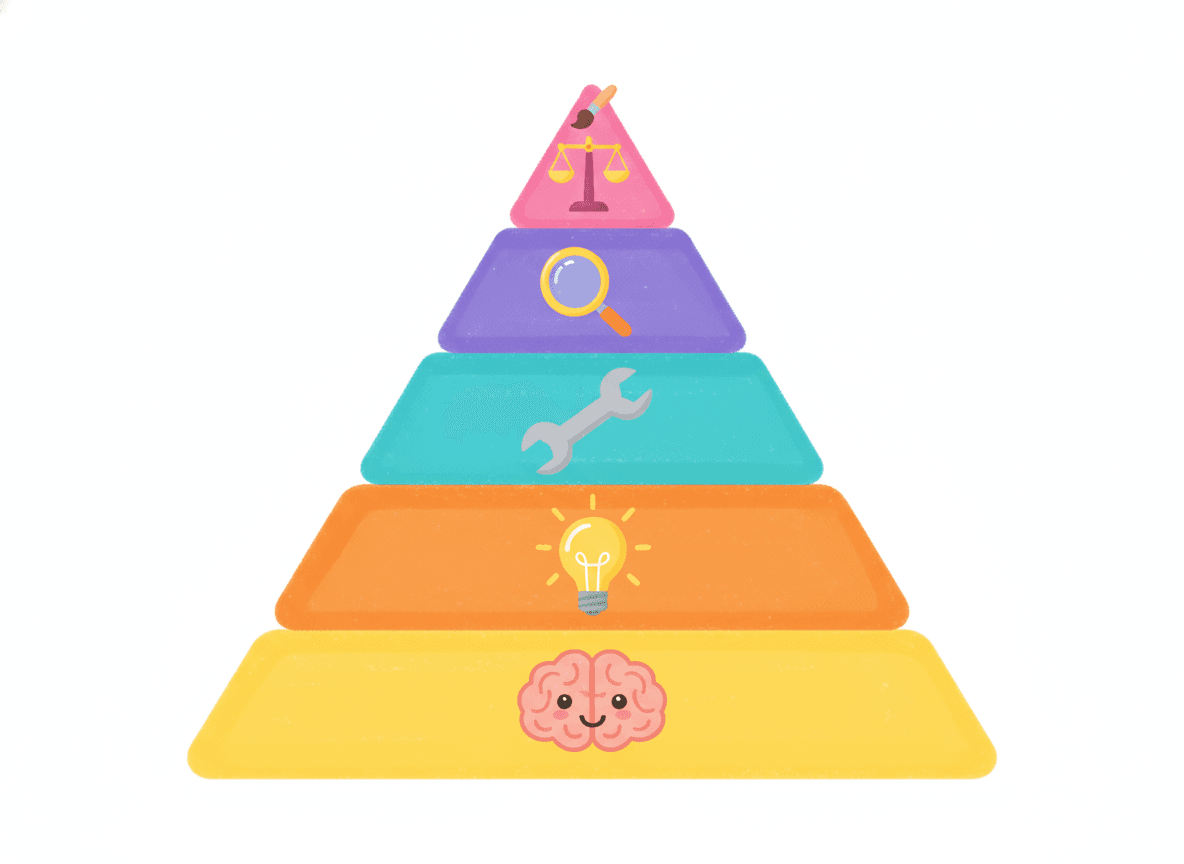
Higher-order thinking refers to the upper three levels of Bloom's Taxonomy - the framework developed by Benjamin Bloom in 1956 (revised 2001) that organizes educational learning objectives from simple to complex.
The six levels of Bloom's Taxonomy, from lowest to highest:
- Remember - recall facts and definitions
- Understand - explain ideas or concepts
- Apply - use information in a new situation
- Analyze - break information into parts; examine relationships ← HOT begins here
- Evaluate - make judgments about quality, validity, or usefulness
- Create - combine information in new ways to produce original work
Higher-order thinking (HOT) = levels 4, 5, and 6.
Lower-Order vs. Higher-Order Thinking
What year did the Civil War begin?: Why did the Civil War happen, and could it have been prevented?
What is the definition of photosynthesis?: How is photosynthesis similar to and different from cellular respiration?
What is 24 ÷ 6?: Is division always the right operation here? Why or why not?
Who are the main characters?: How does the antagonist's motivation change the story's theme? Lower-order thinking is essential - you cannot analyze what you don't remember. But if instruction stays at lower levels, students don't develop the skills they need for complex real-world problems.
How to Incorporate HOT in Any Subject
Use higher-order question stems:
- Compare and contrast...
- What would happen if...
- Evaluate whether...
- Design a... that...
- What is the strongest argument for / against...
- How would you solve this differently?
Design tasks that require HOT:
- Debates and discussions with no single correct answer
- Design challenges with constraints
- Evaluating and comparing multiple sources
- Writing from a different perspective
- Identifying errors in someone else's work and explaining why they're wrong
Sequence up the taxonomy: Start a lesson with lower-order activities (recall, understand) and build toward higher-order tasks (analyze, create). Both have a place - the question is whether you ever get to the upper levels.
Practice Activities
- Give students a solved math problem with a deliberate error and ask them to find it, explain why it's wrong, and correct it (analysis + evaluation).
- After reading a story, ask: "Was the main character's decision right or wrong? Defend your answer with evidence from the text." (evaluation)
- Have students redesign a product or system: "If you could redesign the school lunch menu to be healthier AND tastier, what would you change?" (creation)
- Use "What if?" questions: "What if the American colonists had NOT declared independence? How might life be different today?" (analysis + evaluation)
Frequently Asked Questions
What is higher-order thinking?
Higher-order thinking refers to the top three levels of Bloom's Taxonomy of Learning: analysis (breaking information into parts and examining relationships), evaluation (making judgments about quality or validity), and creation (producing original work by combining ideas in new ways). These contrast with lower-order thinking skills like remembering facts or applying procedures.
Why is higher-order thinking important?
Lower-order thinking (recall and comprehension) is necessary but not sufficient for deep learning. Students need higher-order thinking to solve novel problems, evaluate information critically, transfer knowledge to new situations, and create original work. In a world of easy information access, the ability to analyze and evaluate matters far more than the ability to memorize.
How do you design higher-order thinking tasks?
Higher-order tasks use verbs that require analysis, evaluation, or creation: compare, contrast, judge, argue, design, invent, evaluate, critique, construct, predict, hypothesize, defend. Lower-order tasks use verbs like recall, define, identify, list, describe. The same content can be taught at any level - the task verb determines the level.
Free Higher-Order Thinking Worksheets
Curriculum-aligned printable worksheets for 2nd – 5th Grade. Download free.