What Is a Food Web?
Taught in US schools
Key Takeaways
- A food web is a more complete model than a food chain because it shows that most organisms eat multiple species and are eaten by multiple predators.
- Arrows in a food web point from the organism being eaten toward the organism doing the eating, showing the direction of energy flow.
- Removing one species from a food web can trigger a trophic cascade - a chain reaction of changes that ripples through the entire ecosystem.
What Is a Food Web?
A food web is a diagram that shows how energy moves through an ecosystem by connecting all the feeding relationships among organisms. It is made up of multiple overlapping food chains - each showing who eats whom.
A food web is more realistic and complete than a single food chain because in nature, most organisms eat more than one thing and can be eaten by more than one predator.
From Food Chain to Food Web
A simple food chain looks like this:
Grass → Rabbit → Fox → Eagle
But in a real meadow ecosystem:
- The rabbit also eats berries and seeds.
- The fox also eats mice, birds, and insects.
- The eagle also eats snakes and mice.
- The grass is also eaten by deer, insects, and mice.
When you draw all these relationships together, you get a web of connections.
Levels in a Food Web
Bottom: Producers - Grass, plants, algae, phytoplankton
1st level up: Primary Consumers (herbivores) - Rabbits, deer, caterpillars, zooplankton
2nd level up: Secondary Consumers (omnivores/carnivores) - Frogs, small fish, foxes
3rd level up: Tertiary Consumers (apex predators) - Eagles, sharks, wolves, bears
Side/base: Decomposers - Bacteria, fungi, worms
Energy rule: At each level, only about 10% of the energy from the level below is passed on. This is why there are far fewer apex predators than producers in any ecosystem.
How to Read a Food Web Diagram
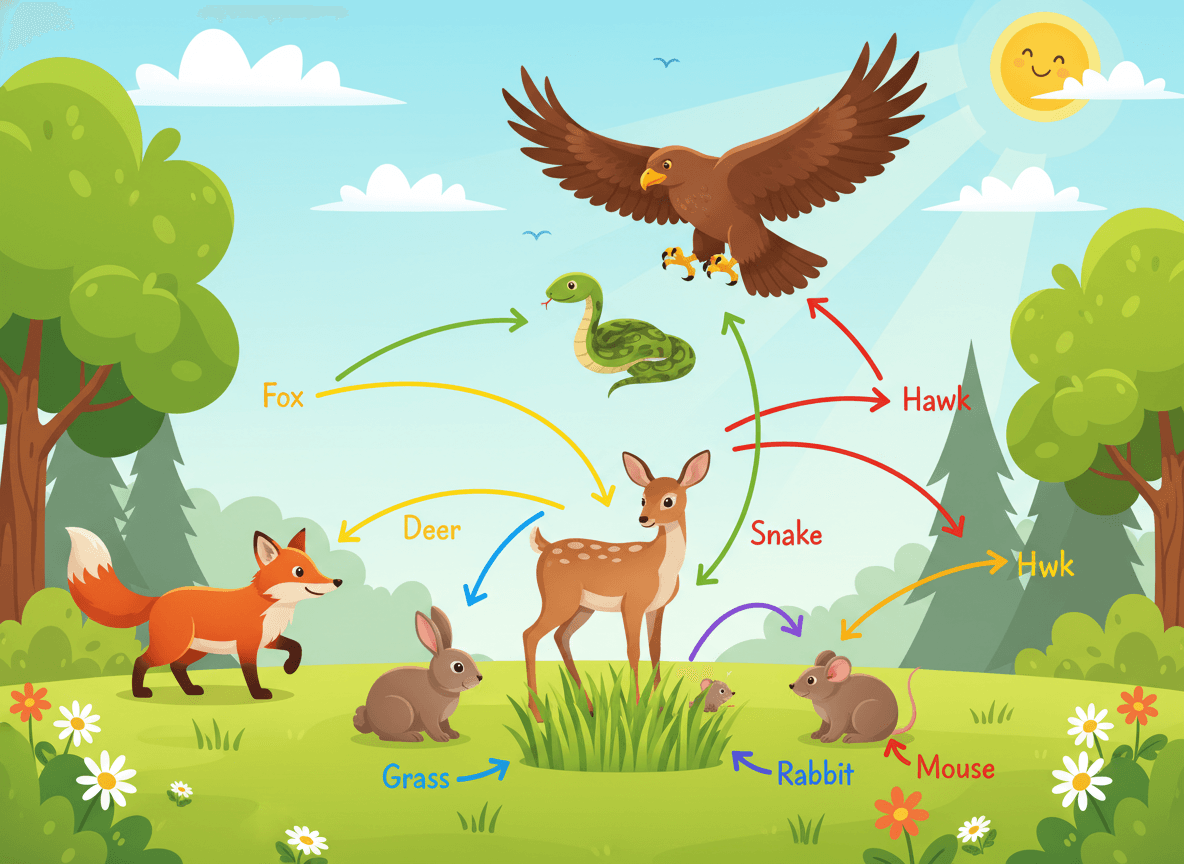
In a food web diagram, each arrow points from prey to predator - showing the direction that energy flows.
Example: Grass → Rabbit → Fox means energy flows from the grass (eaten) into the rabbit, then from the rabbit into the fox.
Trophic Cascades: When One Species Is Removed
A trophic cascade happens when removing one species triggers a chain reaction through the food web.
Famous example: When wolves were removed from Yellowstone National Park, elk populations exploded. Elk overgrazed riverbanks, which eroded the land and changed the shape of rivers. When wolves were reintroduced in 1995, elk moved more and grazed less - riverbanks recovered, plants regrew, and even beavers and songbirds returned. This is called a trophic cascade.
A keystone species is one whose removal would dramatically change the food web, even if it is not the most numerous organism.
Practice Activities
- Build a food web model using cards and yarn - each student holds a species card and students connect themselves with yarn to show feeding relationships.
- Identify what happens when one species is removed from a food web diagram - trace the effects through the web.
- Compare a food chain and food web from the same ecosystem and list what the food web shows that the chain does not.
- Research a local ecosystem (ocean, forest, desert, wetland) and draw its food web with at least 10 organisms.
- Play "Who eats whom?" - give each student an organism card and ask them to find and link to their prey and predators.
Frequently Asked Questions
What is the difference between a food chain and a food web?
A food chain shows a single, linear path of energy transfer (grass -> rabbit -> fox). A food web shows the full network of overlapping food chains in an ecosystem, which is more realistic because most animals eat multiple things and are preyed upon by multiple predators.
What do the arrows mean in a food web diagram?
Each arrow points from prey to predator - from the organism being eaten toward the organism that eats it. The arrow shows the direction that energy flows: energy from the prey's body is transferred to the predator.
What is a decomposer and why is it important in a food web?
Decomposers (bacteria and fungi) break down dead organisms and return nutrients to the soil. They are often shown at the base or side of a food web. Without decomposers, dead organisms would pile up and essential nutrients would not be recycled for producers to use.
Free Food Web Worksheets
Curriculum-aligned printable worksheets for 3rd – 5th Grade. Download free.


