Who Was Frederick Douglass?
Taught in US schools

Key Takeaways
- Frederick Douglass was born into slavery in Maryland around 1818, escaped in 1838, and became the most prominent African American abolitionist of the 19th century.
- His 1845 autobiography, Narrative of the Life of Frederick Douglass, became a bestseller and a powerful argument against slavery.
- Douglass was also a women's rights advocate, attended the Seneca Falls Convention in 1848, and advised President Abraham Lincoln during the Civil War.
Who Was Frederick Douglass?
Frederick Douglass (c. 1818–1895) was born into slavery and became the most influential African American voice of the 19th century. Through his extraordinary writing, oratory, and activism, he helped shape the abolition movement, influenced the course of the Civil War, and fought for the rights of all people - Black Americans, women, and immigrants.
"Once you learn to read, you will be forever free." - Frederick Douglass
Early Life in Slavery
Frederick Augustus Washington Bailey was born around 1818 in Talbot County, Maryland, to a enslaved mother, Harriet Bailey, and an unknown white father who may have been his enslaver. He was separated from his mother as an infant - a common and deliberate practice under slavery designed to break family bonds.
As a young man, he was sent to Baltimore to work as a house servant, where he was introduced to literacy - a transformative experience that would define his life.
The Power of Literacy
His enslaver's wife, Sophia Auld, began teaching Douglass to read. When her husband found out, he angrily said that education would make Douglass "unfit to be a slave." Douglass took these words as confirmation that literacy was his path to freedom.
He continued teaching himself - trading bread with white children in the neighborhood for reading lessons, practicing from newspapers, and reading whatever he could find. He later described literacy as the key that "forever freed" his mind, even while his body remained enslaved.
Escape to Freedom (1838)
On September 3, 1838, at approximately age 20, Douglass escaped. He disguised himself as a free Black sailor, borrowed papers from a free Black man, and traveled by train and ferry from Baltimore to New York City. He then settled in New Bedford, Massachusetts, and took the surname "Douglass."
Abolitionist and Writer
Douglass quickly became a powerful voice in the abolitionist movement - the effort to end slavery. He gave speeches at anti-slavery meetings so compelling that audiences could not believe he had been enslaved.
In 1845, he published his Narrative of the Life of Frederick Douglass, an American Slave - a detailed, eloquent account of his life in slavery and his escape. The book became a bestseller in the United States and Europe and was a devastating argument against the institution of slavery.
Newspapers and Advocacy
In 1847, Douglass founded his own newspaper, The North Star (later renamed Frederick Douglass' Paper), which he published for 16 years. Its motto: "Right is of no Sex - Truth is of no Color - God is the Father of us all, and we are all Brethren."
Women's Rights
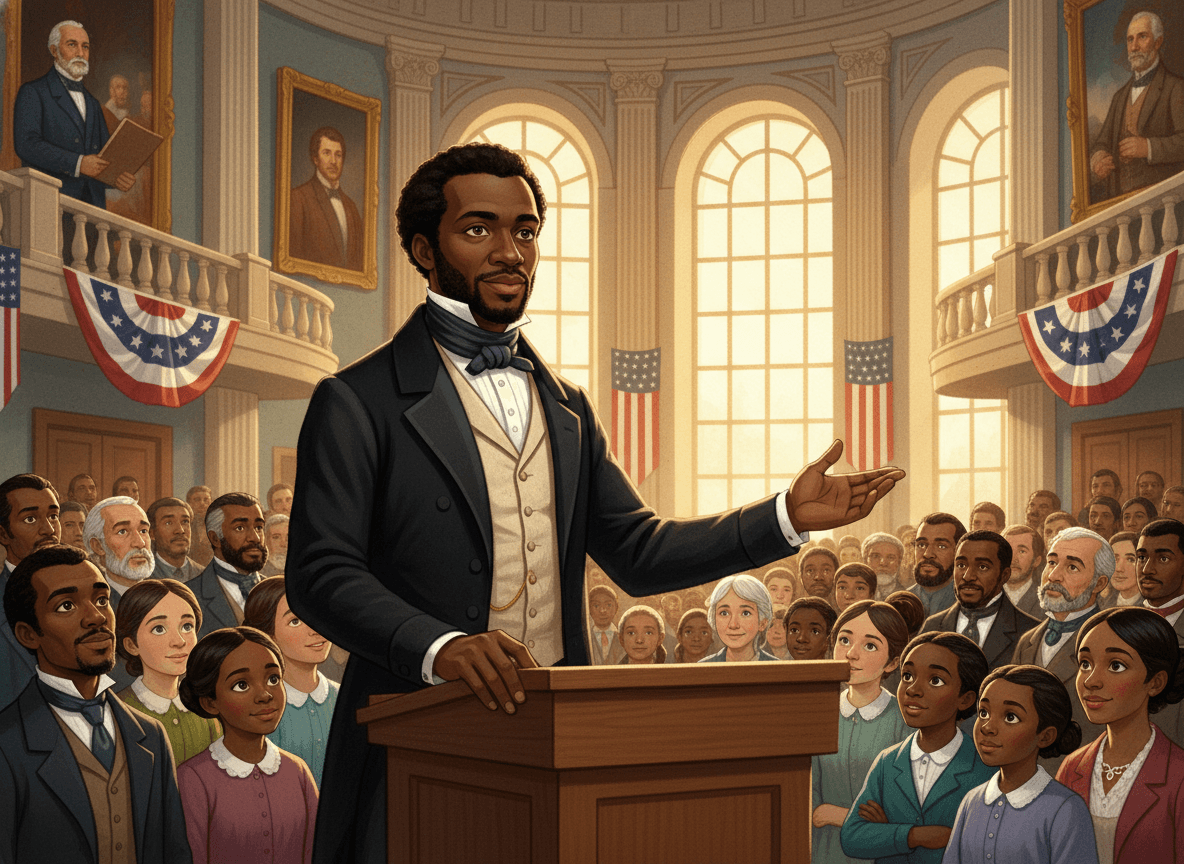
Douglass was one of the few men to attend the Seneca Falls Convention in 1848 - the first women's rights convention in American history, organized by Elizabeth Cady Stanton and Lucretia Mott. He was the only man to speak in favor of women's suffrage at the convention. He believed deeply that the struggle for Black rights and the struggle for women's rights were inseparable.
Civil War and Lincoln
During the Civil War, Douglass met with President Abraham Lincoln multiple times:
- Advocated for the recruitment of Black soldiers into the Union Army (the 54th Massachusetts Infantry was one result)
- Pushed for equal pay for Black soldiers
- Urged Lincoln to make emancipation the central goal of the war
Later Life
After the Civil War, Douglass continued fighting for civil rights and against racial violence. He held several government posts:
- U.S. Marshal for the District of Columbia (1877)
- Recorder of Deeds for D.C. (1881)
- U.S. Minister to Haiti (1889)
He died on February 20, 1895, in Washington, D.C. That morning, he had attended a women's suffrage meeting - advocacy to the end.
Practice Activities
- Read an excerpt from the Narrative of the Life of Frederick Douglass and discuss: what specific details make this primary source powerful?
- Create a biography timeline of key events in Douglass's life - birth, escape, publication of Narrative, Civil War, death.
- Research one speech by Douglass (e.g., "What to the Slave Is the Fourth of July?" 1852) - what is his main argument?
- Compare Douglass and Rosa Parks: how did each use courage and communication to fight injustice?
- Discuss: Douglass said, "Power concedes nothing without a demand." What does this mean? Can students find examples in history that support or challenge this idea?
Frequently Asked Questions
How did Frederick Douglass learn to read?
Douglass was enslaved in Baltimore, Maryland, where his enslaver's wife, Sophia Auld, began teaching him to read before her husband stopped her, saying education would make him unfit for slavery. Douglass continued to teach himself by trading bread with poor white children for reading lessons and by secretly practicing. He later wrote: 'Once you learn to read, you will be forever free.' Literacy became both his means of escape and his most powerful tool.
How did Douglass escape from slavery?
On September 3, 1838, Frederick Douglass escaped from slavery in Baltimore by disguising himself as a free Black sailor and traveling by train and ferry to New York City, then to New Bedford, Massachusetts. The escape was dangerous - he could be caught and returned at any point. He changed his last name to 'Douglass' (inspired by a character in Walter Scott's poem) to make himself harder to find.
What was Frederick Douglass's relationship with Abraham Lincoln?
Douglass met with President Lincoln three times during the Civil War. He advocated for the enlistment of Black soldiers in the Union Army (which Lincoln approved in 1863), pushed for equal pay for Black soldiers, and urged Lincoln to make emancipation a central goal of the war. Douglass was present at Lincoln's second inauguration in 1865. After the assassination, Lincoln's widow gave Douglass the President's walking stick.
Free Frederick Douglass Worksheets
Curriculum-aligned printable worksheets for 4th – 5th Grade. Download free.