What Is a Haiku?
Taught in US schools
Key Takeaways
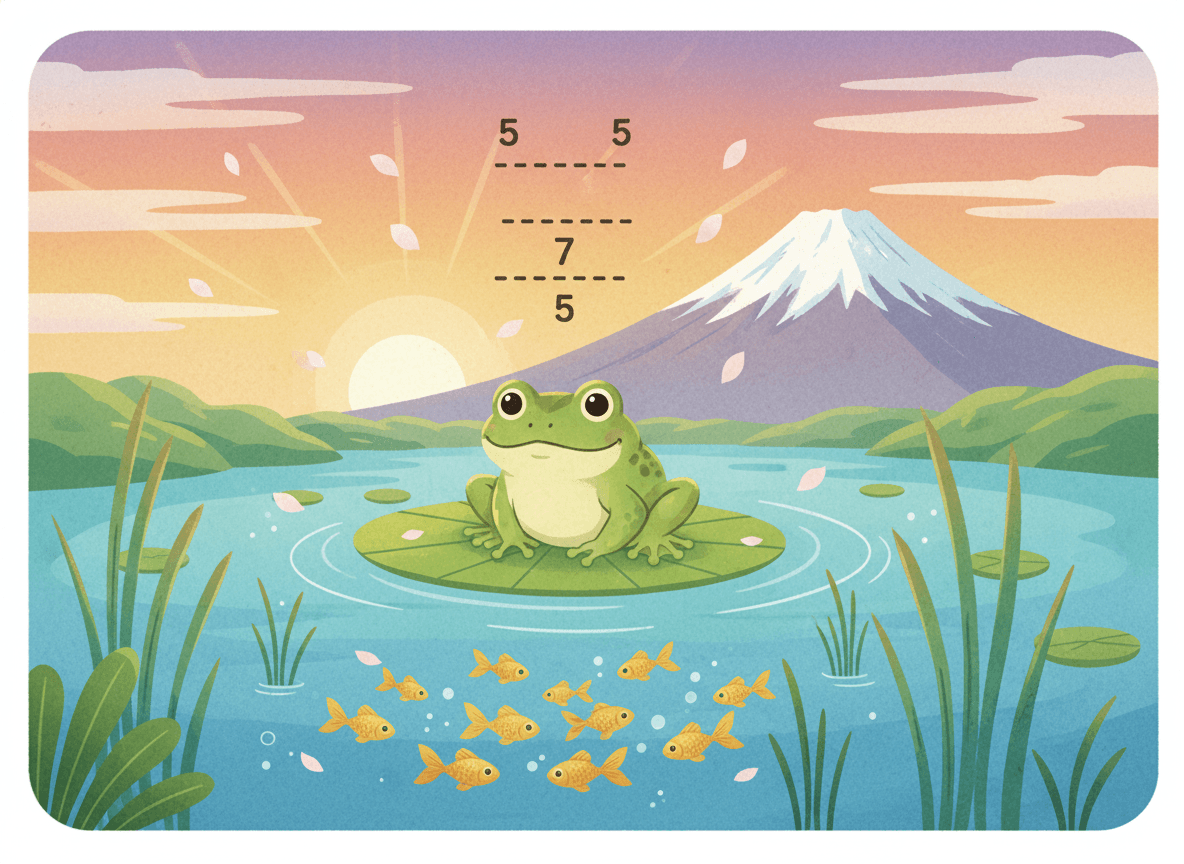
- A haiku has three lines: 5 syllables, 7 syllables, 5 syllables.
- Haiku traditionally focus on nature and capture a single, vivid moment.
- The form teaches careful word choice - every syllable counts.
- Haiku originated in Japan; the master poet Matsuo Basho is the most famous haiku writer.
What Is a Haiku?
A haiku (pronounced hy-koo) is a traditional Japanese form of poetry with three lines that follow a specific syllable count:
Line 1: 5 syllables Line 2: 7 syllables Line 3: 5 syllables
Haiku traditionally focus on nature and the natural world - a season, a weather event, a moment in a garden or forest. They don't rhyme. Instead of telling the reader what to feel, haiku show a precise, vivid image and let the feeling arise on its own.
A Classic Example
By Matsuo Basho, the 17th-century Japanese master:
An old silent pond (5 syllables) A frog jumps into the pond (7 syllables) Splash! Silence again (5 syllables)
Notice: no explanation, no moral, no rhyme. Just an image - and the silence after the splash says everything.
How to Count Syllables
A syllable is a unit of sound - a single beat. To count syllables, clap once for every vowel sound you say:
- frog = 1 syllable
- si-lent = 2 syllables
- si-lence = 2 syllables
- po-et-ry = 3 syllables
Counting syllables is one of the best phonological awareness exercises built into haiku writing.
What Makes Haiku Special
The constraint of 5-7-5 is not a limitation - it's a creative discipline. Because every syllable counts, haiku writers must choose words very carefully. A three-syllable word fits where a one-syllable word doesn't. This forces precision in word choice that students rarely practice in other forms.
The kireji (cutting word or turn) - a subtle shift or surprise between the second and third lines - is what gives a haiku its resonance. The third line should feel like a small discovery.
Writing Haiku in the Classroom
Step 1: Choose a topic - traditionally nature, but classroom haiku can be about anything concrete and sensory.
Step 2: Generate ideas - what can you see, hear, smell, feel, or taste? What moment do you want to capture?
Step 3: Draft - don't worry about syllables first. Get the image down.
Step 4: Count and revise - count syllables, swap words to hit the right count. Use a thesaurus for alternatives.
Step 5: Read aloud - does it sound right? Does the third line feel like a small surprise?
Practice Activities
- Start by having students practice counting syllables in their own names, animals, and weather words before writing.
- Read 5-6 haiku aloud. Ask students: what image do you see? What feeling do you get? Which words do the most work?
- "Haiku about right now" - students write a haiku about exactly what they can observe from their classroom window or seat.
- Display a photograph of a nature scene and have students write a haiku in response to it.
Frequently Asked Questions
What is a haiku?
A haiku is a traditional Japanese poem with exactly three lines: line 1 has 5 syllables, line 2 has 7 syllables, and line 3 has 5 syllables (5-7-5). Haiku traditionally focus on nature, a specific season, or a brief, vivid moment. They avoid rhyme and rely on precise, sensory images to create an impression rather than explaining it.
Where did haiku come from?
Haiku developed in Japan in the 17th century. The poet Matsuo Basho is considered the master of haiku. His most famous haiku: 'An old silent pond / A frog jumps into the pond / Splash! Silence again.' Haiku evolved from a longer form called haiku (renku) and became its own distinct form by the late 1800s.
What makes a good haiku?
A good haiku: (1) follows the 5-7-5 syllable structure; (2) captures a specific, concrete moment or image rather than a general statement; (3) uses sensory language that helps the reader see, hear, or feel something; (4) often contains a subtle surprise or shift in perspective between the second and third lines (called a 'kireji' or cutting word). A weak haiku just describes; a strong haiku creates a feeling.
Free Haiku Worksheets
Curriculum-aligned printable worksheets for 2nd – 5th Grade. Download free.