What Are Homophones?
Taught in US schools

Key Takeaways
- Homophones sound the same but have different spellings and different meanings: there/their/they're.
- Context is the only reliable way to determine which homophone to use.
- Homophones are among the most common spelling and grammar errors in student writing.
- Spell-checkers cannot catch homophone errors - only a human reader can.
What Are Homophones?
Homophones are words that sound exactly the same when spoken but are spelled differently and have different meanings. The word comes from Greek: homos (same) + phone (sound).
Common examples:
-
there / their / they're → place / possessive pronoun / contraction of "they are"
-
to / too / two → preposition / also or excessively / the number
-
your / you're → possessive / contraction of "you are"
-
hear / here → to listen / a location
-
right / write → correct / to write
-
won / one → past tense of win / the number
Why Homophones Are Tricky
Homophones are especially challenging because they sound correct when read aloud. A student who knows how to say "there" correctly may write "their" when they mean "there" - and neither they nor a spell-checker will notice. Only careful reading of meaning catches these errors.
Key Strategies for Choosing the Right Homophone
There / Their / They're:
- There = a place ("Put it over there") or a sentence starter ("There is a dog outside.")
- Their = belongs to them ("Their dog ran away.")
- They're = they are ("They're going to the park.") - test: substitute "they are"
Your / You're:
- Your = belongs to you ("Your backpack is here.")
- You're = you are ("You're my best friend.") - test: substitute "you are"
To / Too / Two:
- To = toward, for ("She went to the store.")
- Too = also or excessively ("I want to come too.")
- Two = the number 2 ("I have two dogs.")
What Grade Do Kids Learn Homophones?
2nd grade: Students encounter common homophones and practice choosing the correct spelling.
3rd grade (L.3.4a): Students use context as a clue to the meaning of a word or phrase, including homophones.
4th grade (L.4.1g): Students use knowledge of language to understand homophones in reading and apply them correctly in writing.
Common Misconceptions
Spell-check will catch it: It won't. Homophones are all correctly spelled words - only context reveals an error. Proofreading for meaning is essential.
Homophones are only 2-word pairs: Some homophone sets have three members (there/their/they're) or four (for/four/fore/fore-).
Once learned, always remembered: Many students learn homophones but still misuse them under time pressure. Regular practice in writing context is more effective than one-time drills.
Practice Activities
-
Homophone sorting: Sort cards into correct piles (there/their/they're) based on sentence context.
-
Error hunt: Give a passage with deliberate homophone errors; students find and fix them.
-
Fill-in-the-blank: Sentences with blank spaces where students choose the correct homophone.
-
Partner write and swap: Students write sentences using homophones; partners verify choices.
-
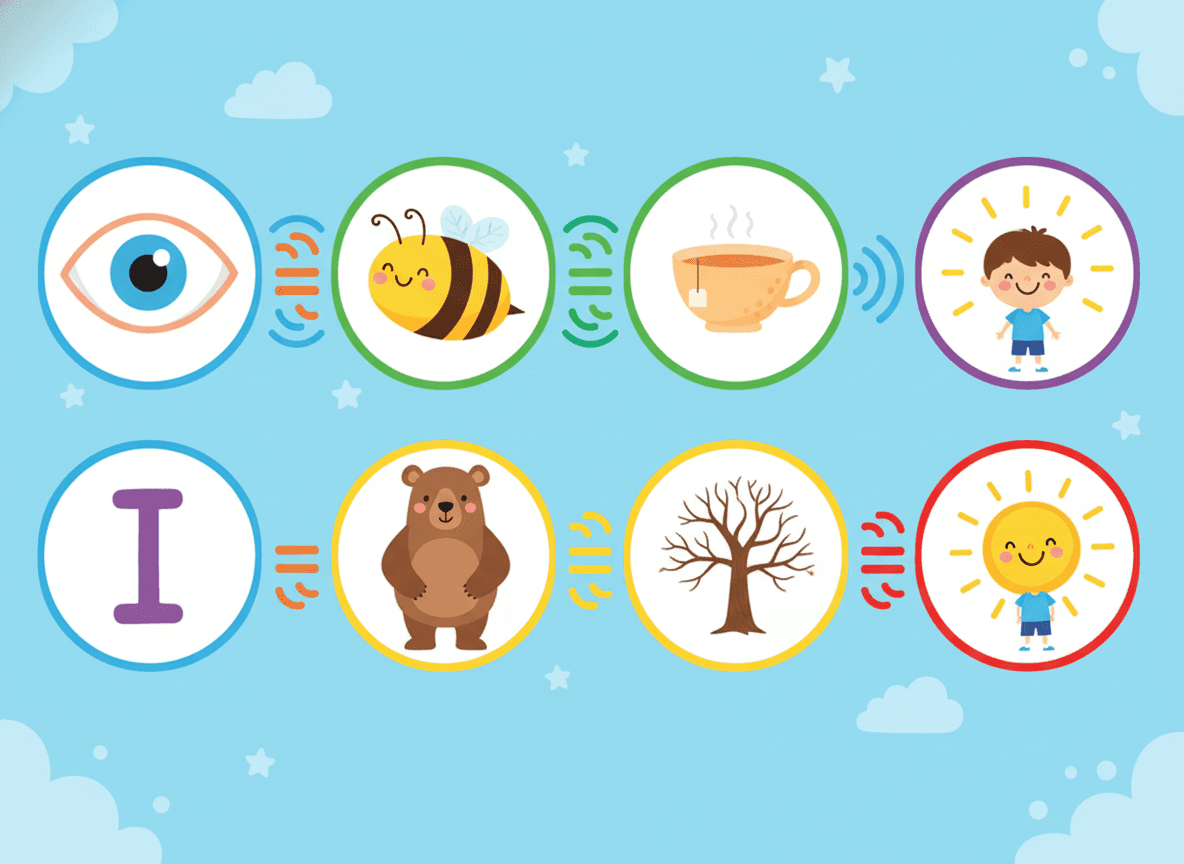
Illustrated homophone book: Students draw pictures contrasting each homophone's meaning (e.g., bare vs. bear).
Frequently Asked Questions
What are homophones?
Homophones are words that have the same pronunciation but different spellings and different meanings. The word 'homophone' comes from Greek: 'homo' (same) + 'phone' (sound). Examples include: there/their/they're, to/too/two, hear/here, write/right, won/one, and meet/meat. Homophones must be carefully distinguished in writing because a spell-checker won't catch them.
What are the most commonly confused homophones?
The most frequently confused homophones in elementary writing are: there/their/they're (place/possessive/contraction), to/too/two (direction/also+excessive/number), your/you're (possessive/contraction), its/it's (possessive/contraction), hear/here (to perceive sound/a location), and then/than (time/comparison). These appear so often that direct, repeated instruction is needed.
How do you choose the right homophone?
Context is the key. Ask: What does this word mean in this sentence? 'Their' shows ownership (their house). 'There' shows location (over there) or is used as a sentence opener (there is). 'They're' is a contraction for 'they are.' If you can substitute 'they are,' use 'they're.' If you're showing possession, use 'their.' For location or opener, use 'there.'
What is the difference between homophones and homonyms?
Homophones sound the same but are spelled differently and mean different things. Homonyms are words that are spelled the same AND sound the same but mean different things (like 'bat' - the animal or the wooden club). Some teachers use these terms interchangeably, but technically they are different categories.
Why can't spell-checkers catch homophone errors?
Spell-checkers check whether a word exists in the dictionary, not whether it is the correct word for the context. If a student writes 'Their going to the park,' a spell-checker sees three valid words and marks them all correct. Only a reader who understands the sentence's meaning can identify that 'Their' should be 'They're.' This is why proofreading is an essential skill.
Free Homophones Worksheets
Curriculum-aligned printable worksheets for 2nd – 4th Grade. Download free.