What Is a Lesson Plan?
Taught in US schools

Key Takeaways
- A lesson plan is a teacher's roadmap for a single lesson: objectives, materials, instructional sequence, and assessment.
- Effective lesson plans are aligned: the objective, instruction, practice, and assessment all target the same skill.
- The most important element of a lesson plan is a clear, specific learning objective - it drives all other decisions.
- Lesson plans are tools for teaching, not performances - they should be flexible enough to respond to student needs in real time.
What Is a Lesson Plan?
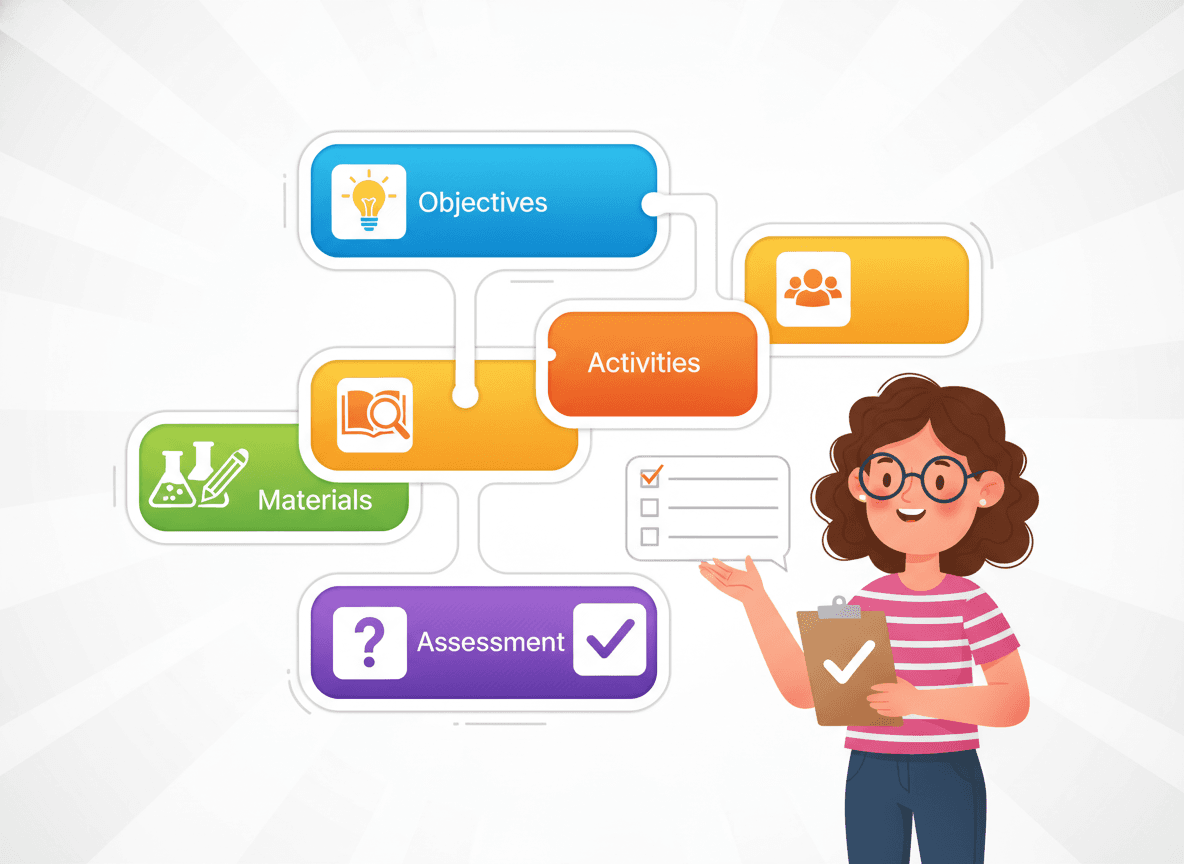
A lesson plan is a teacher's written roadmap for a single instructional session. It translates curriculum goals, standards, and learning objectives into a specific, sequenced plan for what will happen in the classroom: what the teacher will do, what students will do, and how the teacher will know whether learning occurred.
Lesson plans vary widely in format - from one-page outlines to multi-page documents - but all effective plans share core elements and the fundamental purpose of ensuring intentional, aligned instruction.
Core Components of a Lesson Plan
1. Learning Objective
The most important element. A specific, measurable statement of what students will know or be able to do by the end of the lesson.
Weak: Students will learn about fractions.
Strong: Students will be able to identify equivalent fractions using visual models and a number line.
2. Standards
Which state or Common Core standards the lesson addresses. Connects the lesson to the larger curriculum framework.
3. Materials
Everything the teacher needs to gather before the lesson: texts, manipulatives, worksheets, technology, anchor charts.
4. Opening/Warm-Up (Anticipatory Set)
3-5 minutes to activate prior knowledge and set the purpose for the lesson:
- Review previous learning ("Yesterday we learned...")
- Hook that connects to student experience
- Vocabulary preview
- Review of the learning objective
5. Instructional Sequence
The heart of the plan - what the teacher will do and say:
I Do (Modeling): Teacher demonstrates the skill while thinking aloud.
We Do (Guided Practice): Teacher and students practice together with teacher prompting.
You Do Together: Students practice with partners or small groups.
You Do Alone: Students apply the skill independently.
6. Student Practice
What students will do to practice the skill: worksheet, writing task, math problem set, reading response, discussion activity.
7. Closure/Assessment
How the teacher will verify that students met the objective:
- Exit ticket (1-2 questions directly assessing the objective)
- Thumbs up/thumbs down/thumbs sideways check
- Quick write or drawing response
- Partner discussion with observation
8. Differentiation
How the lesson will be modified for:
- Students who need more support (reduced complexity, additional scaffold, sentence frames)
- Students who finish early or need extension (enrichment questions, application tasks)
- ELL students (visual supports, sentence frames, vocabulary preview)
The Principle of Alignment
Every component of the lesson plan should align to the objective:
Compare two fractions: Comparing fractions with models - Compare fractions in multiple ways - Compare fractions independently Misalignment is the most common lesson planning error: teaching one thing, practicing another, assessing a third.
Common Lesson Plan Formats
Madeline Hunter model: Anticipatory set → Objective → Input → Modeling → Checking for Understanding → Guided Practice → Closure → Independent Practice
Workshop model: Mini-lesson → Independent work with conferring → Share
5E model (science): Engage → Explore → Explain → Elaborate → Evaluate
I Do / We Do / You Do (gradual release): Simplified explicit instruction framework common in reading and math
Common Misconceptions
The lesson plan is the lesson: A lesson plan is a preparation tool. The lesson itself happens in real time, with real students. Experienced teachers treat plans as guides, not scripts - they adjust in the moment based on student responses. Over-adherence to a plan when students aren't understanding is a lesson planning error, not a virtue.
More detail = better plan: Detailed plans help novice teachers prepare, but detail is not quality. A well-structured one-page plan with a clear objective and aligned assessment beats a five-page plan with a vague objective and no formative check.
You need a new plan for every lesson: In practice, teachers reuse and adapt successful lesson plans. Building a personal library of strong lesson plans that can be modified is efficient and sustainable.
Practice Activities
-
Backward design: Start with the assessment - what will students do to show mastery? - and design the instruction to prepare students for that task.
-
Objective-to-exit-ticket match: For every lesson, write the exit ticket before writing the instructional sequence. If you can't write an exit ticket, the objective isn't specific enough.
-
Lesson study: Share a draft lesson plan with a colleague; they ask clarifying questions about the objective, the practice, and how you'll know if students learned. Revise based on the conversation.
-
Post-lesson reflection: After each lesson, add 2-3 sentences of reflection: what worked, what didn't, what you'd change - builds institutional knowledge over time.
-
Vertical alignment review: Compare your lesson's objectives with the grade below and grade above - does your lesson build on what was taught and prepare for what comes next?
Frequently Asked Questions
What is a lesson plan?
A lesson plan is a written guide that outlines what a teacher will teach in a single instructional session and how they will teach it. A complete lesson plan typically includes: the learning objective (what students will know or be able to do), standards addressed, materials needed, an opening hook or warm-up, the instructional sequence (modeling, guided practice, independent practice), a closing or assessment of learning, and accommodations for students with different needs. Lesson plans vary in format from school to school but serve the same purpose: translating curriculum goals into specific, sequenced instruction.
What are the essential components of a lesson plan?
Core components include: (1) Learning objective - a clear, specific statement of what students will know or be able to do. (2) Standards - which Common Core or state standard(s) the lesson addresses. (3) Materials - everything needed before the lesson begins. (4) Opening/warm-up - activates prior knowledge and sets the purpose. (5) Instruction - the teaching sequence: model, guided practice, checking for understanding. (6) Student practice - what students will do to practice the skill. (7) Closure/assessment - how the teacher will know if students met the objective (exit ticket, discussion, observation). (8) Differentiation - how the lesson will be modified for students who need more or less support.
How detailed should a lesson plan be?
The appropriate level of detail depends on the teacher's experience and the lesson's complexity. Beginning teachers and student teachers typically write more detailed plans that script key transitions, questions, and explanations - the detail helps them anticipate and prepare. Experienced teachers may use briefer outlines. Whatever the format, the most important elements remain: a clear objective, a sequenced instructional plan, planned checks for understanding, and materials. A useful test: could a competent substitute teach this lesson using only your plan?
What is the difference between a lesson plan and a unit plan?
A lesson plan describes a single instructional session (one class period or one day). A unit plan describes a multi-week sequence of instruction on a topic or skill set - it includes the big goals of the unit, the sequence of lessons, major assessments, and how the lessons connect to each other. Unit plans provide the 'why are we doing this?' context that individual lesson plans serve. Lesson plans should be understood within their unit context - each lesson is one step toward the unit's major goals.
What is the Madeline Hunter lesson plan model?
The Madeline Hunter lesson design model is one of the most widely taught lesson plan frameworks in US teacher education. It includes eight elements: (1) Anticipatory set - hook/warm-up that activates prior knowledge. (2) Objective - the learning goal, stated explicitly. (3) Input - the new information the teacher delivers. (4) Modeling - the teacher demonstrates the skill. (5) Checking for understanding - the teacher confirms students are following. (6) Guided practice - students practice with teacher support. (7) Closure - summarizing and connecting the learning. (8) Independent practice - students practice without direct support. Many schools adapt or simplify this model, but its influence on lesson design remains widespread.
Free Lesson Plan Worksheets
Curriculum-aligned printable worksheets for Kindergarten – 5th Grade. Download free.