What Are Literacy Centers?
Taught in US schools
Key Takeaways
- Literacy centers are independent or partner activity stations that free up the teacher to run small-group guided reading instruction.
- Common center types include word work, independent reading, writing, listening, and technology - each targeting a specific literacy skill.
- Clear routines, expectations, and anchor activities are essential for centers to run smoothly without constant teacher intervention.
What Are Literacy Centers?
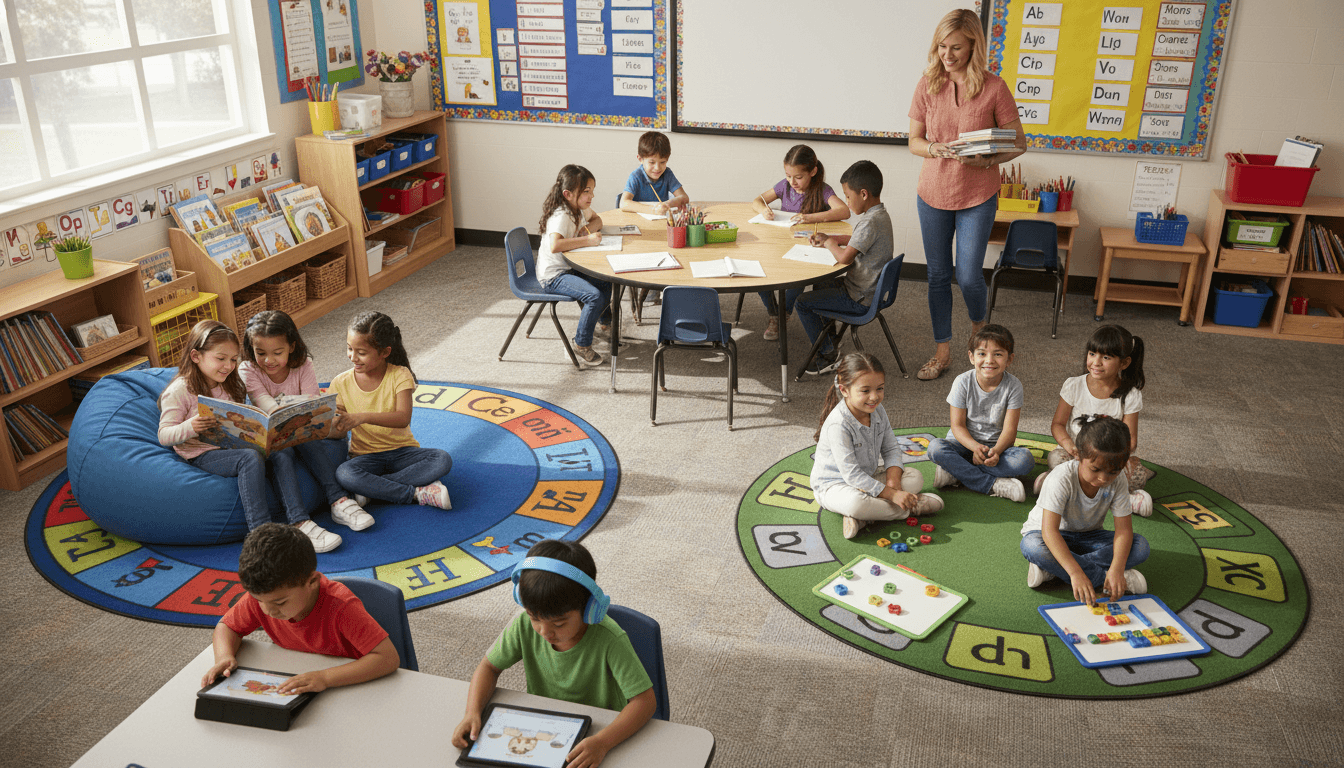
Literacy centers (also called reading centers or work stations) are organized spaces in the classroom where students engage in independent or partner literacy activities while the teacher is working with a small group. Each center targets one or more reading and language skills.
Literacy centers are the structural backbone of the reading workshop model and are essential for guided reading instruction - because a teacher cannot meet privately with five students if the other twenty have nothing purposeful to do.
Why Centers Work
Without some form of independent structure, teachers are pulled in 25 directions at once and small-group instruction becomes impossible. Centers solve this problem by giving students meaningful work they can do independently - work that reinforces skills they are already building.
Well-designed centers are:
-
Independent - students can do them without teacher help
-
Purposeful - directly tied to literacy skills being taught
-
Familiar - activities are introduced before being used as centers so students know what to do
-
Differentiated - materials can be adjusted by reading level or skill focus
Common Literacy Center Types
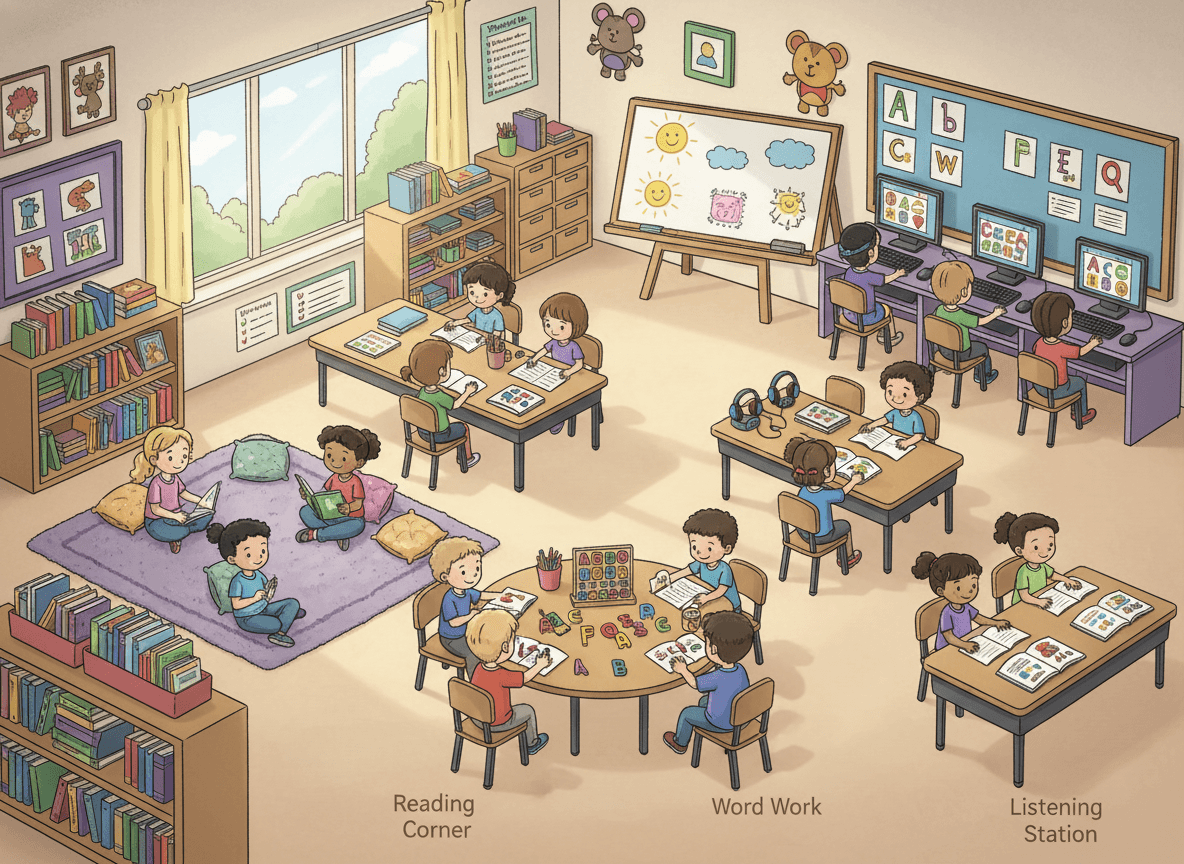
Word Work: Word sorts, building words, spelling patterns - Phonics, spelling, vocabulary
Independent Reading: Read self-selected books at their level - Fluency, comprehension, stamina
Writing: Journal writing, response to reading, creative writing - Written expression
Listening: Listen to an audiobook or recorded story, follow along - Fluency, vocabulary, comprehension
Partner Reading: Read aloud with a partner, take turns - Fluency, expression
Technology: Educational apps, digital phonics games, typing - Mixed literacy skills
Poetry/Fluency: Read and perform poems, Readers Theater scripts - Fluency, expression
Management: Making Centers Run Smoothly
The biggest challenge with centers is management - keeping 20+ students engaged without the teacher being available to redirect every moment.
Key management strategies:
-
Establish routines early. Teach center procedures explicitly in the first weeks of school before beginning small groups. Practice transitions.
-
Use a rotation chart. Post a visual showing which students go to which center at each rotation time, so students are never confused.
-
Set a timer. A visible timer tells students when to rotate without the teacher needing to stop their small group.
-
Define expectations clearly. Use an anchor chart listing what each center looks like ("voices are at a whisper," "materials are put away before rotating").
-
Use an anchor activity. If students finish early, they know exactly where to go without asking.
Differentiation in Centers
Centers can be easily differentiated by swapping out materials:
- At the word work center, different groups might be working on different spelling patterns (short vowels vs. long vowels vs. blends)
- At the reading center, leveled book bins mean each student reads a book appropriate for their level
- At the writing center, some students might be writing sentences while others write multi-paragraph stories
Grade-Level Notes
Centers are most commonly used in Kindergarten through 2nd grade, where the reading workshop structure is the dominant model. They are used through 3rd grade but may be less formal. In grades 4–5, small-group work often happens through flexible grouping rather than structured center rotations.
Practice Activities
- Introduce one center at a time before launching the full rotation system - teach the procedures, practice, and celebrate success.
- Use a "Center Check-In" at the end of the week: students reflect on which center helped them learn the most this week.
- Photograph students at work in centers and create an anchor chart showing what each center looks and sounds like.
- Have students help design a center activity - students who create word sorts for the word work center have ownership over the space.
- Do a center audit every few weeks: observe which centers are truly productive and replace any that have become too easy or too noisy.
Frequently Asked Questions
Why do teachers use literacy centers?
Centers allow teachers to meet with small groups for targeted guided reading instruction while the rest of the class is engaged in meaningful, independent practice. Without centers, the teacher cannot pull small groups because there is nothing structured for the other students to do.
What is an anchor activity in literacy centers?
An anchor activity is a familiar, self-directed task that students know how to do independently - such as rereading a familiar book, writing in a journal, or continuing a word sort. If students finish a center early or need a quiet transition, they go to their anchor activity without asking the teacher.
How long should students stay at each center?
Typical center rotations last 15–20 minutes each, with 3–4 rotations per literacy block. The exact time depends on the age of students, the complexity of the task, and how well routines are established. Younger students often do better with shorter rotations (12–15 minutes) and fewer centers.
Free Literacy Centers Worksheets
Curriculum-aligned printable worksheets for Kindergarten – 3rd Grade. Download free.