What Is Writer's Workshop?
Taught in US schools
Key Takeaways
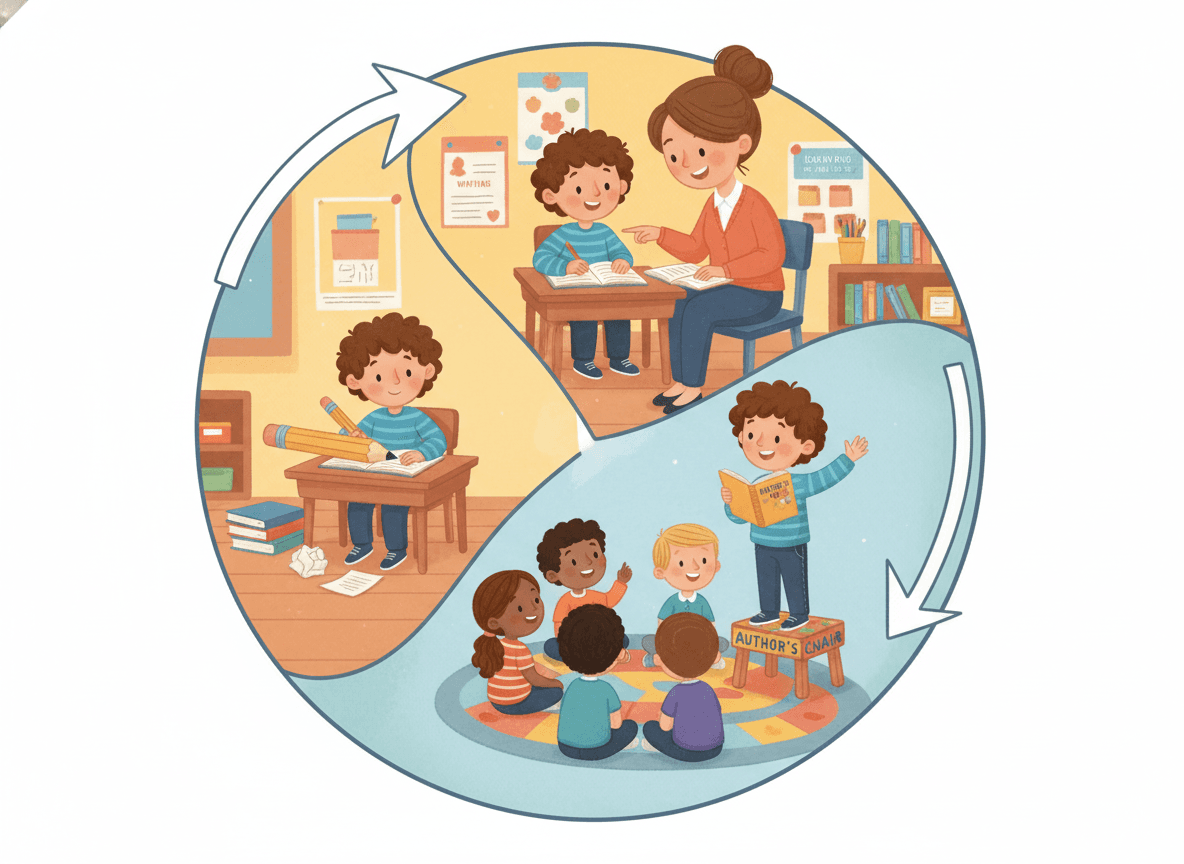
- Writer's Workshop is a daily writing routine with three parts: mini-lesson, independent writing time, and sharing.
- Students choose their own topics, building writing identity and stamina alongside craft.
- The teacher confers individually with students during independent writing time - this is where the most targeted teaching happens.
- Writer's Workshop is associated with Lucy Calkins' Units of Study and Donald Graves' writing process research.
What Is Writer's Workshop?
Writer's Workshop is a structured approach to writing instruction in which students write regularly on self-selected topics, with teacher-led mini-lessons, substantial independent writing time, and regular sharing. It is grounded in the belief that the best way to teach writing is to have students write - a lot - with targeted, individualized instruction along the way.
Writer's Workshop grew from Donald Graves' research in the 1970s-80s and was developed into a curriculum framework by Lucy Calkins and the Teachers College Reading and Writing Project.
The Three-Part Workshop Structure
1. Mini-Lesson (5-10 minutes)
The teacher teaches one specific, focused skill or strategy to the whole class:
- A craft skill: "Good writers show, not tell. Today I'll show you how to replace 'I was scared' with details that show fear."
- A convention: "Today we're practicing how to use quotation marks when a character speaks."
- A process move: "Writers re-read their draft before adding more - let me show you how."
The mini-lesson is mini - focused, short, and actionable.
2. Independent Writing Time (20-40 minutes)
Students write independently on their own pieces while the teacher circulates and confers. This is the heart of the workshop.
During independent writing time, the teacher:
- Confers individually with 3-5 students
- Observes writing behaviors
- Assists with process (pre-writing, drafting, revising, editing)
- Notes patterns to address in future mini-lessons
3. Share Time (5-10 minutes)
One or two students share a portion of their writing. The class responds with specific, warm feedback. Purposes:
- Celebrates student work publicly
- Demonstrates the lesson from the mini-lesson in a student's actual writing
- Builds community around writing
Writing Conferences: The Core Instructional Move
The writing conference is where the most targeted teaching happens. Structure:
- Research: "What are you working on today? Can you read me a part of it?"
- Compliment: Name one specific thing the student is doing well.
- Teach: One specific skill or strategy matched to this student's needs.
- Link: "From now on, when you're writing dialogue, remember to..."
Conference notes track what each student was taught and what they're working on. Over a week, a teacher can confer with every student.
Writer's Workshop Across Grades
Kindergarten: Drawing + labeling → simple sentences. Phonetic spelling encouraged. Focus: getting ideas on paper.
1st-2nd grade: Simple sentences → paragraphs. Stories about personal experience. Focus: adding details, using dialogue.
3rd-4th grade: Multi-paragraph pieces. Narrative, informational, and opinion writing. Focus: organization, transitions, elaboration.
5th grade: Extended essays and research writing. Focus: craft, voice, evidence-based argument.
Common Misconceptions
Students can write about literally anything: Writer's Workshop offers topic choice within a genre framework. During a personal narrative unit, students choose which personal experience to write about - not whether to write a poem or a report. Genre, audience, and purpose are teacher-directed; topic within those parameters is student-chosen.
Writer's Workshop means no grammar instruction: Grammar and conventions are taught in mini-lessons and addressed in writing conferences. The difference is that conventions are taught in the context of student writing, not in isolation. Students learn when and how to use a comma because they need it in their own writing - not on a worksheet disconnected from writing.
Students should fix every error: In Writer's Workshop, editing for conventions happens at the end of the writing process, after revision of content. Teachers help students prioritize the skills they've been taught; students are not expected to achieve perfection beyond their developmental level.
Practice Activities
-
Heart map: Students create a visual "heart map" of people, places, and experiences they care about - a bank of topic ideas to return to throughout the year.
-
Mentor text study: Share a published picture book or short piece; analyze together what the author does that makes it work; students try one of those moves in their own writing.
-
Partner conferences: Students learn the conference structure and practice giving each other one specific compliment and one suggestion.
-
Publishing celebration: At the end of a unit, students publish a final piece and share it with an audience (parents, another class, or a school display).
-
Writing notebooks: Students keep a dedicated notebook for ongoing drafts, brainstorms, and observations - a place where all their writing lives.
Frequently Asked Questions
What is Writer's Workshop?
Writer's Workshop is a structured daily approach to writing instruction developed from Donald Graves' research and popularized by Lucy Calkins and the Teachers College Reading and Writing Project. It consists of three parts: a brief mini-lesson (5-10 minutes) in which the teacher models one specific craft or conventions skill; independent writing time (20-40 minutes) in which students write on self-chosen topics while the teacher confers individually; and a brief share time (5-10 minutes) in which one or two students share their work with the class. The model builds writing stamina, craft, and student identity as writers.
Why do students choose their own topics in Writer's Workshop?
Topic choice is a core principle of Writer's Workshop because research shows that students write better and with more care when they are invested in their topic. Donald Graves found that students who wrote about their own lives, experiences, and interests produced more detailed, authentic, and technically stronger writing than students given assigned topics. Topic choice also builds writing identity - students come to think of themselves as writers with things to say, rather than students completing assignments. Teachers provide guidance about genre and form (narrative, informational, opinion) while students decide what to write about within that genre.
What happens in a writing conference?
A writing conference is a brief (3-5 minute) one-on-one conversation between teacher and student during independent writing time. The teacher sits beside the student, reads or listens to a portion of their writing, asks questions to understand what the student is working on, offers one specific teaching point tailored to that student's current needs, and notes the teaching in a conference log. The conference structure: research (what is the student doing?), compliment (name one thing going well), teach (one specific skill or move), link (how does this apply going forward?). Conferences allow for truly differentiated writing instruction.
How does Writer's Workshop work in kindergarten?
In kindergarten, Writer's Workshop looks different from upper grades but follows the same structure. Mini-lessons focus on foundational skills: how to hold a pencil, how to draw a picture and add labels, how to stretch out sounds to spell. Independent writing in kindergarten begins with drawing and labeling, progressing toward simple sentences. Kindergartners are encouraged to use 'kindergarten spelling' (phonetic spelling) to get ideas on paper without waiting for perfect spelling. By the end of kindergarten, many students are writing 1-3 sentences per page about their own experiences, with illustrations.
What are Writer's Workshop Units of Study?
Units of Study are curricular units developed by Lucy Calkins and the Teachers College Reading and Writing Project that guide instruction across a school year. Each unit focuses on a particular genre or type of writing (personal narrative, informational writing, opinion writing, poetry, etc.) and includes a sequence of mini-lessons, mentor texts, and writing activities. Units typically last 4-6 weeks. Common K-5 units include: Personal Narrative, Small Moment Stories, Information Books, Opinion Writing, and Research-Based Writing. Schools using Units of Study have a structured, coherent writing curriculum built on the Workshop model.
Free Writer's Workshop Worksheets
Curriculum-aligned printable worksheets for Kindergarten – 5th Grade. Download free.