What Is Editing and Revising in Writing?
Taught in US schools
Key Takeaways
- Revising improves the IDEAS and structure of writing - adding, removing, reordering, and clarifying content.
- Editing fixes MECHANICS - grammar, spelling, punctuation, and capitalization.
- Revising comes before editing; it's ineffective to edit a draft you might still significantly change.
- Both stages are essential - great ideas poorly written AND mechanically perfect writing with weak ideas are both incomplete.
What Is Editing and Revising?
Revising and editing are two distinct stages of the writing process that students often confuse - or collapse into one step. Understanding the difference makes both more effective.
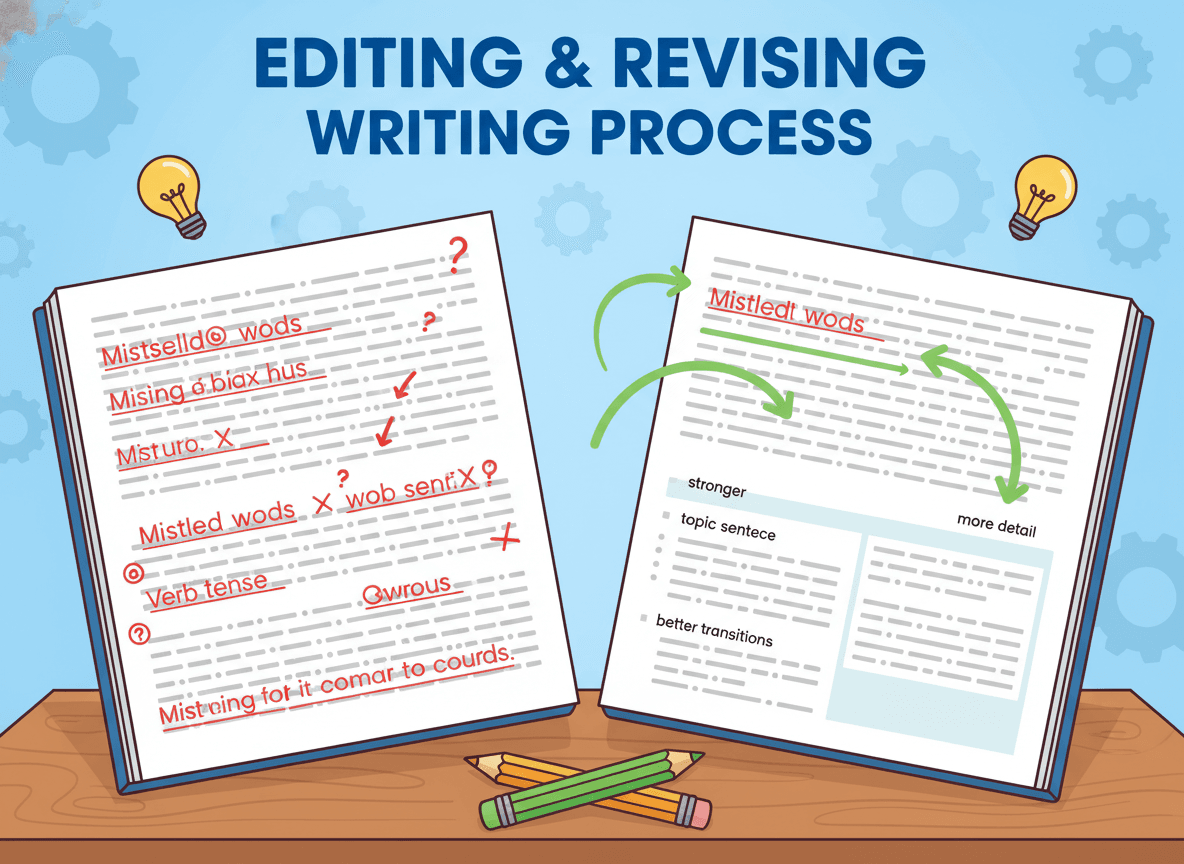
Revising = improving the CONTENT (ideas, organization, clarity, voice)
Editing = fixing the MECHANICS (spelling, grammar, punctuation, capitalization)
Both are essential. A well-organized essay full of spelling errors is incomplete. A perfectly punctuated essay with unclear ideas is also incomplete. Revising comes first because content must be right before you polish mechanics.
What Revision Looks Like
During revision, writers ask: Does this writing communicate well?
ADD: Where could I add more detail, evidence, or explanation?
REMOVE: Where is there repetition, off-topic content, or unnecessary words?
MOVE: Is the order logical? Should this paragraph come earlier or later?
SUBSTITUTE: Where could I use stronger, more precise words or more vivid language?
Revising is big-picture work. It requires stepping back from the draft and reading it as if you were a stranger seeing it for the first time.
What Editing Looks Like
During editing, writers ask: Is this written correctly?
CUPS Checklist:
-
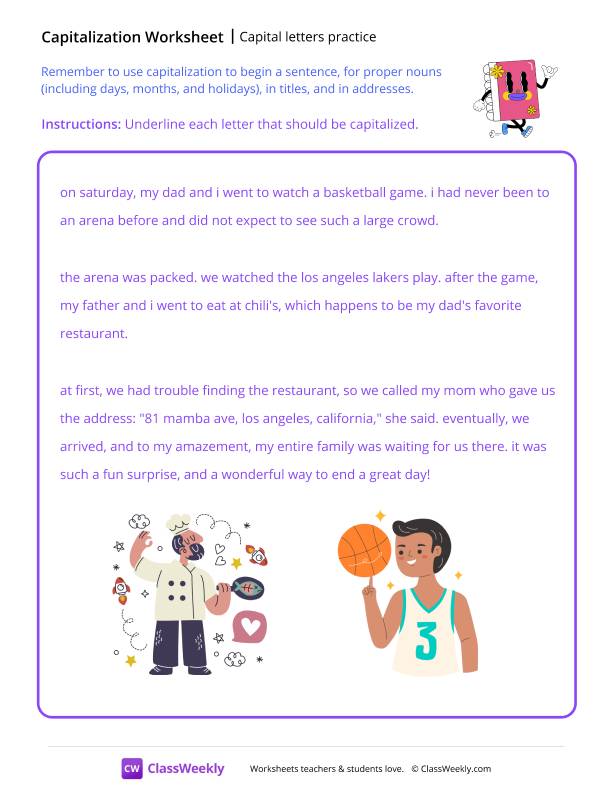
C - Capitalization (beginning of sentences, proper nouns, the word "I")
-
U - Usage (subject-verb agreement, correct pronoun forms, correct word choice)
-
P - Punctuation (periods, commas, quotation marks, apostrophes)
-
S - Spelling (check all uncertain words)
Editing is detail work. It requires reading slowly, often sentence by sentence, and sometimes backward.
The Writing Process Connection
Prewriting: Brainstorm, plan, organize
Drafting: Write the first draft
Revising: Improve content and ideas
Editing: Fix mechanics
Publishing: Share the final product
What Grade Do Kids Learn Editing and Revising?
3rd grade (W.3.5): Students develop and strengthen writing by planning, revising, and editing with guidance and support.
4th grade (W.4.5): Students plan, revise, and edit with increasing independence, focusing on strengthening ideas and mechanics.
5th grade (W.5.5): Students use all stages of the writing process with flexibility; focus on clarity, coherence, and correctness.
Common Misconceptions
Fixing spelling IS revising: Spelling is editing. Revising is much bigger - it concerns whether the ideas work. Students who only fix spelling when told to "revise" are skipping the most important step.
A second draft is a clean copy of the first: A second draft should be meaningfully different from the first - ideas added, removed, moved, or changed. Simply copying out the first draft more neatly is not revision.
Good writers don't need to revise: Even professional authors revise extensively. The ability to step back from your own writing and improve it is a hallmark of a skilled writer at every level.
Practice Activities
-
Peer revision pairs: Each student uses the ARMS checklist to give specific feedback on a partner's draft.
-
Author's chair: Students read their draft aloud; classmates offer one compliment and one revision suggestion.
-
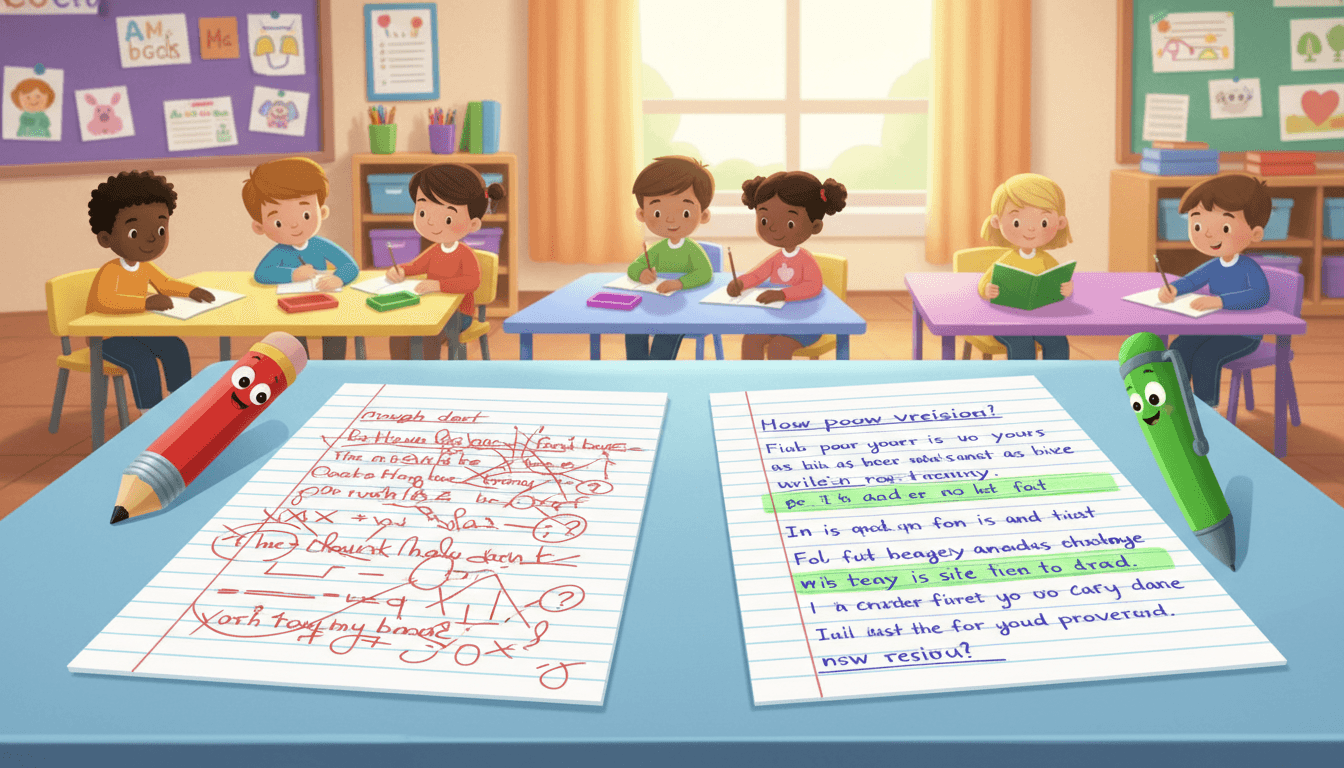
Before and after comparison: Show a first draft and a revised version of the same piece; students identify all the changes and categorize them (add, remove, move, substitute).
-
Editing scavenger hunt: Give a passage with 10 deliberate errors; students use CUPS to find and fix each one.
-
Self-editing checklist: After editing independently, students check off each CUPS item before submitting.
Frequently Asked Questions
What is the difference between revising and editing?
Revising focuses on content and ideas: Does the writing make sense? Is it organized? Are the ideas clear? Do I need more examples? Is anything repetitive or off-topic? Editing focuses on mechanics: Is spelling correct? Is punctuation in the right place? Is grammar accurate? Is capitalization correct? Both matter, but they happen in order - revise first, then edit.
Why does revising come before editing?
Revising might involve deleting sentences, adding new paragraphs, or rearranging content. If you've carefully edited a sentence for comma placement and then decide to delete it during revision, that editing was wasted effort. Revising first ensures the content is right; then you edit only the text that will actually remain in the final draft.
What do students look for when revising?
During revision, students ask: Does the introduction grab attention? Is the main idea clear? Does each paragraph have a topic sentence? Do the ideas flow in a logical order? Is there enough evidence or detail? Are there any parts that are confusing, repetitive, or off-topic? Does the conclusion wrap things up effectively? Can I use stronger or more specific words?
What do students look for when editing?
During editing, students look for: spelling errors, capitalization errors (beginning of sentences, proper nouns), missing or incorrect punctuation (periods, commas, quotation marks), subject-verb agreement errors, tense inconsistency, run-on sentences and fragments, incorrect homophones (their/there/they're), and missing words.
What is a CUPS or ARMS checklist?
CUPS and ARMS are common classroom checklists for editing and revising. CUPS (Editing): Capitalization, Usage, Punctuation, Spelling. ARMS (Revising): Add details, Remove unnecessary parts, Move ideas around, Substitute better words. These acronyms give students a systematic process to follow rather than reading randomly and hoping to find errors.
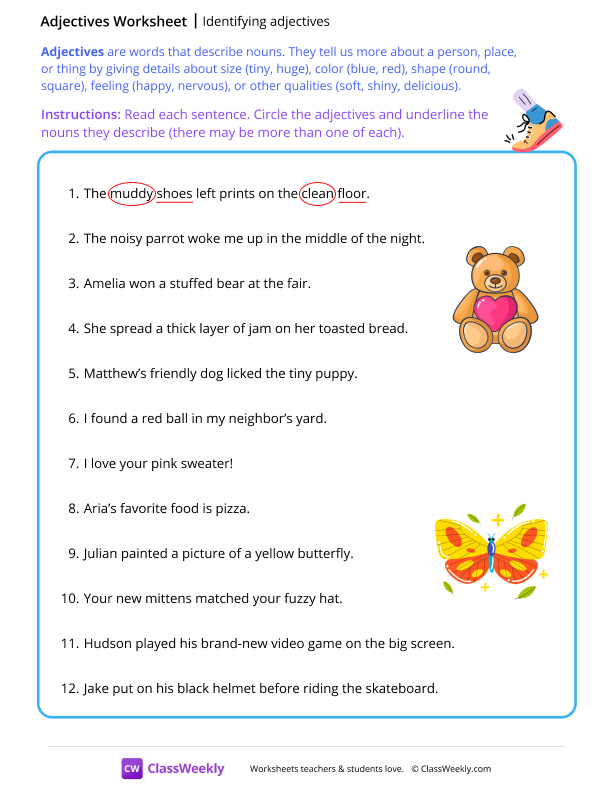
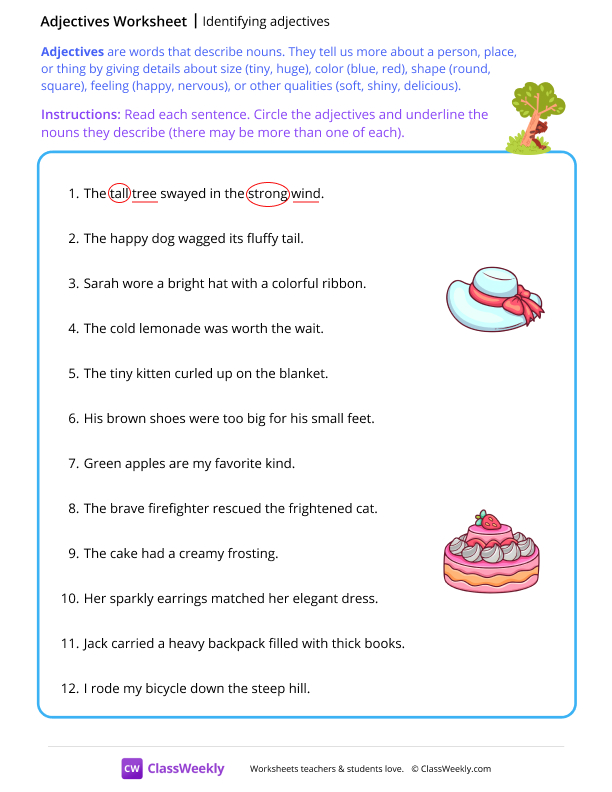
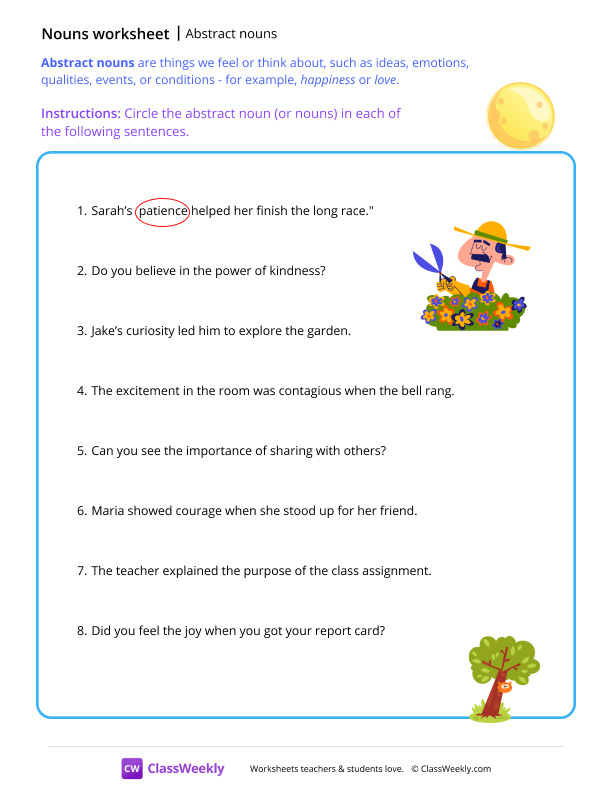
Free Editing and Revising Worksheets
Curriculum-aligned printable worksheets for 3rd – 5th Grade. Download free.